Arctic sea ice hits second-lowest extent, likely lowest volume
October 2nd, 2008
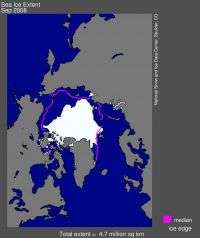
Arctic sea ice extent for September 2008 was 1.8 million square miles, second lowest on satellite record. University of Colorado at Boulder researchers believe it may be the lowest sea ice volume ever recorded. The light blue line in the Arctic shows the normal ice edge. Image: University of Colorado at Boulder's National Snow and Ice Data Center
Arctic sea ice extent during the 2008 melt season dropped to the second-lowest level since satellite measurements began in 1979, reaching the lowest point in its annual cycle of melt and growth on Sept. 14, according to researchers at the University of Colorado at Boulder's National Snow and Ice Data Center.
Preliminary data also indicate 2008 may represent the lowest volume of Arctic sea ice on record, according to the researchers. The declining Arctic sea ice is due to rising concentrations of greenhouse gases that have elevated temperatures across the Arctic and strong natural variability in Arctic sea ice, according to scientists.
Average sea ice extent during September, a benchmark measurement in the scientific study of Arctic sea ice, was 1.8 million square miles. The record monthly low, set in 2007, was 1.65 million square miles. The third lowest monthly low was 2.15 square miles in 2005, according researchers at the center.
The 2008 low strongly reinforces the 30-year downward trend in Arctic sea ice extent, said CU-Boulder Research Professor Mark Serreze, an NSIDC senior scientist. The 2008 September low was 34 percent below the long-term average from 1979 to 2000 and only 9 percent greater than the 2007 record. Because the 2008 low was so far below the September average, the negative trend in the September extent has been pulled downward, from a minus 10.7 percent per decade to a minus 11.7 percent per decade, he said.
"When you look at the sharp decline we have seen over the past 30 years, a recovery from lowest to second lowest is no recovery at all," Serreze said. "Both within and beyond the Arctic, the implications of the decline are enormous."
Conditions in the spring, at the end of the growth season, played an important role in the outcome of this year's melt, the researchers said. In March 2008, thin first-year ice covered a record high 73 percent of the Arctic basin. While it may appear to be a recovery of the sea ice, the large extent masked an important aspect of sea ice health since thin ice is more prone to melting during the summer. The widespread thin ice in spring 2008 set the stage for extensive ice loss during the melt season, according to the NSIDC researchers.
Through the 2008 melt season, a race developed between the melting of thin ice and gradually waning sunlight, said CU-Boulder Research Associate Walt Meier, a research scientist at NSIDC. Summer ice losses allowed significant solar energy to enter the ocean and heat up the water, melting even more ice from the bottom and sides. Warm oceans store heat longer than the atmosphere does, contributing to melt long after the sunlight has begun to wane, Meier said. In August 2008, the Arctic Ocean lost more ice than any previous August on record.
"Warm ocean waters helped contribute to ice losses this year, pushing the already thin ice pack over the edge," said Meier. "In fact, preliminary data indicate that 2008 probably represents the lowest volume of Arctic sea ice on record, partly because less multiyear ice is surviving now and the remaining ice is so thin."
In 2008, summer conditions worked together to save some first-year ice from melting and to "cushion" the thin ice pack from the effects of sunlight and warm ocean waters, preventing the "perfect storm" for ice loss seen in 2007, according to the researchers. Temperatures in 2008 were cooler than in 2007, although still warmer than average.
Cloudier skies also protected the ice from some melt, and wind patterns spread the ice pack out, leading to higher extent numbers, according to CU-Boulder Research Associate Julienne Stroeve, an NSIDC research scientist. The end result was the natural variability of short-term weather patterns provided enough of a "brake" to prevent a new record-low ice extent from occurring, she said.
"I find it incredible that we came so close to beating the 2007 record, without the especially warm and clear conditions we saw last summer," said Stroeve. "I hate to think what 2008 might have looked like if the weather patterns had set up in a more extreme way."
The melt season of 2008 reinforces the decline of Arctic sea ice documented over the past 30 years, said CU-Boulder Senior Research Associate Ted Scambos, NSIDC lead scientist. "The trend of decline in the Arctic continues, despite this year's slightly greater extent of sea ice," said Scambos. "The Arctic is more vulnerable than ever."
Source: University of Colorado at Boulder


We're not talking cores. We're talking sea ice so no, the ice is not the record.
Right, satellite measurements, how about this line:
Compared to what dataset.
If you want to site La Nina here and disregard El Nino in the charts of global warming you have a problem.
You can't site La Nina as preventing this year from being the lowest sea ice on record and disregard El Nino as being responsible for the figures shown on global warming charts. It's dishonest.
All indications are that warming has ceased in 2000-2001. No ocean warming, no atmospheric warming, no tropospheric warming (never was), and no near surface warming - nada.
This year's sea ice recovery is just one more indicator of the coming cooling cycle. Next year's sea ice recovery will get even less, alarmist hysterical press but there will be some true believers to spin it someway.
If warming had ceased at that time, one would think that the record minimum sea ice extent would not have been set in 2007, one would also think that worldwide glacial retreat would have halted by now....
This is NOT what the climate models predicted. They did not predict the current steady state/cooling until after their noses were rubbed in it.
As far as the ice in the arctic, there was a warm air current that was unusually far to the north last year and not this year. The models didn't predict that either.
Finally, since the arctic cap has been smaller than it is not in the last 100 years there is no reason to think that what is occurring isn't a natural pattern.
Actually you global warming denialists instantly dismiss *any* study that does not support your world view.
Nope not so much, just UC at Boulder :)
There's another group that calls anyone who doesn't believe "denialists." Scientologists.
Is that your new argument against global warming? Everyone who doesn't agree with you is a scientologist?
Interesting rationalization.
BTW heres definition of the term from wiki:
http://en.wikiped...enialism
Nothing about scientology, but notice that you are in good company.
http://www.nature...316.html
http://www.agu.or...39.shtml
The recovery is not a recovery.
Draughts caused by Global Warming. Increased rainfall caused by Global Warming. Warming is warming. Cooling is warming. Wind is because of warming. Lack of wind is because of warming.
Is there nothing that Global Warming can't do?
See here for a list of some of the things caused by Global Warming:
http://www.number...list.htm
Would you really hate that Ms. Stroeve, or would you consider it an affirmation of you alarmist research?
Speaking of CU-Boulder, why the pause of sea level information when it appears that the sea levels are declining over the last few years? I'm sure it doesn't have anything to do with the upcoming election.
This graph shows the recent sea level decline, and the announcement of the suspension of posting new data.
I do however agree with scientific consensus, and there is a consensus, even though the issue is controversial, that it is more likely then not that temperature will continue to rise and that it is more likely then not that man made emissions are responsible for significant portion of this effect.
I also agree that potential outcomes might be quite catastrophic for some areas, and that it justifies initiatives which aim at lowering our impact, I do however believe that any such intervention has to be carefully balanced with properly calculated economic costs which will certainly be substantial (unless some miracle new technology comes to save the day).
Actually I wont be *THAT* surprised if in a couple of years global warming will be no more, and some other new mechanism will be presented to explain why it is the case, the climate is an extremely complex system. But that certainly doesn't mean that global warming is not the most likely explanation for what we are seeing today and that we should dismiss it or not try to prevent possible negative outcomes. It only means that we have to factor our uncertainty into any decisions we make.
All in all that makes me pretty skeptical, I do however still consider you denialists cause you jump at each and every study concerning the issue, always disagreeing with *everything*.
And especially you Velanarris, I've already seen so many absurd claims you made on this topic (like completely misunderstanding radiative heat transfer, saying Earth can only cool by precipitation and convection instead of radiation, when in fact its PRECISELY the opposite, etc) that it is obvious you don't understand what you are talking about. Yet it doesn't stop you from spreading your anti-GW mantra everywhere. Your opposition has much more in common with religious fanatism then anything else. For some reason being against global warming is such an important part of your identity that you will go to any length to defend it.
Such approach wont get you far (unless maybe in politics) and you should really rethink your position if staying objective or neutral has any value to you.
How much would you have spent to keep Hurricane Ike from hitting Houston?
The thing is, sir, that no amount of money could have prevented it. That is why most economists say that mitigation is the wrong strategy for dealing with Global Warming. The correct strategy is adaptation, something that the human race has always done.
Mitigation initiatives cannot be justified.
Its not so much about preventing a single hurricane as about lowering their frequency or mean strength (there are of course other factors besides hurricanes, this is just an example). The case is similar to insurance calculations. If a reliable relation can be established between CO2 emissions and hurricane strength and frequency then some amount, up to which it makes sense to try to lower CO2 emissions, can probably be put forth.If it can't be established now then maybe it will be possible in the near future. Maybe some informed guesses are worth the potential benefit, maybe not.
What interventions are presently justified and to what extent is an extremely complex issue, it should be decided by a panel representing all the sides involved with access to the best data and models available (including uncertainties and proper economic costs).
The cost of just blindly forcing everyone to suddenly cut emissions is astronomical and it would kill economy instantly. Even if such laws are passed they will be quickly abandoned when people realize how much it will cost them.
But there might be some initiatives which are economically justified and we should try looking for them before we give up and settle on adaptation.
After all it goes without saying that we will have to adapt no matter what.
It's funny you bring up politics seeing as there is really no such thing as a scientific concensus. Concensus is a political word, not a scientific word.
You're a word twister, and it's a poor tactic in discussion.
Sir, If this WAS similar to insurance calculations, we would need to add even more CO2 to our atmosphere. When there was less CO2 in our atmosphere, the death rate from extreme weather was much, much higher. See this study:
http://www.csccc....t_23.pdf
What you refuse to understand is that radiative forcing is the source of the thermal energy that is available for dissipation via non-radiative means.
The former operates independent of either of the latter; and, in its absence there would be precious little need for such.
More accurate to say that it is a marker of man's ignorance and/or stupidity.
Sir, you are living in a dream world. Wake up before it's too late and you have ceded your rights to someone else.
Who is really stupid and ignorant here?
When you remove all CO2 production from your life, please report back here to tell us how it's going...
You went a little too far with this comment. CO2 is a vital gas in the environment. It's production from human or non-human means is a vital part of our ecosystem and a necessary element for life on this planet. Reducing CO2 below 100ppm would lead to catastophic cooling and the death of the majority of plant life on the planet. Humans artificially produce CO2 for boosting crop yields and ensuring there are enough resources for all humans. CO2 isn't necessarily as evil as it's been sold to be.
When you learn how to engage in rational discourse, rather than sophistry, let us know.
No, it's not necessarily evil; but, it's also very far from being as MikeB claimed.
Taken within the intended context, mine was a most accurate statement. The uncontrolled production of any substance whose presence has either unknown or undesirable consequences is the result of ignorance and/or stupidity.
You still haven't told anyone how you will eliminate your CO2 production. My previous comment was not sophistry. It is only a few questions that you refuse to answer.
Will you take responsibility or not?
Irrelevant, inconsequential, non-responsive, and non sequitur.
I would hate to live inside that conflicted head. If you really believe what you say you do, get off the computer, buy a little land somewhere, build a sustainable house off-grid, and grow your own food. Otherwise, be quiet. You are harming your psyche.
All CO2 production yields wealth? That categorical claim is yours to prove.
Assumes facts not in evidence.
Both red herring and straw man.
Argumentum ad hominem.
Clearly that would be you, as evidenced by the number and kinds of fallacies that you continue to employ.
"Anyone who BELIEVES ... must take personal action ... . Inaction can only mean DISBELIEF ... " Restated, "he who believes but does not act does not believe." Contradiction?
"... or fear."
Fear of what?
You are becoming increasingly irrational.
Not only have you ignored the seeming contradiction called to your attention, but you've now made a statement that is most specious.
Man made emissions. How ironic. Everytime someone farts this nonsense, the world get a little "warmer".
Houseboats, mansions, extra houses, meat, limosines, airplanes... to name a very few things that I have recently seen demonized by the IPCC, Gore, Pachauri and many others. Whether you like it or not, big changes must be made by the believers. Their alarms are definitely NOT credible when they themselves act in a hypocritical fashion. I don't know how to put it any plainer.
If any person here believes that even their expirations are killing their own children, they must act. If, however, they do not act, it would only be logical to question their intentions.
I believe that most people will not act because most people have a fear of poverty, and the common sense to know that these measures will cause poverty.
You've here employed a logical fallacy, that of holding a conditional relationship to be commutative.
While the lack of desire may cause a failure to act, failure to act does not perforce indicate a lack of desire.
That sounds like a personal problem to me, better discussed on a different type of blog. :)
When viewed logically, it is indeed quite simple. However, your position is clearly grounded in the subjective; namely, a concern only for your own personal comport during your very short life span.
That is both specious and non sequitur.
Fear of poverty is not the greatest of all fears.
Setting aside that fact that "common sense" is quite frequently anything but, it does not follow that mitigating mankind's effects on his environment must result in poverty. I look forward to your providing rigorous proof of this claim.
Non sequitur Superhuman, in science nothing is beyond question. On in religion can things be "beyond question" since they depend on faith.
What did you not understand? You are the one who equated belief with a desire to act.
In which case you should see the Chaplain about getting your TS card punched.
Presumably, then, you do not consider Mathematics to be a Science?
Or, that empirical observations have any basis in reality?
To claim that "in science nothing is beyond question" is to cast all knowledge and understanding into the realm of metaphysics.
Is that what I said? I think not.
Cheerio!
permeated your statements?
As for hope, I've little hope of mankind not so thoroughly soiling his cradle as to bring about his own demise.
Fancy that.
Alas... Oh well i guess I'll give you a one for "fancy that"
Hope for the best; plan for the worst.
Sound advice, is it not?
Seems more like a draw, then.
The only exception being when planning for the worst becomes self fulfilling prophecy.
Adaptation wins. We cannot control climate. Let the climate change as it always has, then deal with it.
http://www.theoni...in_beard
We can't control climate? But if we later discover that in fact humans are even partially responsible for global warming, then you would be wrong. You speak with religious conviction on a subject that does not need your "assured conviction in spite of a general lack of evidence on way or another".
You are guilty of the very things you accuse others of. You criticize anyone who says anything that isn't "I specifically disbelieve that humans could possibly have any impact on the earths climate".
Why don't you turn your critical gaze inward for a while, or are you afraid you might not like what you see?
"Hi Pot? This is kettle."
"Oh, hey kettle, you're black."
Actually, no.
Rather, this is a case of righteous self-indulgent posturing, so as to avoid having to accept responsibility for the consequences of ones actions, to be able to continue to seek to sate selfish desires.
The "me firsters" have been called out.
Ok, what's your suggestion in response to the issue?
(My fault on the comment, I should have just quoted "You are guilty of the very things you accuse others of. You criticize anyone who says anything that isn't "I specifically disbelieve that humans could possibly have any impact on the earths climate.")