Millisecond brain signals predict response to fast-acting antidepressant
October 2, 2008
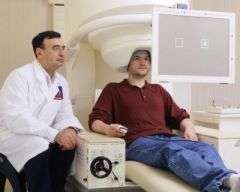
Carlos Zarate, M.D. & MEG Scanner

Carlos Zarate, M.D., (left) NIMH Mood and Anxiety Disorders Program, with MEG scanner. Credit: NIMH

Images of the brain's fastest signals reveal an electromagnetic marker that predicts a patient's response to a fast-acting antidepressant, researchers have discovered.

"Such biomarkers that identify who will benefit from a new class of antidepressants could someday minimize trial-and-error prescribing and speed delivery of care for what can be a life-threatening illness," said Carlos Zarate, M.D., of the National Institute of Mental Health (NIMH), Mood and Anxiety Disorders Program.

In the new study at the National Institutes of Health in Bethesda, MD, depressed patients showed increasing activity in a mood-regulating hub near the front of the brain while viewing flashing frightful faces – the more the increase, the better their response to an experimental fast-acting medication called ketamine. By contrast, healthy controls showed decreasing activity in this brain area under the same conditions.

Zarate, Giacomo Salvadore, M.D., Brian Cornwell, Ph.D., and NIMH colleagues report on their discovery online in Biological Psychiatry September 24, 2008.

Two years ago, Zarate and colleagues reported that ketamine, which targets the brain chemical glutamate, can lift depressions in just hours, instead of the weeks it takes conventional antidepressants, which work through the brain chemical serotonin. Evidence suggests that glutamate likely acts closer to the source of the depression than serotonin, and is not dependant on slower mechanisms, such as the synthesis of new neurons.

Earlier imaging studies with conventional antidepressants had hinted that increased activity of the mood-regulating hub, called the anterior cingulate cortex (ACC), signals a better response.

To find out if ACC activity might also forecast response to glutamate-targeting medications, the NIMH researchers imaged the brain activity of 11 depressed patients and 11 healthy participants, using magnetoencephalography (MEG). This imaging technology can non-invasively detect brain electromagnetic activity lasting only milliseconds – the speed of communications in neural circuits – whereas other functional brain imaging techniques can only capture activity that last seconds or minutes, and some involve radiation exposure.

This precise timing enabled the MEG scanner to capture the brain's split-second responses to rapidly flashing pictures of fearful faces, a task known to activate the ACC. While healthy participants' ACC activity dropped off as they quickly habituated to the faces, patients' ACC activity showed an opposite trend. The more robust this increase, the more symptoms improved just four hours after a patient received a single infusion of ketamine.

"The ACC may be slow to respond, but not completely impaired, in patients who respond to ketamine," explained Cornwell.

The lag in ACC activity could be a window into the dysfunctional workings of the glutamate-related circuitry targeted by the medication, the researchers suggest. Ketamine's side effects make it a poor candidate for becoming a practical antidepressant, but the new findings are helping to focus the search for new treatments that work through the same mechanism, they say.

References:

Salvadore G, Cornwell BR, Colon-Rosario V, Coppola R, Grillon C, Zarate CA Jr, Manji HK. Biol Psychiatry. 2008 Sep 24. [Epub ahead of print] PMID: 18822408.

Tottenham, N., Tanaka, J., Leon, A.C., McCarry, T., Nurse, M., Hare, T.A., Marcus, D.J., Westerlund, A., Casey, B.J., Nelson, C.A. (in press). The NimStim set of facial expressions: judgments from untrained research participants. Psychiatry Research.

Source: National Institute of Mental Health

4.7 /5 (3 votes)  

Rank 4.7 /5 (3 votes)
Tags

Relevant PhysicsForums posts
  • We the immaterial soul
    created3 hours ago
  • Is Everyday Technology Killing Us?
    createdFeb 08, 2012
  • Exercise and weight loss
    createdFeb 08, 2012
  • Why do we have head aches? Our brains can't feel anything.
    createdFeb 07, 2012
  • "The end of diseases" by David Agus, interview from Daily Show with Jon Stewart
    createdFeb 04, 2012
  • Oncolytic adenovirus
    createdFeb 04, 2012
  • More from Physics Forums - Medical Sciences

More news stories

Study finds that anti-diabetic medication can prevent the long-term effects of maternal obesity

In a study to be presented today at the Society for Maternal-Fetal Medicine's annual meeting, The Pregnancy Meeting, in Dallas, Texas, researchers will report findings that show that short therapy with the anti-diabetic medication ...

Medicine & Health / Health

created 20 hours ago | popularity 5 / 5 (1) | comments 1

FDA-approved drug rapidly clears amyloid from the brain, reverses Alzheimer's symptoms in mice

Neuroscientists at Case Western Reserve University School of Medicine have made a dramatic breakthrough in their efforts to find a cure for Alzheimer's disease. The researchers' findings, published in the journal Science, show t ...

Medicine & Health / Neuroscience

created Feb 09, 2012 | popularity 4.9 / 5 (52) | comments 20 | with audio podcast

Steroid injections prove effective in treatment of lumbar disc herniations

The use of epidural steroid injections may be a more efficient treatment option for lumbar disc herniations, according to research presented today at the American Orthopaedic Society for Sports Medicine's Specialty Day in ...

Medicine & Health / Health

created 20 hours ago | popularity 5 / 5 (1) | comments 0

Teen school drop-outs three times as likely to be on benefits in later life

Teen school drop-outs are almost three times as likely to be on benefits in later life as their peers who complete their schooling, indicates research published online in the Journal of Epidemiology and Community Health.

Medicine & Health / Health

created Feb 06, 2012 | popularity not rated yet | comments 11

Amateur football players not always keen on returning to play after ACL injuries

Despite the known success rates of reconstructive Anterior Cruciate Ligament (ACL) surgery, the number of high school and collegiate football players returning to play may not be as high as anticipated, say researchers presenting ...

Medicine & Health / Health

created 20 hours ago | popularity not rated yet | comments 0


Google might launch Drive for cloud storage soon

(PhysOrg.com) -- Google's next big move, according to the Wall Street Journal, is a cloud storage service called Drive. Hardly first to the plate, Google is simply catching up to introducing its cloud reposi ...

Latin America mining boom clashes with conservation

Latin America is experiencing a mining boom as prices rise fuelled by a hike in global demand, but the region is also being hit by a wave of violent protests, strikes and rallies by environmentalists.

Love a click away in Indonesia's Twitter Republic

He was a geeky kid from Yogyakarta, she a glamorous city girl in Jakarta. In a country with one of the world's most vibrant social networking scenes they fell in love on Twitter.

Walney offshore wind farm is world's biggest (for now)

(PhysOrg.com) -- The Walney wind farm on the Irish Sea--characterized by high tides, waves and windy weather--officially opened this week. The farm is treated in the press as a very big deal as the Walney ...

GPS court ruling leaves US phone tracking unclear

A US Supreme Court decision requiring a warrant to place a GPS device on the car of a criminal suspect leaves unresolved the bigger issue of police tracking using mobile phones, legal experts say.

Europeans protest controversial Internet pact

Tens of thousands of people marched in protests in more than a dozen European cities Saturday against a controversial anti-online piracy pact that critics say could curtail Internet freedom.