Cross kingdom conflicts on a beetle's back
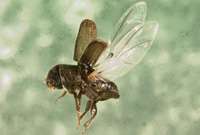
Researchers from Harvard Medical School and the University of Madison-Wisconsin have discovered how beetles and bacteria form a symbiotic and mutualistic relationship—one that ultimately results in the destruction of pine forests. In addition, they've identified the specific molecule that drives this whole phenomenon.
The context of this discovery can easily be imagined as a story arc that includes some of the most unlikely characters and props.
Setting: The interior of a pine tree.
Enter the protagonist: The pine beetle, boring its way through the bark, a five millimeter arthropod ready to go into labor and lay a few hundred eggs. Tucked in a specialized storage compartment in its shell, the beetle has a ready supply of spores for Entomocorticium, a nourishing fungal baby food for the beetle's gestating larvae.
Enter the antagonist: The mite, a microscopic interloper that secretly hitched a ride on the beetle.
Conflict: Unbeknownst to mother pine beetle, the mite has snuck in a supply of Ophiostoma minus, a pathogenic fungi that can wipe out the entire supply of fungal larvae food. The mite releases this toxin.
Climax: Will the baby beetles die of starvation?
Resolution: Catching the mite off guard—as well as the scientists conducting the study!—the mother beetle is ready with actinomycetes, a bacteria that neutralizes the toxic fungi by means of a tiny fatty acid.
Conclusion: While actinomycetes rescues the baby beetles from certain starvation, the larvae-friendly Entomocorticium softens up the pine, allowing the fledgling beetles to eat not only the fungi but the tree itself. Soon, the young beetles leave to begin their new lives. Mother beetle gathers up the remaining supply of Entomocorticium and heads for another tree. The beetles live, and the infernal mite is thwarted.
Surprise ending: The camera pans back, and we quickly realize that the beetles' success has cost the tree its life. An aerial view reveals miles and miles of dead pine forest, and, as the ominous audio track implies, scores of pine beetles will continue moving from tree to tree leaving ravished forests in their wake.
"So you have a beetle, a mite, a tree, two kinds of fungi, and a bacterium," says Jon Clardy, Harvard Medical School professor of biological chemistry and molecular pharmacology who, along with Cameron Currie from the University of Madison-Wisconsin, is co-senior author on the study. "Discovering this particular bacterium, and the active molecule, has added the molecular dimension to this chemical ecology of this complex multi-lateral system. It highlights the importance of bacteria in ways that people don't really even think about."
The findings will be published in the October 3 issue of Science.
The ground work for this study began in 1999 when Currie published a paper demonstrating how leafcutter ants mediate their fungal environment through bacteria. Suspecting that this phenomenon may be common throughout the animal kingdom, Currie teamed up with Clardy to examine the pine beetle.
Pine beetles are like little landscape engineers, drilling through the bark and into pine trees, using fungus to create an environment in which to lay their eggs. As a result of this activity, thousands of miles of trees are destroyed each year, often resulting in widespread forest fires. Regions such as western Canada are particularly affected by this.
Experts have known that just like the fungus-growing ants, pine beetles also use fungus to feed their larvae, and that they often managed to avoid the adverse affects of pathogenic fungi often present in the tree. But the precise means by which they interact with fungal microbes has never been demonstrated.
Currie and research assistant Jarrod Scott discovered that the beetle carries a bacteria in a specialized compartment, and after a series of experiments found that the bacteria produced an antifungal agent that killed the pathogenic fungi snuck in by the trespassing mite.
In order to delve deeper into how the bacteria works, Dong-Chan Oh, a postdoctoral researcher in Clardy's Harvard Medical School lab, used a variety of laboratory tools, such as nuclear magnetic resonance techniques and chromatography, to both locate the molecule and identify its structure. The molecule turns out to be a kind of fatty acid.
"It's becoming clear that symbiotic relationships between plants, animals, and microbes are essential for the diversification of life and evolution of organisms," says Currie. "This is an example of a system where we have insights into the importance of the diversity of microbes. We believe that this type of mutualism is widespread."
In addition, the researchers suspect that this association represents a source of small molecules that can be used in medicine.
"This molecule is nature's anti-fungal," says Clardy, "and it looks like there are a lot of them."
This is particularly significant, since pathogenic fungal infections in people are a major health concern. These infections are often fatal, and at the moment, no reliable medications for them exist. Here, however, we have an example of an antibiotic successfully disabling a powerful fungi.
"This particular molecule is too unstable to be a viable candidate," says Clardy. "Still, we need to study how it kills fungi, learn the mechanisms. We can look into other bacterial genomes and investigate other anti-fungal processes."
Suspecting that this symbiotic dynamic is far more the rule than the exception, Clardy and Currie are investigating other insect species as well to see how universal this "story arc" is.
Citation: Science, October 3, 2008 Vol 321, Issue 5898, "Bacterial Protection of Beetle-Fungus Mutualism"
Source: Harvard Medical School


