Don't stress! Bacterial crisis command center revealed
October 2, 2008
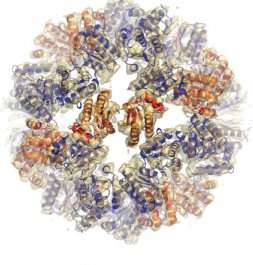
An image of a 'stressosome' from inside a bacteria cell
A bacteria cell's 'crisis command centre' has been observed for the first time swinging into action to protect the cell from external stress and danger, according to new research out today (3 October) in Science.
The research team behind today's study says that finding out exactly how bacteria respond and adapt to stresses and dangers is important because it will further their understanding of the basic survival mechanisms of some of the most resilient, hardy organisms on Earth.
The crisis command centre in certain bacteria cells is a large molecule, dubbed a 'stressosome' by the scientists behind today's research. These cells have around 20 stressosomes floating around inside them, and although scientists knew they played an important role in the cell's response to stressful situations, the complexities of this process had not been fully understood until now.
If a bacteria cell finds itself in a dangerous situation - for example, if the temperature or saltiness of the bacteria's environment reach dangerous levels which threaten the survival of the bacteria -a warning signal from the cell's surface is transmitted into the cell.
Using cutting edge electron microscopy imaging techniques the authors of the new research observed that the stressosomes receive this warning signal, and in response several proteins called RSBT break away from the large stressosome. This breakaway triggers a cascade of signals within the cell which results in over 150 proteins being produced - proteins which enable the cell to adapt, react and survive in its new environment.
Professor Marin van Heel from Imperial College London's Department of Life Sciences, one of the corresponding authors of the study, explains: "The cascade of events inside bacteria cells that occurs as a result of stressosomes receiving warning signals leads to particular genes inside the cell being transcribed more. This means that some genes already active inside the cell are 'turned up' so that levels of particular proteins in the cell increase. These changes to the protein make-up of the cell enable it to survive in a hostile or challenging environment."
Dr Jon Marles-Wright from Newcastle University says: "Our work shows that cells respond to signals much like a dimmer on a light switch. Now we'll be building on this to work out how nature controls that dimmer switch. We wouldn't have been able to carry out this work without access to the Diamond synchrotron Light Source which has enabled us to examine the structures of individual stressosome proteins at atomic resolution."
Dr Tim Grant, one of Imperial's post doctoral researchers, adds that the key to bacteria cells' success at surviving in rapidly changing environments is their speedy response: "The cell's stressosomes are very good at their job as crisis command centres because they provide a very fast effective response to danger. The chain reaction they kickstart produces results really quickly which enables bacteria to adapt to changes in their surroundings almost instantaneously."
The team is now planning to collect very high resolution data of the stressosome complex on the world's newest high-resolution cryo electron microscope, the FEI "KRIOS" that has just been installed in the Max Planck Institute in Martinsried, Germany. Improving the resolution of the stressosome structure by a factor of two will lead to a resolution range normally only attainable by X-ray crystallography and will allow the researchers to directly see the amino-acid components of this fascinating complex.
Source: Imperial College London
-
Protein libraries in a snap
Feb 10, 2012 |
4.8 / 5 (4) |
1
-
Cell death unleashes full force of human antiviral system
Feb 09, 2012 |
5 / 5 (6) |
1
-
Secrets of immune response illuminated in new study
Feb 09, 2012 |
5 / 5 (3) |
0
-
Growing up on a farm directly affects regulation of the immune system
Feb 08, 2012 |
5 / 5 (2) |
1
-
Why bad immunity genes survive: Study implicates arms race between genes and germs
Feb 06, 2012 |
4.2 / 5 (5) |
0
-
Engineers build first sub-10-nm carbon nanotube transistor
Feb 01, 2012 |
4.9 / 5 (31) |
30
-
Something old, something new: Evolution and the structural divergence of duplicate genes
Jan 31, 2012 |
4.6 / 5 (7) |
1
-
The hidden nanoworld of ice crystals: Revealing the dynamic behavior of quasi-liquid layers
Jan 30, 2012 |
5 / 5 (3) |
1
-
Stock market network reveals investor clustering
Jan 27, 2012 |
3.9 / 5 (23) |
8
-
Of microchemistry and molecules: Electronic microfluidic device synthesizes biocompatible probes
Jan 26, 2012 |
5 / 5 (1) |
0
More news stories
Entire genome of extinct human decoded from fossil
(PhysOrg.com) -- In 2010, Svante Pääbo and his colleagues presented a draft version of the genome from a small fragment of a human finger bone discovered in Denisova Cave in southern Siberia. The ...
Feb 07, 2012 |
4.7 / 5 (58) |
44
|
Why are there so few fish in the Earth's oceans?
(PhysOrg.com) -- A Stony Brook University researcher has found that, contrary to popular belief, there are not plenty of fish in the sea.
Feb 08, 2012 |
4.3 / 5 (17) |
26
|
Miami battling invasion of giant African snails
No one knows how they got there. But an invasion of African giant snails has southern Florida in a panic over potential crop damage, disease and general yuckiness surrounding the slimy gastropods.
Feb 10, 2012 |
4.5 / 5 (2) |
5
Deciding to go left or right: Researchers use device to determine that lower animals can navigate too
For decades, scientists have associated binary decision making opting to go left or right with higher-ranking animals, including humans. A team of Harvard researchers, however, is rewriting that ...
Feb 09, 2012 |
4 / 5 (1) |
4
|
Study shows chimps able to understand needs of others
(PhysOrg.com) -- By setting up a unique experiment, a small team of researchers has found that chimpanzees are able to understand need in other chimps, despite their general disinclination to offer aid when ...
Google might launch Drive for cloud storage soon
(PhysOrg.com) -- Google's next big move, according to the Wall Street Journal, is a cloud storage service called Drive. Hardly first to the plate, Google is simply catching up to introducing its cloud reposi ...
Latin America mining boom clashes with conservation
Latin America is experiencing a mining boom as prices rise fuelled by a hike in global demand, but the region is also being hit by a wave of violent protests, strikes and rallies by environmentalists.
Love a click away in Indonesia's Twitter Republic
He was a geeky kid from Yogyakarta, she a glamorous city girl in Jakarta. In a country with one of the world's most vibrant social networking scenes they fell in love on Twitter.
Walney offshore wind farm is world's biggest (for now)
(PhysOrg.com) -- The Walney wind farm on the Irish Sea--characterized by high tides, waves and windy weather--officially opened this week. The farm is treated in the press as a very big deal as the Walney ...
GPS court ruling leaves US phone tracking unclear
A US Supreme Court decision requiring a warrant to place a GPS device on the car of a criminal suspect leaves unresolved the bigger issue of police tracking using mobile phones, legal experts say.
Europeans protest controversial Internet pact
Tens of thousands of people marched in protests in more than a dozen European cities Saturday against a controversial anti-online piracy pact that critics say could curtail Internet freedom.