'Little bang' triggered solar system formation
October 2, 2008
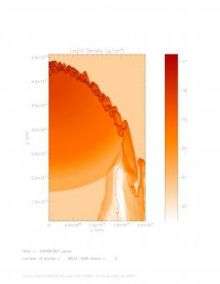
Cross-sectional view of one-half of a solar-mass target cloud being struck by a supernova shock front that is traveling downward. The colors represent the target cloud, with redder colors representing denser regions. The solid black contours delineate material that was originally in the supernova shock front, where short-lived radioisotopes are being injected into the collapsing target cloud.
For several decades, scientists have thought that the Solar System formed as a result of a shock wave from an exploding star—a supernova—that triggered the collapse of a dense, dusty gas cloud that contracted to form the Sun and the planets. But detailed models of this formation process have only worked under the simplifying assumption that the temperatures during the violent events remained constant. Now, astrophysicists at the Carnegie Institution's Department of Terrestrial Magnetism (DTM) have shown for the first time that a supernova could indeed have triggered the Solar System's formation under the more likely conditions of rapid heating and cooling. The results, published in the October 20, 2008, issue of the Astrophysical Journal, have resolved this long-standing debate.
"We've had chemical evidence from meteorites that points to a supernova triggering our Solar System's formation since the 1970s," remarked lead author, Carnegie's Alan Boss. "But the devil has been in the details. Until this study, scientists have not been able to work out a self-consistent scenario, where collapse is triggered at the same time that newly created isotopes from the supernova are injected into the collapsing cloud."
Short-lived radioactive isotopes—versions of elements with the same number of protons, but a different number of neutrons—found in very old meteorites decay on time scales of millions of years and turn into different (so-called daughter) elements. Finding the daughter elements in primitive meteorites implies that the parent short-lived radioisotopes must have been created only a million or so years before the meteorites themselves were formed. "One of these parent isotopes, iron-60, can be made in significant amounts only in the potent nuclear furnaces of massive or evolved stars," explained Boss. "Iron-60 decays into nickel-60, and nickel-60 has been found in primitive meteorites. So we've known where and when the parent isotope was made, but not how it got here."
Previous models by Boss and former DTM Fellow Prudence Foster showed that the isotopes could be deposited into a pre-solar cloud if a shock wave from a supernova explosion slowed to 6 to 25 miles per second and the wave and cloud had a constant temperature of -440 °F (10 K). "Those models didn't work if the material was heated by compression and cooled by radiation, and this conundrum has left serious doubts in the community about whether a supernova shock started these events over four billion years ago or not," remarked Harri Vanhala, who found the negative result in his Ph.D. thesis work at the Harvard-Smithsonian Center for Astrophysics in 1997.
Using an adaptive mesh refinement hydrodynamics code, FLASH2.5, designed to handle shock fronts, as well as an improved cooling law, the Carnegie researchers considered several different situations. In all of the models, the shock front struck a pre-solar cloud with the mass of our Sun, consisting of dust, water, carbon monoxide, and molecular hydrogen, reaching temperatures as high as 1,340°F (1000 K). In the absence of cooling, the cloud could not collapse. However, with the new cooling law, they found that after 100,000 years the pre-solar cloud was 1,000 times denser than before, and that heat from the shock front was rapidly lost, resulting in only a thin layer with temperatures close to 1,340°F (1000 K). After 160,000 years, the cloud center had collapsed to become a million times denser, forming the protosun. The researchers found that isotopes from the shock front were mixed into the protosun in a manner consistent with their origin in a supernova.
Source: Carnegie Institution
-
Star explosion leaves behind a rose
Dec 12, 2011 |
5 / 5 (3) |
0
-
Researchers discover novel chemical route to form organic molecules
Jan 13, 2012 |
5 / 5 (2) |
0
-
Fermi shows that Tycho's star shines in gamma rays
Dec 13, 2011 |
4.9 / 5 (11) |
6
-
Space image: New supernova remnant lights up
Sep 13, 2011 |
5 / 5 (9) |
12
-
Hubble observations of supernova reveal composition of 'star guts' pouring out
Sep 02, 2010 |
4.6 / 5 (17) |
9
-
Engineers build first sub-10-nm carbon nanotube transistor
Feb 01, 2012 |
4.9 / 5 (33) |
30
-
Something old, something new: Evolution and the structural divergence of duplicate genes
Jan 31, 2012 |
4.6 / 5 (7) |
1
-
The hidden nanoworld of ice crystals: Revealing the dynamic behavior of quasi-liquid layers
Jan 30, 2012 |
5 / 5 (4) |
1
-
Stock market network reveals investor clustering
Jan 27, 2012 |
3.9 / 5 (23) |
8
-
Of microchemistry and molecules: Electronic microfluidic device synthesizes biocompatible probes
Jan 26, 2012 |
5 / 5 (2) |
0
-
Never ending outer space.....
19 hours ago
-
Neutron Star fragments?
21 hours ago
-
stationary or not?
Feb 11, 2012
-
Scale of the Universe
Feb 10, 2012
-
Titan's lack of impact craters
Feb 09, 2012
-
Real pictures of black hole eating a star?
Feb 08, 2012
- More from Physics Forums - General Astronomy
More news stories
Latin America mining boom clashes with conservation
Latin America is experiencing a mining boom as prices rise fuelled by a hike in global demand, but the region is also being hit by a wave of violent protests, strikes and rallies by environmentalists.
12 hours ago |
5 / 5 (1) |
1
Salvage workers begin pumping fuel from Italian shipwreck
Salvage workers Sunday began pumping fuel from the shipwrecked Italian cruise liner Costa Concordia, a day ahead of schedule, officials said.
4 hours ago |
not rated yet |
0
Political leaders play key role in how worried Americans are by climate change: study
More than extreme weather events and the work of scientists, it is national political leaders who influence how much Americans worry about the threat of climate change, new research finds.
Feb 06, 2012 |
5 / 5 (6) |
73
NASA budget will axe Mars deal with Europe: scientists
US President Barack Obama's budget proposal to be submitted next week for 2013 will cut NASA's budget by 20 percent and eliminate a major partnership with Europe on Mars exploration, scientists said Thursday.
Space & Earth / Space Exploration
Feb 10, 2012 |
5 / 5 (3) |
58
Humans may have helped the decline of African rainforests 3000 years ago
(PhysOrg.com) -- Large areas of rainforests in Central Africa mysteriously disappeared over three thousand years ago, to be replaced by savannas. The prevailing theory has been that the cause was a change ...
Overeating may double risk of memory loss
New research suggests that consuming between 2,100 and 6,000 calories per day may double the risk of memory loss, or mild cognitive impairment (MCI), among people age 70 and older. The study was released today and will be ...
Google might launch Drive for cloud storage soon
(PhysOrg.com) -- Google's next big move, according to the Wall Street Journal, is a cloud storage service called Drive. Hardly first to the plate, Google is simply catching up to introducing its cloud reposi ...
Scientists discover molecular secrets of 2,000-year-old Chinese herbal remedy
For roughly two thousand years, Chinese herbalists have treated Malaria using a root extract, commonly known as Chang Shan, from a type of hydrangea that grows in Tibet and Nepal. More recent studies suggest that halofuginone, ...
New method to examine batteries -- MRI from the inside
There is an ever-increasing need for advanced batteries for portable electronics, such as phones, cameras, and music players, but also to power electric vehicles and to facilitate the distribution and storage of energy derived ...
Lab study raises questions over nano-particle impact
Tests involving chickens have raised questions about the impact on health from engineered nano-particles, the ultra-fine grains commonly used in drugs and processed foods, scientists said on Sunday.
Injured boomers beware: Know when to see doctor
(AP) -- It happened to nurse Jane Byron years after an in-line skating fall, business owner Haralee Weintraub while doing "men's" push-ups, and avid cyclist Gene Wilberg while lifting a heavy box.
Oct 03, 2008
Rank: 1 / 5 (2)
1.http://www.physor...544.html
2.Supernova Remnants Dance in the LMC
http://www.physor...263.html
Search my book:
Heart of the Universe-The Science in Philosophy-
©2007-TXu 1-364-245- Author Vidyardhi Nanduri
[ Pridhvi Viswam Asya DharineemCosmos yoga vision series-II- cover upto 10^5 Light Years-Centre of the Universe]