Space voyaging rock reveals insight into detecting life on other planets
October 2, 2008
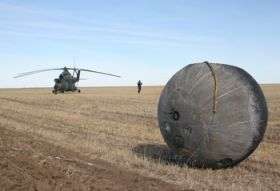
Photo courtesy R. Demets/F. Brandstatter - Spacecraft after landing in Kazakhstan after the experiment. Samples, including Orkney sample, are screwed onto the outside.
(PhysOrg.com) -- Intelligent life from other planets would be able to tell that Earth is inhabited if they had come into contact with a space voyaging piece of Orkney rock, scientists have revealed.
The specially prepared slab of rock was launched into space attached to a Russian spacecraft by University of Aberdeen experts in September last year as part of a European Space Agency mission.
Studies of the quarter of the rock which survived the journey have shown that if it had landed as a meteorite on another far distant planet and been tested by an alien life form, its chemical formations would have shown that life exists on other planets.
Findings unveil that the chemical information found within the rock survived the rigorous process of atmospheric entry after 12 days orbiting the Earth. These chemicals, which exist in the rock due to biological processes and could not have been formed by chance, would have provided evidence of life on the planet from which the rock arrived.
Professor John Parnell, School of Geosciences, University of Aberdeen who led the study with colleague Dr. Stephen Bowden, will present the findings of the rock's space voyage at the Royal Observatory Edinburgh Workshop: Habitability in our Galaxy in Edinburgh next week (Wednesday 8 October).
Professor Parnell said: "The specially prepared piece of Orkney rock took part in the unmanned Foton M3 mission which aimed to examine the rock's behaviour when it was exposed to the extreme temperatures involved in it's re-entry through the Earth's atmosphere.
"Three quarters of the rock, which was about the size of a small pork pie, was burnt off in the experiment. However, the quarter which returned to Earth has shown us that if intelligent life were to have come into contact with the rock, it would have provided them with evidence that life exists on another planet.
"If they were to have scientifically analysed the rock the chemical information extracted would have indicated that the remains of some other life form had been incorporated within the rock, as those chemicals could not have existed or been created by chance. In this case, the rock contains the remains of primitive algae that lived in the Orkney region almost 400 million years ago. We would be extremely excited if we found similar remains in a meteorite arriving from another world."
"The Orkney rock was chosen for the experiment due to its robust qualities which made it most likely to be able to survive the harsh conditions endured during re-entering the Earth's atmosphere, and its organic-rich nature which gave us a chemical signature to search for after the experiment."
The rock was blasted into space along with 35 other European Space Agency experiments in life and physical sciences.
Professor Parnell said: "The findings of the experiment tell us that we should look very carefully at meteorites arriving on Earth from Mars, in case they show signs of any life that might once have existed there."
Provided by University of Aberdeen
-
New insights: How soil production processes respond to erosion
8 hours ago |
not rated yet |
0
-
Mars-bound NASA rover carries coin for camera checkup
22 hours ago |
4.2 / 5 (6) |
7
-
Surface of Mars an unlikely place for life after 600 million year drought, say scientists
Feb 03, 2012 |
4.3 / 5 (13) |
10
-
Scientists confirm rocks fell from Mars (Update)
Jan 17, 2012 |
3.4 / 5 (10) |
3
-
Laser music: BYU electrical engineers use light to beam songs across a room
Dec 20, 2011 |
4.8 / 5 (5) |
6
-
Engineers build first sub-10-nm carbon nanotube transistor
Feb 01, 2012 |
4.9 / 5 (30) |
30
-
Something old, something new: Evolution and the structural divergence of duplicate genes
Jan 31, 2012 |
4.6 / 5 (7) |
1
-
The hidden nanoworld of ice crystals: Revealing the dynamic behavior of quasi-liquid layers
Jan 30, 2012 |
5 / 5 (3) |
1
-
Stock market network reveals investor clustering
Jan 27, 2012 |
3.9 / 5 (23) |
8
-
Of microchemistry and molecules: Electronic microfluidic device synthesizes biocompatible probes
Jan 26, 2012 |
5 / 5 (1) |
0
-
Titan's lack of impact craters
22 hours ago
-
Real pictures of black hole eating a star?
Feb 08, 2012
-
Hypothetical way to travel faster than light, but not technically exceed lightspeed
Feb 06, 2012
-
How do scientists monitor the Sun's activity?
Feb 05, 2012
-
Search patterns in observational studies
Feb 05, 2012
-
Derivation of Pogson's law
Feb 03, 2012
- More from Physics Forums - General Astronomy
More news stories
Could Venus be shifting gear?
(PhysOrg.com) -- ESAs Venus Express spacecraft has discovered that our cloud-covered neighbour spins a little slower than previously measured. Peering through the dense atmosphere in the infrared, the ...
Space & Earth / Space Exploration
46 minutes ago |
5 / 5 (1) |
0
|
What does a nebula sound like?
What do things sound like out in the cosmos? Of course, sound waves cant travel through the vacuum of space; however, electromagnetic waves can. These electromagnetic waves can be recorded by devices called spectrographs ...
Space & Earth / Space Exploration
53 minutes ago |
5 / 5 (1) |
0
Two new moons for Jupiter
Advances in technology have lead to the discovery of new planets outside of our Solar System, and now even new moons in our own backyard.
Space & Earth / Space Exploration
51 minutes ago |
not rated yet |
2
Sandy streets over the Atlantic
Thick dust from the Sahara blowing over the ocean off the western coast of Africa encounters the islands of Cape Verde, forming a wake of swirling vortex streets visible by satellite.
Space & Earth / Earth Sciences
18 minutes ago |
not rated yet |
0
Humans may have helped the decline of African rainforests 3000 years ago
(PhysOrg.com) -- Large areas of rainforests in Central Africa mysteriously disappeared over three thousand years ago, to be replaced by savannas. The prevailing theory has been that the cause was a change ...
The power of estrogen -- male snakes attract other males
A new study has shown that boosting the estrogen levels of male garter snakes causes them to secrete the same pheromones that females use to attract suitors, and turned the males into just about the sexiest ...
Experts reveal how plants don't get sunburn
(PhysOrg.com) -- Experts at the University of Glasgow have discovered how plants survive the harmful rays of the sun.
Team isolates nerve cells involved in storing long term memory and gene proteins associated with them
(Medical Xpress) -- A research team in Taiwan has succeeded in isolating two nerve cells in fruit fly brains that are believed to be the major players in allowing for the formation of long term memories. Furthermore, ...
Measurements from high-energy collisions lead to better understanding of why meson particles disappear
For several years, physicists at the Relativistic Heavy Ion Collider (RHIC) at Brookhaven National Laboratory (BNL), USA, have studied an unusual state of matter called the quarkgluon plasma, which they ...
SLAC, Stanford team focuses on high-energy electrons to treat cancer
Accelerator physicists at SLAC and cancer specialists from Stanford are working on a new technology that could dramatically reduce the time needed for cancer radiation treatments. The team ran an initial experiment ...
News of plaque-clearing drug tops week of major advances against Alzheimer's disease
In the last eight days, scientists have delivered a powerful one-two punch in the fight to defeat Alzheimer's disease. At the same time, the White House and members of Congress are proposing increases in Alzheimer's research ...
Oct 09, 2008
Rank: not rated yet