NASA Spacecraft Finds the Sun is Not a Perfect Sphere
October 2, 2008 NASA Spacecraft Finds the Sun is Not a Perfect Sphere

Enlarge

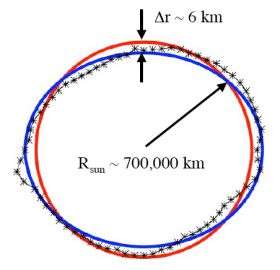
In this diagram, the sun's oblateness has been magnified 10,000 times for easy visibility. The blue curve traces the sun's shape averaged over a three month period. The black asterisked curve traces a shorter 10-day average. The "wiggles" in the 10-day curve are real, caused by strong magnetic ridges in the vicinity of sunspots.(NASA Goddard Space Flight Center)

(PhysOrg.com) -- Scientists using NASA’s RHESSI spacecraft have measured the roundness of the sun with unprecedented precision. They find that it is not a perfect sphere. During years of high solar activity the sun develops a thin “cantaloupe skin” that significantly increases its apparent oblateness: the sun’s equatorial radius becomes slightly larger than its polar radius. Their results appear the Oct. 2nd edition of Science Express.

“The sun is the biggest and therefore smoothest object in the solar system, perfect at the 0.001% level because of its extremely strong gravity,” says study co-author Hugh Hudson of UC Berkeley. “Measuring its exact shape is no easy task.”

The team accomplished the task by analyzing data from the Reuven Ramaty High-Energy Solar Spectroscopic Imager, RHESSI for short, an x-ray/gamma-ray space telescope launched in 2002 on a mission to study solar flares. Although RHESSI was never intended to measure the roundness of the sun, it has turned out ideal for the purpose. RHESSI observes the solar disk through a narrow slit and spins at 15 rpm. The spacecraft’s rapid rotation and high data sampling rate (necessary to catch fast solar flares) make it possible for investigators to trace the shape of the sun with systematic errors much less than any previous study. Their technique is particularly sensitive to small differences in polar vs. equatorial radius or “oblateness.”

“We have found that the surface of the sun has rough structure: bright ridges arranged in a network pattern, as on the surface of a cantaloupe but much more subtle,” describes Hudson. During active phases of the solar cycle, these ridges emerge around the sun’s equator, brightening and fattening the “stellar waist.” At the time of RHESSI’s measurements in 2004, ridges increased the sun’s apparent equatorial radius by an angle of 10.77 +- 0.44 milli-arcseconds, or about the same as the width of a human hair viewed one mile away.

“That may sound like a very small angle, but it is in fact significant,” says Alexei Pevtsov, RHESSI Program Scientist at NASA Headquarters. Tiny departures from perfect roundness can, for example, affect the sun’s gravitational pull on Mercury and skew tests of Einstein’s theory of relativity that depend on careful measurements of the inner planet’s orbit. Small bulges are also telltale signs of hidden motions inside the sun. For instance, if the sun had a rapidly rotating core left over from early stages of star formation, and if that core were tilted with respect to its outer layers, the result would be surface bulging. “RHESSI’s precision measurements place severe constraints on any such models.”

The “cantaloupe ridges” are magnetic in nature. They outline giant, bubbling convection cells on the surface of the sun called “supergranules.” Supergranules are like bubbles in a pot of boiling water amplified to the scale of a star; on the sun they measure some 30,000 km across (twice as wide as Earth) and are made of seething hot magnetized plasma. Magnetic fields at the center of these bubbles are swept out to the edge where they form ridges of magnetism. The ridges are most prominent during years around Solar Max when the sun’s inner dynamo “revs up” to produce the strongest magnetic fields. Solar physicists have known about supergranules and the magnetic network they produce for many years, but only now has RHESSI revealed their unexpected connection to the sun’s oblateness.

“When we subtract the effect of the magnetic network, we get a ‘true’ measure of the sun’s shape resulting from gravitational forces and motions alone,” says Hudson. “The corrected oblateness of the non-magnetic sun is 8.01 +- 0.14 milli arcseconds, near the value expected from simple rotation.”

Further analysis of RHESSI oblateness data may help researchers detect a long-sought type of seismic wave echoing through the interior of the sun: the gravitational oscillation or “g-mode.” Detecting g-modes would open a new frontier in solar physics—the study of the sun’s internal core.

The paper reporting these results, “A large excess in apparent solar oblateness due to surface magnetism,” was authored by Martin Fivian, Hugh Hudson, Robert Lin and Jabran Zahid, and appears in the Oct. 2nd issue of Science Express.

Provided by NASA, by Dr. Tony Phillips


print this article email this article download pdf blog this article bookmark this article     Stumble it Digg this share on Facebook retweet share on Reddit add to delicious
Rate this story - 4 /5 (26 votes)

Rank Filter

Move the slider to adjust rank threshold, so that you can hide some of the comments.


Display comments: newest first

  • skye - Oct 03, 2008
    • Rank: 1 / 5 (2)
    Because there is a nearby small brown dwarf star pulling at it. And i mean nearby as in it is already making its path back near the edge of our solar system. And guess what, thats what is also causing global warming, because its pulling at our orbit. I'm guessing that 2012 will probably be the year it is the closest to us and at peak destructive gravitational pulling of the earth.
    You dont have to realize the truth, but if you want to verify what I think, then please start researching nibiru, and the legends and stories of the original tribes and people on earth. They all say the same thing. That people descended from the heavens and created them to help them with their work. If you understand what they are saying, then you should start to understand that the Illuminati are not satanist, they worship their gods, the aliens from nibiru. All the blood sacrifices on both sides of the worlds to their gods, the pyramids, advanced civilizations, they were all guided by a higher presence. Life is AMAZING, don't you feel like that getting a job, paying taxes is going against the grain of life? Its basically slavery..A cage built of fear, loneliness, money, and peoples expectations. Everyone should be allowed to live their life doing whatever they want to do, unless that involves hurting someone else ;). Getting up and going to work every day feels so pointless, its depressing.. seriously. I would love to be able to do what I want to do, not WORK MOST OF MY LIFE. But you need money to do anything in society.. what a stupid system. Thank god nature and life still provide plenty of free pleasures and enjoyments.
  • wonko - Oct 04, 2008
    • Rank: not rated yet
    Oh, I think you missed something...

    Ni.Bi.Ru came out 2005. It even got some quite nice reviews. But point-and-click is not everyones taste...
  • Alizee - Oct 08, 2008
    • Rank: not rated yet
    One (at least me) would expect, the Sun must be curved a much more due it's rotation. The giant stars are all flattened due their rotation.

    http://upload.wik...rnar.jpg
  • VPXL - Oct 09, 2008
    • Rank: 1 / 5 (1)
    Does it really matter whether the Sun is a perfect sphere or not?
    http://www.fdadrugstore.org - my favorite web site
  • bmcghie - Oct 09, 2008
    • Rank: not rated yet
    I was kind of surprised at the headline. I always assumed that, like the earth, objects undergoing rotation are going to be distorted. Unless you have infinite gravity, there is going to be some distortion around the equator. That said, the sunspot distortions are cool!
  • pills - Nov 16, 2008
    • Rank: not rated yet

October 2, 2008 all stories

Comments: 6

4 /5 (26 votes)
  • Stumble this up

  • Digg this

  • share this

  • hide
  • Related Stories

  • Harnessing the power of salt, Norway tries osmotic power
    created 10 hours ago | popularity not rated yet | comments 0
  • Cassini's Big Sky: The View from the Center of Our Solar System
    created Nov 20, 2009 | popularity not rated yet | comments 0
  • Hunting for Planets in the Dark
    created Nov 19, 2009 | popularity not rated yet | comments 0
  • Mystery of the Solar Tsunami -- Solved (w/ Video)
    created Nov 19, 2009 | popularity not rated yet | comments 0
  • Liquid battery big enough for the electric grid?
    created Nov 19, 2009 | popularity not rated yet | comments 0


  • hide
  • Relevant PhysicsForums posts

  • Primary Mirror grinding
    created 2 hours ago
  • dark energy can escape black holes.
    created 10 hours ago
  • Are there green, purple and pink stars?
    created 22 hours ago
  • Sideral question
    created Nov 21, 2009
  • More from Physics Forums - General Astronomy

Other News

Spitzer Telescope Observes Baby Brown Dwarf

Spitzer Telescope Observes Baby Brown Dwarf

Space & Earth / Astronomy

created 20 minutes ago | popularity 5 / 5 (2) | comments 0

(PhysOrg.com) -- NASA's Spitzer Space Telescope has contributed to the discovery of the youngest brown dwarf ever observed -- a finding that, if confirmed, may solve an astronomical mystery about how these ...


The Crab Nebula: A Cosmic Icon

The Crab Nebula: Energy for 100,000 Suns

Space & Earth / Astronomy

created 36 minutes ago | popularity 5 / 5 (2) | comments 0

(PhysOrg.com) -- A star's spectacular death in the constellation Taurus was observed on Earth as the supernova of 1054 A.D.


New computer-developed map shows more extensive valley network on Mars

New computer-developed map shows more extensive valley network on Mars

Space & Earth / Space Exploration

created 1hour ago | popularity not rated yet | comments 0

New research adds to the growing body of evidence suggesting the Red Planet once had an ocean.


Supervolcano eruption -- in Sumatra -- deforested India 73,000 years ago

Supervolcano eruption -- in Sumatra -- deforested India 73,000 years ago

Space & Earth / Earth Sciences

created 3 hours ago | popularity 4 / 5 (2) | comments 0

A new study provides "incontrovertible evidence" that the volcanic super-eruption of Toba on the island of Sumatra about 73,000 years ago deforested much of central India, some 3,000 miles from the epicenter, ...


Using new technique, scientists find 11 times more aftershocks for 2004 quake

Space & Earth / Earth Sciences

created 5 hours ago | popularity 4 / 5 (1) | comments 0

(PhysOrg.com) -- Using a technique normally used for detecting weak tremor, scientists at the Georgia Institute of Technology discovered that the 2004 magnitude 6 earthquake along the Parkfield section of the San Andreas ...