Chemical 'orienteering': how accurately can cells follow a chemical trail to find their way around?
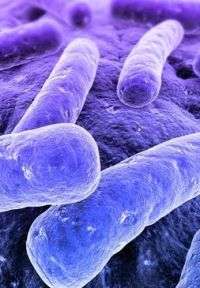
(PhysOrg.com) -- Scientists have long known that single-cell organisms find their way around by detecting chemicals in their surroundings. Now new research out this week in the Proceedings of the National Academy of Sciences (PNAS) journal has shown how accurately cells are able to do this.
Organisms such as bacteria, amoeba, yeast cells and human immune cells need to be able to 'see' how the concentration levels of important chemicals vary in their immediate surroundings, so they know if they are moving in the right direction.
For example in order to move towards a source of food, fast swimming bacteria and slowly crawling amoeba need to be able to sense whether food particles are more concentrated in front or behind them, so they can adjust their course to head towards the higher concentration of nutrients. Similarly, yeast cells need to be able to follow an increasingly concentrated trail of pheromones from other yeast cells in order to find a partner for sexual reproduction. Human immune cells use the same method of gradient sensing to find their way through the body to the site of an infection, even when the concentration of the important chemical they are trying to detect varies only a miniscule amount from one side of the cell to another.
In the new research out this week, scientists explain how accurately such cells can carry out gradient measurements of their surroundings given that the particles they are trying to measure are floating around at random.
Dr Robert Endres from Imperial College London's Division of Molecular Biosciences in the Department of Life Sciences, one of the authors of the study, comments:
"To survive under threat of starvation, amoeba collectively form long-lasting spores. In order to do this, individual amoeba cells emit chemicals which signal the need to form a collective. These chemicals are detected and followed by neighbouring amoeba cells, bringing multiple amoeba cells together in groups to form the spores. My colleague Dr Ned Wingreen from Princeton University and I set out to find out how accurately this clever mechanism can work theoretically."
Dr Endres explains further: "The accuracy of sensing is ultimately limited by distractions, or 'noise', created by randomly arriving chemical particles at the cell surface. We have precisely calculated the fundamental physical limit of a cell's ability to sense gradients. Other noise sources caused by chemical reactions inside the cell contribute additional noise not investigated here. However, we find that our calculations compare very favourably with migration of real amoeba in shallow chemical gradients, indicating that cells have evolved to 'work' near physical possible limit."
Specifically, Dr Endres and Dr Wingreen found that a theoretical model called the "perfectly absorbing sphere" accurately describes the way cells sense chemical gradients. This theoretical model assumes that every chemical particle coming into contact with the cell surface is counted only once, creating a very accurate picture of different chemical concentration levels surrounding the cell on all sides.
The researchers suggest that once a chemical particle has bound to a receptor, that receptor is sucked inside, or 'internalised' by the cell, or enzymes on the surfaces of the cell degrade the signal from chemical particles once they have been detected. Both methods ensure the particles cannot be detected again. Dr Endres explains that this sophisticated detection system means cells are able to accurately detect even the smallest chemical gradients because misleading 'double counts' do not occur:
"These cells avoid counting the same chemical particle twice, and because of this they have significantly reduced what we call 'background noise' – the kind of double counts and inaccuracies which would make this process far less efficient. In fact, these cells are so accurate that they are operating at the very physical limits of gradient detection, sensing the smallest gradients imaginable," he says.
These findings are particularly important for migrating cells inside the body during development where multiple chemical stimuli can lead to substantial distraction. For instance, germ cells in zebra fish need to migrate over long distances to their target site before they can develop further into sperm or egg cells.
Provided by Imperial College London


