Earliest Animal Footprints Ever Found -- Discovered in Nevada
October 5th, 2008 Earliest Animal Footprints Ever Found -- Discovered in Nevada

Enlarge

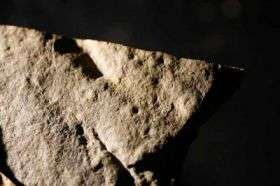
Pictured below is the trackway of one of the earliest animals, a multilegged creature that walked over the bed of an ancient sea once covering Nevada. The animal left behind a pair of parallel impressions -- small, round dots in the silt that later became rock. Photo by Kevin Fitzsimons, Ohio State University

The fossilized trail of an aquatic creature suggests that animals walked using legs at least 30 million years earlier than had been thought. The tracks -- two parallel rows of small dots, each about 2 millimeters in diameter -- date back some 570 million years, to the Ediacaran period.

The Ediacaran preceded the Cambrian period, the time when most major groups of animals first evolved.

Scientists once thought that it was primarily microbes and simple multicellular animals that existed prior to the Cambrian, but that notion is changing, explained Loren Babcock, professor of earth sciences at Ohio State University.

"We keep talking about the possibility of more complex animals in the Ediacaran -- soft corals, some arthropods, and flatworms -- but the evidence has not been totally convincing," he said. "But if you find evidence, like we did, of an animal with legs -- an animal walking around -- then that makes the possibility much more likely."

Soo-Yeun Ahn, a doctoral student at Ohio State, presented the discovery in a poster session at the Geological Society of America meeting Sunday in Houston. Coauthors included Margaret Rees of the University of Nevada, Las Vegas, and J. Stewart Hollingsworth of the Institute for Cambrian Studies.

Babcock was surveying rocks in the mountains near Goldfield, Nevada, with Hollingsworth in 2000 when he found the tracks.

"This was truly an accidental discovery. We came on an outcrop that looked like it crossed the Precambrian-Cambrian boundary, so we stopped to take a look at it. We just sat down and started flipping rocks over. We were there less than an hour when I saw it."

The creature must have stepped lightly onto the soft marine sediment, because its legs only pressed shallow pinpoints into that long-ago sea bed. But when Babcock flipped over the rock containing those tracks, the low-angle sunlight cast the dots in crisp shadow.

He immediately suspected that the tracks were made by an arthropod, such as one resembling a centipede or millipede, or by a leg-bearing worm.

He couldn't be certain of the length of the creature, or the number of legs it had. But judging from the tracks, he guessed that it carried its centimeter-wide body on many spindly legs.

In 2002, other researchers reported a similar fossil trail from Canada that dated back to the middle of the Cambrian period, about 520 million years ago. Another set of tracks found in South China date back to 540 million years ago.

At approximately 570 million years old, this new fossil not only provides the earliest suggestion of animals walking on legs, but it also shows that complex animals were alive on earth before the Cambrian.

Not many macroscopic fossils exist from that time because soft-bodied creatures are not normally preserved.

Babcock is an expert in "exceptional preservation" -- the special chemical, physical and biologic conditions that enabled some soft-bodied creatures to fossilize. By knowing where to look in the geologic record, he has uncovered a menagerie of unusual fossils, from unusual echinoderms in Nevada to sulfur-eating bacteria in Antarctica.

The shallow sea covering western Nevada 570 million years ago would have been a good site for exceptional preservation. The sediment surface was probably bound together by a microbial mat -- a cohesive carpet of bacteria and sediment grains. A creature's tracks could have been readily preserved when the animal pressed its legs into the sediment.

Babcock says that he is "reasonably certain -- not 100 percent" that the fossil was made by a centipede-like arthropod or a leg-bearing worm. A fossil of the animal itself would be more definitive. He is going to continue looking in the same region of Nevada, but that is not the only potential site. Similar fossils might be found in the White Sea area of Russia, South Australia, Newfoundland or Namibia, where body fossils of Ediacaran organisms have been found.

"I expect that there will be a lot of skepticism," he said about the discovery. "There should be. But I think it will cause some excitement. And it will probably cause some people to look harder at the rocks they already have. Sometimes it's just a matter of thinking differently about the same specimen."

Source: Ohio State University


print this article email this article download pdf blog this article bookmark this article     Digg this Stumble it share on Facebook share on Reddit add to delicious save to Yahoo! bookmarks
4.6/5 after 30 votes

Rank Filter

Move the slider to adjust rank threshold, so that you can hide some of the comments.


Display comments: newest first

  • jimology - Oct 05, 2008
    • Rank: 1 / 5 (9)
    This is truly exciting news, but even more exciting is the human footprints alongside dinosauer prints found in Glen River Tex
  • dachpyarvile - Oct 05, 2008
    • Rank: 4 / 5 (1)
    There is no excitement about these footprints because they are not human footprints. For starters, visit this page:

    http://www.badarc...luxy.php

    I have looked at the tracks as well myself. They are not human footprints of any age. I wish they were but they aren't. :-(
  • Arikin - Oct 05, 2008
    • Rank: not rated yet
    "Scientists once thought that it was primarily microbes and simple multicellular animals that existed prior to the Cambrian"

    Ah... just a reminder to phrase all your findings with the words: According to our current evidence we theorize that...

    :-)
  • DGBEACH - Oct 06, 2008
    • Rank: not rated yet
    The article never claimed they were human dachpyarville
  • MGraser - Oct 06, 2008
    • Rank: not rated yet
    Just had a thought - the lingo should switch from "than scientists previously thought" to "than scientists previously documented". Or, perhaps some other variation. The impression is always - oops, scientists were wrong again! It makes them look like they are always in shock, when that's not the case. Anyway - just thought I'd throw it out there.
  • nlight - Oct 11, 2008
    • Rank: not rated yet
    DGBEACH : dachpyarville's comment is directed at the creationist troll jimology.

October 5th, 2008 all stories
Other Sciences / Archaeology & Fossils

Comments: 6
Rank: 4.6/5 after 30 votes

  • Stumble this up

  • Digg this

  • Share it:
  • share on Facebook
  • share on MySpace
  • share on Slashdot
  • rss-newsfeed
  • share on Google
  • share on Reddit
  • add to delicious
  • save to Yahoo! bookmarks
  • share on Windows Live
  • Add to Mixx!
Rating: 4.6/5 after 30 votes


  • Physicists Demonstrate Quantum Memory with Matter Qubits
    Physicists Demonstrate Quantum Memory with Matter Qubits
    Physics / General Physics
    created Jul 03, 2009 | popularity 4.4 / 5 (17) | comments 1
  • 'Holey' Nanosheets for Wastewater Dye Removal
    Nanotechnology / Nanomaterials
    created Jul 01, 2009 | popularity 5 / 5 (5) | comments 1
  • Jellyfish Robot Swims Like its Biological Counterpart
    Jellyfish Robot Swims Like its Biological Counterpart
    Electronics / Robotics
    created Jun 26, 2009 | popularity 4.4 / 5 (8) | comments 1
  • Could Maxwell's Demon Exist in Nanoscale Systems?
    Could Maxwell's Demon Exist in Nanoscale Systems?
    Physics / General Physics
    created Jun 24, 2009 | popularity 4.4 / 5 (18) | comments 29
  • Living Safely with Robots, Beyond Asimov's Laws
    Living Safely with Robots, Beyond Asimov's Laws
    Electronics / Robotics
    created Jun 22, 2009 | popularity 4.6 / 5 (53) | comments 40
  • Other News

    Creation Museum president Ken A. Ham

    Paleontologists brought to tears, laughter by Creation Museum

    Other Sciences / Other

    created Jun 30, 2009 | popularity 4.3 / 5 (44) | comments 125

    For a group of paleontologists, a tour of the Creation Museum seemed like a great tongue-in-cheek way to cap off a serious conference.


    Mummified dinosaur skin yields up new secrets

    Mummified dinosaur skin yields up new secrets

    Other Sciences / Archaeology & Fossils

    created Jul 01, 2009 | popularity 4.7 / 5 (15) | comments 10

    (PhysOrg.com) -- Scientists from The University of Manchester have identified preserved organic molecules in the skin of a dinosaur that died around 66-million years ago.


    Liberal? Conservative? Stanford study says mental nudge can make voters flip-flop

    Liberal? Conservative? Stanford study says mental nudge can make voters flip-flop

    Other Sciences / Social Sciences

    created Jul 02, 2009 | popularity 3.8 / 5 (6) | comments 4

    (PhysOrg.com) -- No doubt you’ve worked hard for your success. But chances are you’ve also had some help and lucky breaks along the way.


    Probing Question: How do Ponzi Schemes work?

    Other Sciences / Economics

    created Jul 02, 2009 | popularity 5 / 5 (2) | comments 2

    Imagine the shock, the horror, and the sheer panic that would come with learning that the financial plan you’d sunk your life savings into was a sham, the financial experts you trusted were crooks, and all your money was ...


    Tourists enjoy a "Pineapple Tour" in Costa Rica

    Costa Rica tops happiness, 'green living' poll

    Other Sciences / Social Sciences

    created Jul 04, 2009 | popularity 3.5 / 5 (4) | comments 0

    Costa Rica is the happiest place on earth, and one of the most environmentally friendly, according to a new survey by a British non-governmental group.