Nanoscopic screening process to speed drug discovery
October 6th, 2008 Lab-on-Bead Development

Enlarge

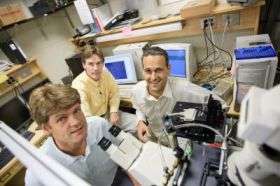
Wake Forest University physics professors (from left to right) Martin Guthold, Keith Bonin and Jed Macasko work in Guthold's laboratory on development of Lab-on-Bead processing, a novel drug-screening technique with the potential to be 10,000 times faster than current methods. Credit: Wake Forest University/Ken Bennett

Researchers at Wake Forest University are using nanotechnology to search for new cancer-fighting drugs through a process that could be up to 10,000 times faster than current methods.

The "Lab-on-Bead" process will screen millions of chemicals simultaneously using tiny plastic beads so small that 1,000 of them would fit across a human hair. Each bead carries a separate chemical, which can be identified later if it displays the properties needed to treat cancer cells. One batch of nanoscopic beads can replace the work of thousands of conventional, repetitive laboratory tests.

"This process allows the beads to do the work for you," explains Jed Macosko, project director and assistant professor of physics at Wake Forest. "By working at this scale, we will be able to screen more than a billion possible drug candidates per day as opposed to the current limit of hundreds of thousands per day."

Other members of the research team at Wake Forest include co-principal investigator Martin Guthold, an associate professor of physics, and Keith Bonin, department chair and professor of physics.

Macosko said the team and their collaborators at the University of Waterloo in Ontario, Canada, are developing a device that will automate the Lab-on-Bead process and permit parallel processing to attain faster screening results. The Wake Forest researchers are also working with biotechnologists at Harvard University in Boston and Université Louis Pasteur in Strasbourg, France, which are providing the chemicals being screened for drug candidates. Biotech company NanoMedica has shown interest in commercializing the process. The North Carolina Biotechnology Center, a private, nonprofit corporation funded by the N.C. General Assembly, has provided $75,000 in funding for the project.

Wake Forest's Center for Nanotechnology and Molecular Materials, which maintains ongoing research programs in the areas of health and medicine, energy technologies and synthesis of nanomaterials, will facilitate some elements of Lab-on-Bead development.

Source: Wake Forest University


print this article email this article download pdf blog this article bookmark this article     Digg this Stumble it share on Facebook share on Reddit add to delicious save to Yahoo! bookmarks
4.1/5 after 9 votes


October 6th, 2008 all stories
Nanotechnology / Bio & Medicine

Comments: 0
Rank: 4.1/5 after 9 votes

  • Stumble this up

  • Digg this

  • Share it:
  • share on Facebook
  • share on MySpace
  • share on Slashdot
  • rss-newsfeed
  • share on Google
  • share on Reddit
  • add to delicious
  • save to Yahoo! bookmarks
  • share on Windows Live
  • Add to Mixx!
Rating: 4.1/5 after 9 votes

  • Related Stories

  • Amazon carbon sink threatened by drought
    created Mar 05, 2009 | popularity not rated yet | comments 0
  • Researchers develop new platinum-based anti-tumor compound
    created Feb 11, 2009 | popularity not rated yet | comments 0
  • Higher blood sugar levels linked to lower brain function in diabetics, study shows
    created Feb 11, 2009 | popularity not rated yet | comments 0
  • Hormone therapy linked to brain shrinkage, but not lesions
    created Jan 12, 2009 | popularity not rated yet | comments 0
  • Minor shift in vaccine schedule has potential to reduce infant illness, death
    created Nov 03, 2008 | popularity not rated yet | comments 0


  • Physicists Demonstrate Quantum Memory with Matter Qubits
    Physicists Demonstrate Quantum Memory with Matter Qubits
    Physics / General Physics
    created Jul 03, 2009 | popularity 4.4 / 5 (16) | comments 1
  • 'Holey' Nanosheets for Wastewater Dye Removal
    Nanotechnology / Nanomaterials
    created Jul 01, 2009 | popularity 5 / 5 (5) | comments 1
  • Jellyfish Robot Swims Like its Biological Counterpart
    Jellyfish Robot Swims Like its Biological Counterpart
    Electronics / Robotics
    created Jun 26, 2009 | popularity 4.4 / 5 (7) | comments 1
  • Could Maxwell's Demon Exist in Nanoscale Systems?
    Could Maxwell's Demon Exist in Nanoscale Systems?
    Physics / General Physics
    created Jun 24, 2009 | popularity 4.4 / 5 (18) | comments 29
  • Living Safely with Robots, Beyond Asimov's Laws
    Living Safely with Robots, Beyond Asimov's Laws
    Electronics / Robotics
    created Jun 22, 2009 | popularity 4.6 / 5 (52) | comments 40
  • Other News

    A 'quantum of sol' -- how nanotechnology could hold the key to a solar-powered future

    A 'quantum of sol' -- how nanotechnology could hold the key to a solar-powered future

    Nanotechnology / Nanomaterials

    created Jun 30, 2009 | popularity 3.7 / 5 (12) | comments 16

    (PhysOrg.com) -- A new generation of 'nano-structured' millimetre-sized solar cells that could convert the sun's energy to electricity more than twice as efficiently as current technology, is the subject of ...


    Australian researchers are set to begin human trials of a tiny nano-cell that acts as a "Trojan horse" against cancer

    Hi-tech 'Trojan horse' can kill cancer cells: researchers

    Nanotechnology / Bio & Medicine

    created Jun 29, 2009 | popularity 4.6 / 5 (11) | comments 7

    Australian researchers are set to begin human trials of a tiny nano-cell that acts as a "Trojan horse" against cancer cells, a breakthrough they say may curb the need for debilitating chemotherapy.


    Harnessing Nanoparticles To Track Cancer Cell Changes

    Nanotechnology / Bio & Medicine

    created Jul 03, 2009 | popularity not rated yet | comments 1

    The more dots there are, the more accurate a picture you get when you connect them. Cancer researchers adopting that philosophy have developed a new imaging technology that could give scientists the ability to simultaneously ...


    'Holey' Nanosheets for Wastewater Dye Removal

    Nanotechnology / Nanomaterials

    created Jul 01, 2009 | popularity 5 / 5 (5) | comments 1

    (PhysOrg.com) -- Researchers have discovered that extremely thin sheets of nickel oxide with hexagonally shaped holes can absorb hazardous dyes from wastewater nearly as well as the best traditional methods, but are recyclable. ...


    New statistical technique improves precision of nanotechnology data

    New statistical technique improves precision of nanotechnology data

    Nanotechnology / Nanophysics

    created Jul 01, 2009 | popularity 3 / 5 (2) | comments 0

    A new statistical analysis technique that identifies and removes systematic bias, noise and equipment-based artifacts from experimental data could lead to more precise and reliable measurement of nanomaterials ...