NASA spacecraft ready to explore outer solar system
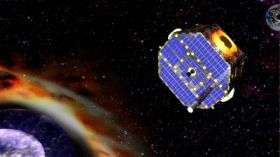
October 6, 2008 Artist's Impression of NASA's IBEX

An artist's impression of NASA's IBEX spacecraft exploring the edge of our solar system. Credit: NASA/GSFC

The first NASA spacecraft to image and map the dynamic interactions taking place where the hot solar wind slams into the cold expanse of space is ready for launch Oct. 19. The two-year mission will begin from the Kwajalein Atoll, a part of the Marshall Islands in the Pacific Ocean.

Called the Interstellar Boundary Explorer or IBEX, the spacecraft will conduct extremely high-altitude orbits above Earth to investigate and capture images of processes taking place at the farthest reaches of the solar system. Known as the interstellar boundary, this region marks where the solar system meets interstellar space.

"The interstellar boundary regions are critical because they shield us from the vast majority of dangerous galactic cosmic rays, which otherwise would penetrate into Earth's orbit and make human spaceflight much more dangerous," said David J. McComas, IBEX principal investigator and senior executive director of the Space Science and Engineering Division at the Southwest Research Institute in San Antonio.

The story of the outer solar system began to unfold when the Voyager 1 and Voyager 2 spacecrafts left the inner solar system and headed out toward the boundary between our solar system and interstellar space.

"The Voyager spacecraft are making fascinating observations of the local conditions at two points beyond the termination shock that show totally unexpected results and challenge many of our notions about this important region," said McComas.

Other spacecraft have continued the exploration of the interstellar boundary region. Recently, a pair of NASA sun-focused satellites, the Solar Terrestrial Relations Observatory mission, detected a higher-energy version of the particles IBEX will observe in the heliosphere. The heliosphere is an area that contains the solar wind. It stretches from the sun to a distance several times the orbit of Pluto.

IBEX is poised to thoroughly map this interstellar boundary region of the solar system. The images will allow scientists to understand the global interaction between our sun and the galaxy for the very first time.

IBEX will be launched aboard a Pegasus rocket dropped from under the wing of an L-1011 aircraft flying over the Pacific Ocean. The Pegasus will carry the spacecraft approximately 130 miles above Earth and place it in orbit.

"What makes the IBEX mission unique is that it has an extra kick during launch," said Willis Jenkins, IBEX program executive at NASA Headquarters in Washington. "An extra solid-state motor pushes the spacecraft further out of low-Earth orbit where the Pegasus launch vehicle leaves it."

Source: NASA/Goddard Space Flight Center


print this article email this article download pdf blog this article bookmark this article     Stumble it Digg this share on Facebook retweet share on Reddit add to delicious
Rate this story - 4.5 /5 (15 votes)

Rank Filter

Move the slider to adjust rank threshold, so that you can hide some of the comments.


Display comments: newest first


October 6, 2008 all stories

Comments: 1

4.5 /5 (15 votes)
  • Stumble this up

  • Digg this

  • share this

  • hide
  • Related Stories

  • Fantastic Voyage
    created Nov 02, 2009 | popularity not rated yet | comments 0
  • 'Ultra-primitive' particles found in comet dust
    created Nov 02, 2009 | popularity not rated yet | comments 0
  • Galactic magnetic fields may control the boundaries of our solar system
    created Oct 16, 2009 | popularity not rated yet | comments 0
  • Cassini Data Help Redraw Shape of Solar System (w/ Video)
    created Oct 16, 2009 | popularity not rated yet | comments 0
  • Scientists Explore Galactic Frontier, Release First-Ever All-Sky Map (w/ Video)
    created Oct 15, 2009 | popularity not rated yet | comments 0


  • hide
  • Relevant PhysicsForums posts

  • The shape of our solar system's orbits.
    created 18 hours ago
  • Above or Below the Line of Nodes
    created 22 hours ago
  • Supernova vs. Nova?
    created Nov 07, 2009
  • Supernova's Gamma Rays and Comets
    created Nov 06, 2009
  • More from Physics Forums - General Astronomy

Other News

Deep creep means milder, more frequent earthquakes along Southern California's San Jacinto fault

Deep creep means milder, more frequent earthquakes along Southern California's San Jacinto fault

Space & Earth / Earth Sciences

created 4 hours ago | popularity 4.7 / 5 (3) | comments 0

With an average of four mini-earthquakes per day, Southern California's San Jacinto fault constantly adjusts to make it a less likely candidate for a major earthquake than its quiet neighbor to the east, the ...


Success in 'space elevator' competition (AP)

Success in 'space elevator' competition (Update 3)

Space & Earth / Space Exploration

created Nov 05, 2009 | popularity 4.3 / 5 (33) | comments 50

(AP) -- A robot powered by a ground-based laser beam climbed a long cable dangling from a helicopter on Wednesday to qualify for prize money in a $2 million competition to test the potential reality of the ...


'Dropouts' pinpoint earliest galaxies

'Dropouts' pinpoint earliest galaxies

Space & Earth / Astronomy

created Nov 06, 2009 | popularity 4.2 / 5 (10) | comments 12

Astronomers, conducting the broadest survey to date of galaxies from about 800 million years after the Big Bang, have found 22 early galaxies and confirmed the age of one by its characteristic hydrogen signature ...


Space hotel taking bookings for 2012 opening

Space hotel taking bookings for 2012 opening

Space & Earth / Space Exploration

created Nov 05, 2009 | popularity 4.4 / 5 (20) | comments 11

(PhysOrg.com) -- The first orbiting space hotel is on track to open for its first customers in 2012, but hurry, as bookings are filling fast.


In a Galaxy Far, Far Away...

In a Galaxy Far, Far Away...

Space & Earth / Astronomy

created Nov 06, 2009 | popularity 4.8 / 5 (4) | comments 12

(PhysOrg.com) -- Astronomers have published the discovery of the farthest known object in the cosmos: a star that exploded when the universe was only 630 million years old -- only 4.6% of its current age. ...