Bioengineers fill holes in science of cellular self-organization
October 6, 2008
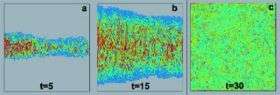
Results of MD simulations for the colony growth in a closed container. The growth is limited by four rigid walls. The size of the square domain is Lx=Lz=136.6d where d is the cell diameter. a-c: Initially the colony is prepared by placing randomly oriented cells of different length in the middle section. The panels show snapshots of the population taken at t=5.0, 15.0, 30.0. The cells are colorized according to the value of the contact stress.Credit: UCSD
The chemical and biological aspects of cellular self-organization are well-studied; less well understood is how cell populations order themselves biomechanically – how their behavior and communication are affected by high density and physical proximity. Bioengineers and physicists at the University of California San Diego, in a paper published in the current issue of the Proceedings of the National Academy of Sciences, have begun to address these fundamental questions.
The UC San Diego scientists focused their research on dense colonies of the rod-shaped bacteria Escherichia coli. By analyzing the spatial organization of the bacteria in a microfluidic chemostat – a kind of mini-circuit board for liquids rather than electrons – they found that growth and expansion of a dense colony of cells leads to a dynamic change from relative disorder to a remarkable re-orientation and alignment of the rod-like cells.
That finding, described in their paper "Biomechanical Ordering of Dense Cell Populations," allowed them to develop a model of collective cell dynamics, and to use this model to "elucidate the mechanism of cell ordering, and quantify the relationship between the dynamics of cell proliferation and the spatial structure of the population."
One of the authors, Lev S. Tsimring, at UC San Diego's Institute of Nonlinear Science, explained the bioengineers' use of bacteria to study the biomechanical ordering of cells.
"When environmental conditions are harsh, bacteria like to stick together. The most typical form of bacterial organization in nature is a biofilm: a dense quasi-two-dimensional colony of bacteria. Biofilms grow in and on living tissues, the surfaces of rocks and soils, and in aquatic environments," he said, "but they're also found in man-made systems and devices such as industrial piping and artificial implants. And bacteria are known to actively migrate toward surfaces and small cavities, where they form high-density colonies."
At low densities, he said, bacteria and other cells communicate "remotely" by sending chemical signals – "chemotaxis" – but, as they aggregate and form dense communities, direct biomechanical contacts play a bigger and bigger role in how they organize themselves.
"Although previous studies have explored the complex signaling mechanisms in the early stages of biofilm formation," Tsimring said, "the biomechanics of direct cellular contacts have received little attention. We focused, therefore, on the structure and dynamics of a growing two-dimensional colony of non-motile bacteria."
His fellow researcher, Jeff Hasty, at the Institute for Nonlinear Science and UC San Diego's Department of Bioengineering, said the team's work provides a multiscale description of cell colony growth.
"Our results reveal how cell growth and colony expansion trigger the formation of the orientational order in the population," Hasty said, "which, in turn, affects the mechanical and biochemical properties of the colony."
The details of their research, the authors say, helps scientists understand how the local interaction of elementary components leads to collective behavior and the formation of a highly organized system.
Source: University of California - San Diego
-
Scientists devise new imaging technique for analysis of biological samples
Jan 20, 2012 |
5 / 5 (2) |
0
-
Petroleum-eating mushrooms
Nov 30, 2011 |
4.2 / 5 (5) |
2
-
New clue to Parkinson's: Shape of key protein surprises researchers
Aug 14, 2011 |
4.8 / 5 (17) |
1
-
Disease-causing tangle could spawn new materials
Aug 01, 2011 |
5 / 5 (1) |
4
-
Microbial study reveals sophisticated sensory response
Aug 01, 2011 |
5 / 5 (2) |
1
-
Engineers build first sub-10-nm carbon nanotube transistor
Feb 01, 2012 |
4.9 / 5 (33) |
30
-
Something old, something new: Evolution and the structural divergence of duplicate genes
Jan 31, 2012 |
4.6 / 5 (7) |
1
-
The hidden nanoworld of ice crystals: Revealing the dynamic behavior of quasi-liquid layers
Jan 30, 2012 |
5 / 5 (4) |
1
-
Stock market network reveals investor clustering
Jan 27, 2012 |
3.9 / 5 (23) |
8
-
Of microchemistry and molecules: Electronic microfluidic device synthesizes biocompatible probes
Jan 26, 2012 |
5 / 5 (2) |
0
More news stories
A mitosis mystery solved: How chromosomes align perfectly in a dividing cell
Although the process of mitotic cell division has been studied intensely for more than 50 years, Whitehead Institute researchers have only now solved the mystery of how cells correctly align their chromosomes during symmetric ...
9 hours ago |
4.3 / 5 (15) |
0
|
Researchers find extensive RNA editing in human transcriptome
In a new study published online in Nature Biotechnology, researchers from BGI, the world's largest genomics organization, reported the evidence of extensive RNA editing in a human cell line by analysis of RNA-seq data, demons ...
9 hours ago |
5 / 5 (4) |
0
|
The proteins ensuring genome protection
Researchers from the University of Geneva (UNIGE), Switzerland, have discovered the crucial role of two proteins in developing a cell 'anti-enzyme shield'. This protection system, which operates at the level of molecular ...
9 hours ago |
5 / 5 (3) |
0
|
Entire genome of extinct human decoded from fossil
(PhysOrg.com) -- In 2010, Svante Pääbo and his colleagues presented a draft version of the genome from a small fragment of a human finger bone discovered in Denisova Cave in southern Siberia. The ...
Feb 07, 2012 |
4.7 / 5 (60) |
51
|
Why are there so few fish in the Earth's oceans?
(PhysOrg.com) -- A Stony Brook University researcher has found that, contrary to popular belief, there are not plenty of fish in the sea.
Feb 08, 2012 |
4.2 / 5 (18) |
27
|
Scientists discover molecular secrets of 2,000-year-old Chinese herbal remedy
For roughly two thousand years, Chinese herbalists have treated Malaria using a root extract, commonly known as Chang Shan, from a type of hydrangea that grows in Tibet and Nepal. More recent studies suggest that halofuginone, ...
New method to examine batteries -- MRI from the inside
There is an ever-increasing need for advanced batteries for portable electronics, such as phones, cameras, and music players, but also to power electric vehicles and to facilitate the distribution and storage of energy derived ...
Google might launch Drive for cloud storage soon
(PhysOrg.com) -- Google's next big move, according to the Wall Street Journal, is a cloud storage service called Drive. Hardly first to the plate, Google is simply catching up to introducing its cloud reposi ...
Lab study raises questions over nano-particle impact
Tests involving chickens have raised questions about the impact on health from engineered nano-particles, the ultra-fine grains commonly used in drugs and processed foods, scientists said on Sunday.
Starve a virus, feed a cure? Findings show how some cells protect themselves against HIV
A protein that protects some of our immune cells from the most common and virulent form of HIV works by starving the virus of the molecular building blocks that it needs to replicate, according to research published online ...
Overeating may double risk of memory loss
New research suggests that consuming between 2,100 and 6,000 calories per day may double the risk of memory loss, or mild cognitive impairment (MCI), among people age 70 and older. The study was released today and will be ...