Cassini flyby of Saturn moon offers insight into solar system history
October 7, 2008
Cassini Huygens

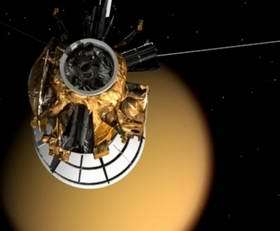
NASA's Cassini spacecraft is scheduled to fly within 16 miles of Saturn's moon Enceladus on Oct. 9 and measure molecules in its space environment that could give insight into the history of the solar system.

"This encounter will potentially have far-reaching implications for understanding how the solar system was formed and how it evolved," said professor Tamas Gombosi, chair of the University of Michigan Department of Atmospheric, Oceanic and Space Sciences.

Gombosi is the interdisciplinary scientist for magnetosphere and plasma science on the Cassini mission. His role is to coordinate studies that involve multiple plasma instruments on the spacecraft.

Enceladus is Saturn's sixth-largest moon, orbiting within the planet's outermost ring. It is approximately 313 miles in diameter.

In this flyby, Cassini will be close enough to Enceladus to identify individual molecules in the moon's space environment, including ions and isotopes. An ion is a charged particle, or a version of an element that has lost or gained negatively charged electrons. An isotope is a version of an element that has in its nucleus the typical protons for that element, but a different number of neutrons, thus exhibiting a different atomic weight.

The atoms around Enceladus are expected to hold clues to the past because they come from interior regions that have changed little since the moon was formed. Geysers near the moon's south pole spew water and other molecules from the satellite's interior. Because of Enceladus' weak gravity and low atmospheric pressure, the water and gas molecules waft off to space.

The encounter will contribute to scientists' understanding of how particles become charged and energized in Saturn's magnetosphere. Also, when Cassini identifies the different isotopes in the space around the moon, it will help scientists discern the temperatures at various stages in Enceladus' formation eons ago.

Cassini discovered the geysers on Enceladus in 2005. Scientists believe that there could be a liquid ocean beneath the moon's surface. They also detected organic molecules at the moon in March. Organic molecules have carbon-hydrogen bonds, and are found in living organisms, and in comets.

"The mission as a whole is expected to bring central pieces of the solar system evolution puzzle into place," Gombosi said. "This encounter is expected to provide some of those puzzle pieces."

This will be Cassini's fifth encounter with Enceladus. A sixth encounter, during which it will approach within 122 miles of the moon, is scheduled for Oct. 31. Four more flybys are planned in the next two years of Cassini's extended mission, the Cassini Equinox Mission.

The Cassini-Huygens spacecraft was launched in 1997 and reached Saturn to study the planet and its moons in 2004. It is a cooperative project of NASA, the European Space Agency and the Italian Space Agency. The Jet Propulsion Laboratory (JPL), a division of the California Institute of Technology in Pasadena, manages the mission for NASA's Science Mission Directorate, Washington, D.C. The Cassini orbiter was designed, developed and assembled at JPL.


Source: University of Michigan

4.5 /5 (17 votes)  

Rank 4.5 /5 (17 votes)
Related Stories
Relevant PhysicsForums posts
  • Never ending outer space.....
    created21 hours ago
  • Neutron Star fragments?
    created23 hours ago
  • stationary or not?
    createdFeb 11, 2012
  • Scale of the Universe
    createdFeb 10, 2012
  • Titan's lack of impact craters
    createdFeb 09, 2012
  • Real pictures of black hole eating a star?
    createdFeb 08, 2012
  • More from Physics Forums - General Astronomy

More news stories

Salvage workers begin pumping fuel from Italian shipwreck

Salvage workers Sunday began pumping fuel from the shipwrecked Italian cruise liner Costa Concordia, a day ahead of schedule, officials said.

Space & Earth / Environment

created 7 hours ago | popularity 5 / 5 (1) | comments 0

Latin America mining boom clashes with conservation

Latin America is experiencing a mining boom as prices rise fuelled by a hike in global demand, but the region is also being hit by a wave of violent protests, strikes and rallies by environmentalists.

Space & Earth / Environment

created 15 hours ago | popularity 5 / 5 (1) | comments 1

Political leaders play key role in how worried Americans are by climate change: study

More than extreme weather events and the work of scientists, it is national political leaders who influence how much Americans worry about the threat of climate change, new research finds.

Space & Earth / Environment

created Feb 06, 2012 | popularity 5 / 5 (7) | comments 73

NASA budget will axe Mars deal with Europe: scientists

US President Barack Obama's budget proposal to be submitted next week for 2013 will cut NASA's budget by 20 percent and eliminate a major partnership with Europe on Mars exploration, scientists said Thursday.

Space & Earth / Space Exploration

created Feb 10, 2012 | popularity 5 / 5 (3) | comments 58

Humans may have helped the decline of African rainforests 3000 years ago

(PhysOrg.com) -- Large areas of rainforests in Central Africa mysteriously disappeared over three thousand years ago, to be replaced by savannas. The prevailing theory has been that the cause was a change ...

Space & Earth / Environment

created Feb 10, 2012 | popularity 4.1 / 5 (14) | comments 21 | with audio podcast report


Scientists discover molecular secrets of 2,000-year-old Chinese herbal remedy

For roughly two thousand years, Chinese herbalists have treated Malaria using a root extract, commonly known as Chang Shan, from a type of hydrangea that grows in Tibet and Nepal. More recent studies suggest that halofuginone, ...

New method to examine batteries -- MRI from the inside

There is an ever-increasing need for advanced batteries for portable electronics, such as phones, cameras, and music players, but also to power electric vehicles and to facilitate the distribution and storage of energy derived ...

A mitosis mystery solved: How chromosomes align perfectly in a dividing cell

Although the process of mitotic cell division has been studied intensely for more than 50 years, Whitehead Institute researchers have only now solved the mystery of how cells correctly align their chromosomes during symmetric ...

Overeating may double risk of memory loss

New research suggests that consuming between 2,100 and 6,000 calories per day may double the risk of memory loss, or mild cognitive impairment (MCI), among people age 70 and older. The study was released today and will be ...

Lab study raises questions over nano-particle impact

Tests involving chickens have raised questions about the impact on health from engineered nano-particles, the ultra-fine grains commonly used in drugs and processed foods, scientists said on Sunday.

Google might launch Drive for cloud storage soon

(PhysOrg.com) -- Google's next big move, according to the Wall Street Journal, is a cloud storage service called Drive. Hardly first to the plate, Google is simply catching up to introducing its cloud reposi ...