Tracking Down the Cause of Mad Cow Disease
October 7, 2008
Tracking Down the Cause of Mad Cow Disease

Enlarge

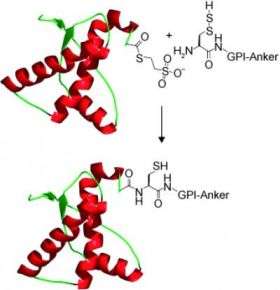
The chemical synthesis of a cysteine-modified glycosylphosphatidylinositol anchor provides access to homogeneous GPI-anchored prion protein through expressed protein ligation. By this method, it should be possible to investigate the influence of the complex post-translational GPI modification on protein structure and function. (C) Wiley-VCH 2008

(PhysOrg.com) -- The cause of diseases such as BSE in cattle and Creutzfeld–Jakob disease in humans is a prion protein. This protein attaches to cell membranes by way of an anchor made of sugar and lipid components (a glycosylphosphatidylinositol, GPI) anchor. The anchoring of the prions seems to have a strong influence on the transformation of the normal form of the protein into its pathogenic form, which causes scrapie and mad cow disease.

A team headed by Christian F. W. Becker at the TU Munich and Peter H. Seeberger at the ETH Zurich has now “recreated” the first GPI-anchored prion in the laboratory. As they report in the journal Angewandte Chemie, they have been able to develop a new general method for the synthesis of anchored proteins.

The isolation of a complete prion protein that includes the anchor has not yet been achieved, nor has it been possible to produce a synthetic GPI-anchored protein. The function of the GPI anchor has thus remained in the dark. A new synthetic technique has now provided an important breakthrough for the German and Swiss team of researchers.

The sugar component of natural prion GPI anchors consists of five sugar building blocks, to which further sugars are attached through branches. Details of the lipid component have not been determined before. As a synthetic target, the researchers thus chose a construct made of the five sugars and one C18-lipid chain and worked out the corresponding synthetic route. First, the anchor was furnished with the sulfur-containing amino acid cysteine.

The prion protein was produced with the use of bacteria and was given an additional thioester (a sulfur-containing group). The centerpiece of the new concept is the linkage of the protein and anchor by means of a native chemical ligation, in which the cysteine group reacts with the thioester. This allowed the prion protein to firmly attach to the vesicle membranes by way of the artificial anchor.

This new concept will allow production of sufficient quantities of proteins modified with GPI anchors for in-depth studies. Experiments with the artificial GPI prion protein should help to clarify the influence of membrane association on conversion of the protein into the pathogenic scrapie form. This should finally make it possible to track down the infectious form of the prion.

Citation: Christian F. W. Becker, Semisynthesis of a Glycosylphosphatidylinositol-Anchored Prion Protein, Angewandte Chemie International Edition 2008, 47, No. 43, 8215–8219, doi: 10.1002/anie.200802161

Provided by Wiley

4.6 /5 (10 votes)  

Filter


Move the slider to adjust rank threshold, so that you can hide some of the comments.


Display comments: newest first

E_L_Earnhardt
Oct 08, 2008

Rank: not rated yet
OH! That we could understand the "protein"!
Rank 4.6 /5 (10 votes)
Relevant PhysicsForums posts

More news stories

Fool's gold may prove an unlikely alternative to overexploited catalytic materials

Catalytic materials, which lower the energy barriers for chemical reactions, are used in everything from the commercial production of chemicals to catalytic converters in car engines. However, with current catalytic materials ...

Chemistry / Materials Science

created 13 hours ago | popularity 4.3 / 5 (7) | comments 5 | with audio podcast

Unpicking HIV’s invisibility cloak

Drug researchers hunting for alternative ways to treat human immunodeficiency virus (HIV) infections may soon have a novel target—its camouflage coat. HIV hides inside a cloak unusually rich in a sugar ...

Chemistry / Biochemistry

created 13 hours ago | popularity 5 / 5 (4) | comments 0

No entry without protein recycling: Researchers discover new coherence in enzyme transport

The group of Prof. Dr. Ralf Erdmann at the Ruhr-Universität Bochum, Germany, discovered a connection of peroxisomal protein import and receptor export. In the Journal of Biological Chemistry, they disclo ...

Chemistry / Biochemistry

created 13 hours ago | popularity not rated yet | comments 0

Hydrogen from acidic water: Researchers develop potential low cost alternative to platinum for splitting water

A technique for creating a new molecule that structurally and chemically replicates the active part of the widely used industrial catalyst molybdenite has been developed by researchers with the Lawrence Berkeley ...

Chemistry / Materials Science

created Feb 09, 2012 | popularity 5 / 5 (12) | comments 13 | with audio podcast

Under the microscope #7

In this video Dr Ingrid Graz shows us a thin layer of gold on top of rubber. Cracks in the gold allow it to stretch and we can use this for stretchable electronics.

Chemistry / Other

created 15 hours ago | popularity not rated yet | comments 0


Anonymous knocks CIA website offline (Update)

The website of the Central Intelligence Agency was inaccessible on Friday after the hacker group Anonymous claimed to have knocked it offline.

Google users warned of threat to smartphone wallets

Users of Google smartphone wallets were being warned on Friday that there is a way to crack pass codes intended to thwart thieves from going on illicit shopping sprees.

New error-correcting codes guarantee the fastest possible rate of data transmission

Error-correcting codes are one of the triumphs of the digital age. They’re a way of encoding information so that it can be transmitted across a communication channel — such as an optical fiber o ...

Humans may have helped the decline of African rainforests 3000 years ago

(PhysOrg.com) -- Large areas of rainforests in Central Africa mysteriously disappeared over three thousand years ago, to be replaced by savannas. The prevailing theory has been that the cause was a change ...

Complex wiring of the nervous system may rely on a just a handful of genes and proteins

Researchers at the Salk Institute have discovered a startling feature of early brain development that helps to explain how complex neuron wiring patterns are programmed using just a handful of critical genes. ...

The power of estrogen -- male snakes attract other males

A new study has shown that boosting the estrogen levels of male garter snakes causes them to secrete the same pheromones that females use to attract suitors, and turned the males into just about the sexiest ...