Stars stop forming when big galaxies collide
October 7th, 2008 Stars stop forming when big galaxies collide

Enlarge

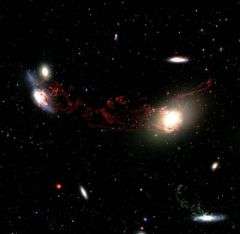
M86-NGC4438 complex: A deep image of part of the Virgo cluster revealing tendrils of ionized hydrogen gas 400,000 light-years long that connect the elliptical galaxy M86 (right) and the disturbed spiral galaxy NGC 4438 (left). Taken with the wide-field Mosaic imager on the National Science Foundation's Mayall 4-meter telescope at Kitt Peak National Observatory. Credit: Tomer Tal and Jeffrey Kenney/Yale University and NOAO/AURA/NSF

Astronomers studying new images of a nearby galaxy cluster have found evidence that high-speed collisions between large elliptical galaxies may prevent new stars from forming, according to a paper to be published in a November 2008 issue of The Astrophysical Journal Letters.

Led by Jeffrey Kenney, professor and chair of astronomy at Yale, the team saw a spectacular complex of warm gas filaments 400,000 light-years-long connecting the elliptical galaxy M86 and the spiral galaxy NGC 4438 in the Virgo galaxy cluster, providing striking evidence for a previously unsuspected high-speed collision between the galaxies. The view was constructed using the wide-field Mosaic imager on the National Science Foundation telescope at Kitt Peak National Observatory near Tucson, Arizona.

"Our data show that this system represents the nearest recent collision between a large elliptical galaxy and a large spiral galaxy," said Kenney, who is lead author of the paper. "This discovery provides some of the clearest evidence yet for high-speed collisions between large galaxies, and it suggests a plausible alternative to black holes as an explanation of what turns off star formation in the biggest galaxies."

Previously, scientists had seen the filaments of gas around both galaxies, but had not seen or inferred any connection between the two galaxies located approximately 50 million light-years from Earth. The new image shows extended and faint emissions that directly connect the two galaxies — and there are no obvious stars in the filaments.

As in most elliptical galaxies, gas within M86 is extremely hot, and radiates X-rays in a long plume, which had previously been interpreted as a tail of gas being stripped as M86 falls into the Virgo cluster. The new image suggests that most of the disturbances in M86 are instead due to the collision with NGC 4438.

"Like with a panoramic camera, the view from the telescope using the wide-field imager at Kitt Peak let us see the bigger picture," said Kenney. "We needed to look deep and wide to see the M86 complex."

A current mystery in astronomy is what causes the biggest galaxies in the universe —primarily elliptical galaxies like M86 — to stop forming stars. "Something needs to heat up the gas so it doesn't cool and form stars," Kenney says. "Our new study shows that gravitational interactions may do the trick."

According to the authors, low-velocity collisions between small- or medium-sized galaxies often produce an increase in the local star formation rate, but in high-velocity collisions that happen naturally between large galaxies, the energy of the collision can cause the gas to heat up so much that it cannot easily cool and form stars.

"The same physical processes occur in both strong and weak encounters, and by studying the observable effects in extreme cases like M86 we can learn about the role of gravity in the heating of galaxy gas, which appears to be quite significant," Kenney adds.

Source: Yale University


print this article email this article download pdf blog this article bookmark this article     Digg this Stumble it share on Facebook share on Reddit add to delicious save to Yahoo! bookmarks
4.7/5 after 13 votes

Rank Filter

Move the slider to adjust rank threshold, so that you can hide some of the comments.


Display comments: newest first

  • NeilFarbstein - Oct 07, 2008
    • Rank: 2 / 5 (1)
    when galaxies collide, stars are aborted and dark matter results. Dark matter is aborted stars. Maybe the problem has been solved. protn7@att.net
  • yyz - Oct 08, 2008
    • Rank: not rated yet
    The 'intergalactic junk' at the bottom right represents gas being tidally stripped from the galaxy NGC 4388 moving through the Virgo Cluster. The paper referencing this result (and M 86 -NGC 4438) can be found at arXiv:0810.0711 by JDP Kenney et al posted on October 3, 2008. By pure happenstance, I was reading a paper by JC Mihos et al published in the Astrophysical Journal Letters Vol. 631, L41-L43, September 20, 2005 entitled 'Diffuse Light in the Virgo Cluster'. Although this paper examined this same region in the Virgo Cluster, the survey looked at continuum light between these galaxies & thus missed the hydrogen alpha emission seen in this current study. Still, this short paper (try googling the Journal reference, its available thru ADS or NED) does show some remarkable, coincidental similarities of this region of the Virgo Cluster. The new paper referenced above addresses both the H-alpha filaments between M 86 & NGC 4438 and the 'green' H-alpha emission seen being stripped away from NGC 4388. Interested readers should check out both papers and compare the images presented in both. Definitely, the Virgo Cluster is an active, dynamic system with various types of intergalactic interactions ongoing simultaneously. The link to the NOAO press release has an 11Mb version of the new M 86-NGC 4438-NGC 4388 image! Awesome!

October 7th, 2008 all stories
Space & Earth / Astronomy

Comments: 2
Rank: 4.7/5 after 13 votes

  • Stumble this up

  • Digg this

  • Share it:
  • share on Facebook
  • share on MySpace
  • share on Slashdot
  • rss-newsfeed
  • share on Google
  • share on Reddit
  • add to delicious
  • save to Yahoo! bookmarks
  • share on Windows Live
  • Add to Mixx!
Rating: 4.7/5 after 13 votes

  • Related Stories

  • Intense heat killed the Universe's would-be galaxies, researchers say
    created Jul 01, 2009 | popularity not rated yet | comments 0
  • Largest ever survey of very distant galaxy clusters completed
    created Jun 30, 2009 | popularity not rated yet | comments 0
  • Galaxies coming of age in cosmic blobs
    created Jun 24, 2009 | popularity not rated yet | comments 0
  • Baby Stars Finally Found in Jumbled Galactic Center
    created Jun 10, 2009 | popularity not rated yet | comments 0
  • Keck Study Sheds New Light on "Dark" Gamma-ray Bursts
    created Jun 08, 2009 | popularity not rated yet | comments 0


  • Physicists Demonstrate Quantum Memory with Matter Qubits
    Physicists Demonstrate Quantum Memory with Matter Qubits
    Physics / General Physics
    created Jul 03, 2009 | popularity 4.4 / 5 (17) | comments 1
  • 'Holey' Nanosheets for Wastewater Dye Removal
    Nanotechnology / Nanomaterials
    created Jul 01, 2009 | popularity 5 / 5 (5) | comments 1
  • Jellyfish Robot Swims Like its Biological Counterpart
    Jellyfish Robot Swims Like its Biological Counterpart
    Electronics / Robotics
    created Jun 26, 2009 | popularity 4.4 / 5 (8) | comments 1
  • Could Maxwell's Demon Exist in Nanoscale Systems?
    Could Maxwell's Demon Exist in Nanoscale Systems?
    Physics / General Physics
    created Jun 24, 2009 | popularity 4.4 / 5 (18) | comments 29
  • Living Safely with Robots, Beyond Asimov's Laws
    Living Safely with Robots, Beyond Asimov's Laws
    Electronics / Robotics
    created Jun 22, 2009 | popularity 4.6 / 5 (53) | comments 40
  • Other News

    Scientists: Silent tremors may foretell next Big One

    Space & Earth / Earth Sciences

    created 59 minutes ago | popularity not rated yet | comments 0

    The seismometer is snugged in its hole and tamped over with dirt. Now it's time for the stomp test.


    California to require sun-blocking car windows

    Space & Earth / Environment

    created 57 minutes ago | popularity not rated yet | comments 0

    New cars sold in California must include windshields that block or absorb the sun's rays beginning in 2012, the state's Air Resources Board recently ruled.


    Steam billows from the cooling towers at a nuclear power generating station in Byron

    Tropical zone expanding due to climate change: study

    Space & Earth / Earth Sciences

    created 3 hours ago | popularity 5 / 5 (2) | comments 0

    Climate change is rapidly expanding the size of the world's tropical zone, threatening to bring disease and drought to heavily populated areas, an Australian study has found.


    The least sea ice in 800 years

    The least sea ice in 800 years

    Space & Earth / Earth Sciences

    created Jul 01, 2009 | popularity 4.1 / 5 (65) | comments 60

    New research, which reconstructs the extent of ice in the sea between Greenland and Svalbard from the 13th century to the present indicates that there has never been so little sea ice as there is now. The ...


    Gas around young galaxy

    Intense heat killed the Universe's would-be galaxies, researchers say

    Space & Earth / Astronomy

    created Jul 01, 2009 | popularity 3.4 / 5 (21) | comments 29

    (PhysOrg.com) -- Our Milky Way galaxy only survived because it was already immersed in a large clump of dark matter which trapped gases inside it, scientists led by Durham University's Institute for Computational ...