MESSENGER Returns Images from Oct. 6 Mercury Fly-By
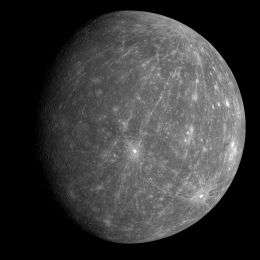
October 7, 2008 MESSENGER Returns Images from Oct. 6 Mercury Fly-By

Enlarge

Credit: NASA/Johns Hopkins University Applied Physics Laboratory/Carnegie Institution of Washington

MESSENGER is the first mission sent to orbit the planet closest to the sun. On Oct. 6, 2008, at roughly 4:40 a.m. ET, MESSENGER flew by Mercury for the second time this year. During the encounter, the probe swung just 125 miles (200 kilometers) above the cratered surface of Mercury, snapping hundreds of pictures and collecting a variety of other data from the planet as it gains a critical gravity assist that keeps the probe on track to become the first spacecraft ever to orbit the innermost planet beginning in March 2011.

At roughly 1:50 a.m. ET on October 7, MESSENGER's most recent images began to be received back on Earth. The spectacular image shown here is one of the first to be returned. It shows Mercury about 90 minutes after the spacecraft’s closest approach.

The bright crater just south of the center of the image is Kuiper, identified on images from the Mariner 10 mission in the 1970s. For most of the terrain east of Kuiper, toward the limb (edge) of the planet, the departing images are the first spacecraft views of that portion of Mercury’s surface. A striking characteristic of this newly imaged area is the large pattern of rays that extend from the northern region of Mercury to regions south of Kuiper.

Provided by NASA


print this article email this article download pdf blog this article bookmark this article     Stumble it Digg this share on Facebook retweet share on Reddit add to delicious
Rate this story - 4.3 /5 (8 votes)


October 7, 2008 all stories

Comments: 0

4.3 /5 (8 votes)
  • Stumble this up

  • Digg this

  • share this

  • hide
  • Related Stories

  • Hidden Territory on Mercury Revealed
    created Nov 04, 2009 | popularity not rated yet | comments 0
  • Fantastic Voyage
    created Nov 02, 2009 | popularity not rated yet | comments 0
  • How the Moon produces its own water
    created Oct 15, 2009 | popularity not rated yet | comments 0
  • MESSENGER Spacecraft Flies by Mercury
    created Sep 30, 2009 | popularity not rated yet | comments 0
  • Space scientists set for final spacecraft flyby of Mercury
    created Sep 28, 2009 | popularity not rated yet | comments 0


  • hide
  • Relevant PhysicsForums posts

  • The shape of our solar system's orbits.
    created Nov 07, 2009
  • Above or Below the Line of Nodes
    created Nov 07, 2009
  • Supernova vs. Nova?
    created Nov 07, 2009
  • Supernova's Gamma Rays and Comets
    created Nov 06, 2009
  • More from Physics Forums - General Astronomy

Other News

NASA satellites see Ida spreading out before landfall

NASA satellites see Ida spreading out before landfall

Space & Earth / Earth Sciences

created 1hour ago | popularity not rated yet | comments 0

NASA's Aqua and Terra satellites are keeping a close eye on Tropical Storm Ida, and both have instruments aboard that show her clouds and rains are already widespread inland over the U.S. Gulf coast states. ...


Australian scientists call for urgent 'global cooling' to save coral reefs

Space & Earth / Environment

created 38 minutes ago | popularity not rated yet | comments 0

(PhysOrg.com) -- Australian marine scientists have issued an urgent call for massive and rapid worldwide cuts in carbon emissions, deep enough to prevent atmospheric CO2 levels rising to 450 parts per million (ppm).


L-R: Chiwetel Ejiofor, Amanda Peet and John Cusack at the premiere of "2012"

NASA on crusade to debunk 2012 apocalypse myths

Space & Earth / Space Exploration

created 5 hours ago | popularity not rated yet | comments 0

The world is not coming to an end on December 21, 2012, the US space agency insisted Monday in a rare campaign to dispel widespread rumors fueled by the Internet and a new Hollywood movie.


Antarctica glacier retreat creates new carbon dioxide store

Antarctica glacier retreat creates new carbon dioxide store

Space & Earth / Earth Sciences

created 10 hours ago | popularity 4.3 / 5 (3) | comments 0

Large blooms of tiny marine plants called phytoplankton are flourishing in areas of open water left exposed by the recent and rapid melting of ice shelves and glaciers around the Antarctic Peninsula. This ...


NASA satellites make a movie and get rainfall, wind info on Ida

NASA satellites make a movie and get rainfall, wind info on Ida (w/ Video)

Space & Earth / Earth Sciences

created 5 hours ago | popularity not rated yet | comments 0

NASA satellites are amazing examples of technology. The TRMM satellite peers into tropical cyclones and can tell how much rain is falling per hour and where. QuikScat uses microwave technology to measure Ida's ...