CoRoT discovery challenges the definition of extra-solar planets
October 7, 2008 CoRoT discovery challenges the definition of extra-solar planets

Enlarge

(PhysOrg.com) -- The CoRoT satellite has discovered a planet-sized object so exotic that astronomers are unsure whether to call it a planet. The object, named CoRoT-Exo-3b, is approximately the same size as Jupiter, but more than 20 times its mass. It orbits a star slightly larger than the Sun every 4 and a quarter days, and passes in front of the star each time. When this occurs CoRoT observes a small dip in the star's brightness, and it is thanks to these 'transits' that the companion was detected.

Leader of the discovery team, Dr. Magali Deleuil from the Laboratoire d'Astrophysique de Marseille (LAM), said, "It was a surprise to find a companion of this mass so close to its host star. CoRoT-Exo-3b is a unique object, and its exact nature is under debate. If it is a planet, CoRoT-Exo-3b would be the most massive and densest found to date - more than twice as dense as lead. Just how such a massive, close companion can form is an open question."

Dr. Hans Deeg, from the Instituto de Astrofisica de Canarias (IAC) commented, "On the other hand it could also be a very low-mass brown dwarf, a ‘failed star’ which never got massive and hot enough to shine like a normal star."

Dr Suzanne Aigrain of the University of Exeter, explains why this new object is such an important find for planet hunters: "There is no clear consensus among scientists where to draw the exact boundary between planets and brown dwarfs. No object has been found before which is so close to this boundary, yet orbits its host star so rapidly. Many astronomers had started to think that such objects did not exist.”

"Of course, it could be a rare object which CoRoT found by sheer luck", comments Dr. Francois Bouchy, another member of the discovery team from Institut d'Astrophysique de Paris (IAP), "but it could also be the first member of a new family of very massive planets which form around stars more massive than our Sun. There seems to be an emerging trend: more massive stars have more massive planets."

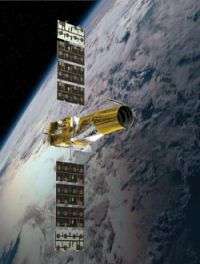
CoRoT (COnvection, ROtation and planetary Transits) is a 27-cm aperture space telescope designed to detect tiny changes in brightness from nearby stars. The instrument has two scientific objectives: the search for planets around other stars than our Sun, and the detection of stellar oscillations to study their interiors (stellar seismology). The CoRoT space mission is a co-operative mission led by the French space agency CNES, with contributions from Austria, Belgium, Germany, Spain, Brazil and the European Space Agency.

This discovery was supported by ground-based observations using a network of facilities operated by different institutes and in different countries: the telescope of Observatoire de Haute Provence (France), the European Southern Observatory telescopes at Paranal and La Silla (Chile), the Thuringia State Observatory in Tautenburg (Germany), the Canada-France-Hawaii Telescope on Mauna Kea, and a series of 1-m class telescopes: the swiss Euler Telescope at La Silla (Chile), the 1m telescope at WISE Observatory (Israel), and the 1m European Space Agency and 80cm Astrophysical Institute of the Canary Islands telescopes on Mt. Teide in Tenerife (Spain).

Provided by University of Exeter


print this article email this article download pdf blog this article bookmark this article     Stumble it Digg this share on Facebook retweet share on Reddit add to delicious
Rate this story - 4.5 /5 (31 votes)

Rank Filter

Move the slider to adjust rank threshold, so that you can hide some of the comments.


Display comments: newest first

  • earls - Oct 07, 2008
    • Rank: 2.3 / 5 (3)
    Two dupes in a couple hours? I think the physorg team needs to have a pow-wow.
  • Valentiinro - Oct 07, 2008
    • Rank: not rated yet
    So what's the deal? It's a planet made of gold and tungsten or something?
    Or is it just a Jupiter-like thing with a whole lot more degenerate matter (like metallic hydrogen) or something? Could the closeness to the sun make it become metallic sooner?

    Is it close enough for tidal forces? Are these forces making it get denser or something?

    Anyone know what it could be?
  • Velanarris - Oct 07, 2008
    • Rank: 5 / 5 (1)
    So what's the deal? It's a planet made of gold and tungsten or something?
    Or is it just a Jupiter-like thing with a whole lot more degenerate matter (like metallic hydrogen) or something? Could the closeness to the sun make it become metallic sooner?

    Is it close enough for tidal forces? Are these forces making it get denser or something?

    Anyone know what it could be?


    Due to proximity and densitity it would have to be made of something fairly deep on the periodic table. Metallic hydrogen is right out, all the extrasolar planets made of gas we've seen that close to a star have been almost marshmellow in density due to heat.

    Whatever it is, it's certainly interesting.
  • googleplex - Oct 07, 2008
    • Rank: not rated yet
    It sounds to me like a dwarf star of some kind. I recall that if Jupiters mass were to increase slightly it would become a star. The density is very unusual for a planet and sounds more like a burnt out star. The nuclear burning of H and He eventually transform into the most stable nuclei of the periodic table (e.g. Fe and other metal isotopes).
    The name of the satellite telescope is rather boring. Have they ran out of Greek gods and other ideas?
  • Valentiinro - Oct 07, 2008
    • Rank: not rated yet
    A dwarf star with a density higher than lead?
    Stars tend to be made of hydrogen, which tends to be less dense than lead.

    And a neutron star or something would be too dense. It's not so degenerate as that.
  • earls - Oct 07, 2008
    • Rank: not rated yet
    this has a lot more to do with "is it a failed star or a planet." this is the beginning of a paradigm shift of understanding.
  • Modernmystic - Oct 08, 2008
    • Rank: 5 / 5 (1)
    I'm beginning to think we might have as may classifications for bodies in a solar system as we have federal regulations before it's all over.

    Basically I think if it's possible we'll eventually find it. Perhaps beyond that we will probably find a few things we thought were impossible.

    In any case it's looking more and more like there is no such thing as a "typical" solar system, rather there are many differen't types or classifications of them.

October 7, 2008 all stories

Comments: 7

4.5 /5 (31 votes)
  • Stumble this up

  • Digg this

  • share this

  • hide
  • Related Stories

  • COROT discovery stirs exoplanet classification rethink
    created Oct 07, 2008 | popularity not rated yet | comments 0
  • In a Galaxy Far, Far Away...
    created Nov 06, 2009 | popularity not rated yet | comments 0
  • Solar power generation around the clock
    created Nov 05, 2009 | popularity not rated yet | comments 0
  • Measuring distances in microseconds
    created Nov 05, 2009 | popularity not rated yet | comments 0
  • Research sheds new light on neutron stars (w/ Video)
    created Nov 02, 2009 | popularity not rated yet | comments 0


  • hide
  • Relevant PhysicsForums posts

  • The shape of our solar system's orbits.
    created 18 hours ago
  • Above or Below the Line of Nodes
    created 23 hours ago
  • Supernova vs. Nova?
    created Nov 07, 2009
  • Supernova's Gamma Rays and Comets
    created Nov 06, 2009
  • More from Physics Forums - General Astronomy

Other News

Deep creep means milder, more frequent earthquakes along Southern California's San Jacinto fault

Deep creep means milder, more frequent earthquakes along Southern California's San Jacinto fault

Space & Earth / Earth Sciences

created 4 hours ago | popularity 4.7 / 5 (3) | comments 0

With an average of four mini-earthquakes per day, Southern California's San Jacinto fault constantly adjusts to make it a less likely candidate for a major earthquake than its quiet neighbor to the east, the ...


Success in 'space elevator' competition (AP)

Success in 'space elevator' competition (Update 3)

Space & Earth / Space Exploration

created Nov 05, 2009 | popularity 4.3 / 5 (33) | comments 50

(AP) -- A robot powered by a ground-based laser beam climbed a long cable dangling from a helicopter on Wednesday to qualify for prize money in a $2 million competition to test the potential reality of the ...


'Dropouts' pinpoint earliest galaxies

'Dropouts' pinpoint earliest galaxies

Space & Earth / Astronomy

created Nov 06, 2009 | popularity 4.2 / 5 (10) | comments 12

Astronomers, conducting the broadest survey to date of galaxies from about 800 million years after the Big Bang, have found 22 early galaxies and confirmed the age of one by its characteristic hydrogen signature ...


Space hotel taking bookings for 2012 opening

Space hotel taking bookings for 2012 opening

Space & Earth / Space Exploration

created Nov 05, 2009 | popularity 4.4 / 5 (20) | comments 11

(PhysOrg.com) -- The first orbiting space hotel is on track to open for its first customers in 2012, but hurry, as bookings are filling fast.


In a Galaxy Far, Far Away...

In a Galaxy Far, Far Away...

Space & Earth / Astronomy

created Nov 06, 2009 | popularity 4.8 / 5 (4) | comments 12

(PhysOrg.com) -- Astronomers have published the discovery of the farthest known object in the cosmos: a star that exploded when the universe was only 630 million years old -- only 4.6% of its current age. ...