Ultrananocrystalline-diamond coating improves mechanical pump seals
October 7, 2008 By Rachel Lichtenfeld
Ultrananocrystalline-diamond coating improves mechanical pump seals

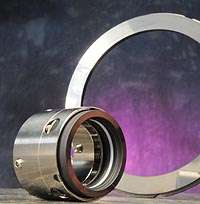
These ultrananocrystalline diamond-coated pump seals garnered one of Argonne's two 2008 R&D 100 awards, which recognize the most important inventions in the previous year. Photo by George Joch.

(PhysOrg.com) -- From petroleum to food and beverage to pharmaceuticals, most industries use mechanical pumps, and all these pumps rely on seals to reduce leaks and maintenance costs. Argonne researchers, along with industry partners, have developed a new, efficient and cost-effective alternative to conventional seals.

The surfaces of these Ultrananocrystalline-Diamond (UNCD) Mechanical Seals are specially treated with a continuous film of tiny diamonds. This diamond coating improves the pumps' reliability, durability and ability to prevent fluids from escaping into the environment. UNCD is an engineered nanomaterial invented at Argonne. It consists of diamond grains two to five nanometers in diameter.

For their work on the innovative mechanical pump seals, Argonne scientists and their industrial partners received an R&D 100 award this summer. The award is Argonne's 101st since the R&D 100s were introduced by R&D magazine in 1964. Dubbed the "Oscars of innovation" by the Chicago Tribune, the award indicates that a product represents one of the most innovative inventions of the year, according to R&D magazine.

Scientists have known about the advantages of diamond-based products for a long time, but diamonds are generally difficult to synthesize as small films and are even harder to integrate with other materials. To make a difference in manufacturing, any new mechanical pump seals would have to be priced to compete with the less-efficient silicon-carbide seals they would replace.

“I think that's a big part of what makes this such a huge breakthrough,” said John Hryn, principal process development engineer at Argonne. “We not only managed to integrate UNCD with the pump seal, but we also made it in a way where it could be manufactured at a large production facility and would be cost-effective for those who would want to use it.”

Argonne developed the UNCD thin film production technology in 2002 with partner iplas GmbH, near Cologne, Germany. This technology won an R&D 100 Award in 2003. UNCD marked the first-ever affordable diamond film suitable for mass production of a wide range of diamond-based microelectromechanical systems, nanoelectromechanical system devices, biodevices, biosensors and microelectronic circuits. Adjustments in the original production process made UNCD cost-effective for mechanical seals.

The UNCD Mechanical Seals were jointly developed by a team from Argonne, Advanced Diamond Technologies, Inc., (ADT), Romeoville, Ill., and John Crane Inc., Morton Grove, Ill. The Argonne team included John Hryn, lead development engineer, Gregory Krumdick, engineer, Jeffrey Elam, chemist, and Joseph Libera, engineer and post-doctoral appointee. The ADT contributors included Charles West, vice president of engineering, James Netzel, director of seals engineering, and John Carlisle, chief technical officer, and Orlando Auciello, ADT technical consultant and Argonne senior physicist. The John Crane team included Douglas Volden, new products director, Joe Haas, vice president of engineering, and Rick Page, vice president of marketing.

The Industrial Technologies Program of the U.S. Department of Energy's Office of Energy Efficiency and Renewable Energy provided funding for the development of the UNCD Mechanical Seals. The Industrial Technologies Program works with U.S. industry to improve industrial energy efficiency and environmental performance. The program invests in high-risk, high-value R&D to reduce industrial energy use while stimulating productivity and growth.

ADT, an Argonne spin-off company, has developed a commercial manufacturing platform for making UNCD Seals in volume with exceptional reproducibility and quality. John Crane, the world's largest manufacturer of seals and associated products, performed exhaustive tests to show that the UNCD-enhanced seals significantly reduce friction, which improves their performance compared to seals made with conventional materials.

Provided by Argonne National Laboratory

4.7 /5 (6 votes)  

Rank 4.7 /5 (6 votes)
Relevant PhysicsForums posts
  • polymer nanocomposites
    createdFeb 10, 2012
  • Corrosion Tests on Magnesium
    createdFeb 09, 2012
  • polyethylene copper nanocomposite
    createdFeb 09, 2012
  • Output of xrd analysis
    createdFeb 08, 2012
  • Transport phenomena problem based on problems 18.B11 and 19B.6 from Bird, stewart, lw
    createdFeb 06, 2012
  • Help with material selection - Car Piston
    createdFeb 05, 2012
  • More from Physics Forums - Materials & Chemical Engineering

More news stories

New kind of solar cell could capture significantly more energy than current cells

New solar cells could increase the maximum efficiency of solar panels by over 25%, according to scientists from the University of Cambridge.

Nanotechnology / Nanophysics

created Feb 08, 2012 | popularity 4.5 / 5 (12) | comments 14 | with audio podcast

Nanoshell whispering galleries improve thin solar panels

Visitors to Statuary Hall in the U.S. Capitol Building may have experienced a curious acoustic feature that allows a person to whisper softly at one side of the cavernous, half-domed room and for another on ...

Nanotechnology / Nanomaterials

created Feb 07, 2012 | popularity 4.3 / 5 (6) | comments 6 | with audio podcast

'Dark plasmons' transmit energy

Microscopic channels of gold nanoparticles have the ability to transmit electromagnetic energy that starts as light and propagates via "dark plasmons," according to researchers at Rice University.

Nanotechnology / Nanophysics

created Feb 09, 2012 | popularity 4.8 / 5 (9) | comments 1 | with audio podcast

Revealing how a battery material works

Since its discovery 15 years ago, lithium iron phosphate (LiFePO4) has become one of the most promising materials for rechargeable batteries because of its stability, durability, safety and ability to deliver ...

Nanotechnology / Nanomaterials

created Feb 08, 2012 | popularity 5 / 5 (5) | comments 0 | with audio podcast

Harnessing plasmonics, engineers weld nanowires with light

At the nano level, researchers at Stanford have discovered a new way to weld together meshes of tiny wires. Their work could lead to exciting new electronics and solar applications. To succeed, they called ...

Nanotechnology / Nanophysics

created Feb 06, 2012 | popularity 4.8 / 5 (11) | comments 1 | with audio podcast


Google might launch Drive for cloud storage soon

(PhysOrg.com) -- Google's next big move, according to the Wall Street Journal, is a cloud storage service called Drive. Hardly first to the plate, Google is simply catching up to introducing its cloud reposi ...

Latin America mining boom clashes with conservation

Latin America is experiencing a mining boom as prices rise fuelled by a hike in global demand, but the region is also being hit by a wave of violent protests, strikes and rallies by environmentalists.

Walney offshore wind farm is world's biggest (for now)

(PhysOrg.com) -- The Walney wind farm on the Irish Sea--characterized by high tides, waves and windy weather--officially opened this week. The farm is treated in the press as a very big deal as the Walney ...

Love a click away in Indonesia's Twitter Republic

He was a geeky kid from Yogyakarta, she a glamorous city girl in Jakarta. In a country with one of the world's most vibrant social networking scenes they fell in love on Twitter.

GPS court ruling leaves US phone tracking unclear

A US Supreme Court decision requiring a warrant to place a GPS device on the car of a criminal suspect leaves unresolved the bigger issue of police tracking using mobile phones, legal experts say.

Europeans protest controversial Internet pact

Tens of thousands of people marched in protests in more than a dozen European cities Saturday against a controversial anti-online piracy pact that critics say could curtail Internet freedom.