Protein shown to play a key role in normal development of nervous system
October 7, 2008 Dendrite Development

Enlarge

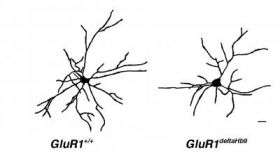
Dendrites have fewer branches in the neuron of a mouse in which the GluR1 gene is knocked out (right), compared to a neuron in a control mouse. Credit: The Children's Hospital of Philadelphia

A protein that enables nerve cells to communicate with each other plays a key role in controlling the developing nervous system. Research into how that protein helps precise connections to form among nerve cells may provide a basis for eventual treatments for patients who suffer injuries to their nervous system, including spinal cord injury.

"This expands our basic knowledge of how the nervous system develops in animals and humans," said study leader Robert Kalb, M.D., a neurologist at The Children's Hospital of Philadelphia. Kalb and colleagues published two studies in the Journal of Neuroscience.

The first study, published Oct. 1, showed that the protein GluR1, which is a receptor for the neurotransmitter glutamate, promotes the growth of dendrites, both in nerve cell cultures and in the nervous system of mice. Dendrites are branching extensions of nerve cells that carry signals into the cell. The most vigorous dendrite growth occurs shortly after birth, when GluR1 is present on the surface of the cell. As neurons mature, GluR1 is lost from the cell surface of some neurons, and dendrites stop growing.

Kalb and colleagues showed that suppressing GluR1 activity reduced dendrite growth, and led to poor development of connections between neurons. As a result of these defects, mice displayed less strength and less endurance on treadmill tests. On the other hand, using genetic manipulation that led to cell surface expression of GluR1 protein in adult mice led to supernormal motor performance, as shown by longer duration on treadmills.

"Our observations could be relevant to helping patients recover motor function after they suffer an injury to the spinal cord or other parts of the nervous system," said Kalb. "Often neural circuits remain intact after an injury, and are capable of reorganizing themselves, given the proper stimulation. If we can eventually manipulate this protein's activity in neurons, we might enhance communication among those neurons, and allow patients to receiver greater benefit from therapeutic exercises."

The second study by Kalb and colleagues, published Oct. 8, described the molecular pathways by which GluR1 binds with another protein, SAP97, to control dendrite growth during the early postnatal period. "Our work suggests that GluR1 brings the scaffolding protein SAP97 to the membrane of nerve cells, where it can receive pro-growth signals to build dendrites."

Although both studies were performed in mice, the neurodevelopmental process is considered to be similar for all mammals. "The first few weeks of postnatal life are a critical period for sculpting the architecture of the nervous system," added Kalb. "Greater understanding of how neural architecture develops normally may give us insight into how to intervene when things go wrong."

Source: Children's Hospital of Philadelphia


print this article email this article download pdf blog this article bookmark this article     Stumble it Digg this share on Facebook retweet share on Reddit add to delicious
Rate this story - 1 /5 (1 vote)


October 7, 2008 all stories

Comments: 0

1 /5 (1 vote)
  • Stumble this up

  • Digg this

  • share this

  • hide
  • Related Stories

  • Cocaine: How addiction develops
    created Aug 21, 2008 | popularity not rated yet | comments 0
  • Nerve-cell transplants help brain-damaged rats fully recover lost ability to learn
    created Dec 09, 2009 | popularity not rated yet | comments 0
  • Researchers identify new stem cell
    created Dec 07, 2009 | popularity not rated yet | comments 0
  • Researchers identify gene that spurs deadly brain cancer
    created Dec 03, 2009 | popularity not rated yet | comments 0
  • Green tea chemical combined with another may hold promise for treatment of brain disorders
    created Dec 03, 2009 | popularity not rated yet | comments 0


  • hide
  • Relevant PhysicsForums posts

  • Inflamed trapezius muscle
    created Dec 11, 2009
  • Nociceptors
    created Dec 05, 2009
  • Nanomaterials destroy cancer!
    created Nov 30, 2009
  • Nuclear Medicine
    created Nov 30, 2009
  • More from Physics Forums - Medical Sciences

Other News

Immune cell activity linked to worsening COPD

Medicine & Health / Diseases

created 49 minutes ago | popularity not rated yet | comments 0

A new study links chronic obstructive pulmonary disease, or COPD, with increased activity of cells that act as sentinels to activate the body's immune system.


Kids' Swine flu shots recalled; not strong enough

Medicine & Health / Medications

created 37 minutes ago | popularity not rated yet | comments 0

(AP) -- Hundreds of thousands of swine flu shots for children have been recalled because tests indicate the vaccine doses lost some strength, government health officials said Tuesday.


For older adults, participating in social service activities can improve brain functions

Medicine & Health / Health

created 52 minutes ago | popularity not rated yet | comments 0

Volunteer service, such as tutoring children, can help older adults delay or reverse declining brain function, according to a study led by researchers at the Johns Hopkins Bloomberg School of Public Health. Using functional ...


Sleep and Cancer: Uncomfortable Bedfellows

Medicine & Health / Cancer

created 25 minutes ago | popularity not rated yet | comments 0

(PhysOrg.com) -- Newly-diagnosed cancer patients face a number of life-long challenges, but a new study from the Duke Clinical Research Institute suggests that a lack of sleep may be one of the most persistent and disruptive. ...


Mastery of physical goals lessens disease-related depression and fatigue

Mastery of physical goals lessens disease-related depression and fatigue

Medicine & Health / Psychology & Psychiatry

created 52 minutes ago | popularity not rated yet | comments 0

Physical activity is known to reduce depression and fatigue in people struggling with chronic illness. A new study indicates that this effect stems from an individual's sense of mastery over - or belief in ...