Preserved by ice: Glacial dams helped prevent erosion of Tibetan plateau
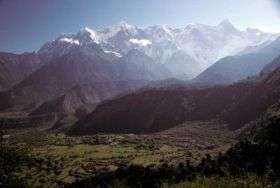
The Tsangpo River is the highest major river in the world, starting at 14,500 feet elevation and plunging to the Bay of Bengal, scouring huge amounts of rock and soil along the way. Yet in its upper reaches, the powerful Tsangpo seems to have had little effect on the elevation of the Tibetan Plateau.
New research suggests that the plateau edge might have been preserved for thousands of years by ice during glacial advances and by glacial debris deposited at the mouth of many Tsangpo tributaries during warmer times when glaciers retreated. Those debris walls, or moraines, acted as dams that prevented the rapidly traveling water in the main Tsangpo gorge from carving upstream into the plateau.
"At the edge of the plateau, the river's erosion has been defeated because the dams have flattened the river's slope and reduced its ability to cut into the surrounding terrain, making it more like a lake," said David Montgomery, a University of Washington geomorphologist.
Montgomery is co-author of a paper in the Oct. 9 issue of Nature that describes a new hypothesis of why the Tibetan Plateau has maintained its elevation when it appears it should have been worn down in the area of the Tsangpo system.
The paper's lead author is Oliver Korup of the Swiss Federal Institute for Snow and Avalanche Research in Davos, Switzerland. The work was financed in part by the European Commission and the National Science Foundation in the U.S.
The researchers focused on the three primary rivers of the Tsangpo system, the Yarlung Tsangpo and its two major tributaries, the Yigong Tsangpo and the Parlung Tsangpo. The scientists mapped geologic evidence of more than 300 natural dams, including 260 moraines, that have formed repeatedly at the mouths of tributaries in the last 10,000 years to block water flow on the three main streams.
The first evidence of the dams was found at the edge of the Tibetan Plateau, and additional evidence continued to be found upstream, Montgomery said. The dams essentially formed giant lakes along the river and prevented the water from carving into bedrock.
"The glaciers seem to have helped preserve the edge of the plateau by keeping the river from ripping into it," he said. "This isn't the explanation for why the rest of the plateau is so well preserved, but it might work for this area where the Tsangpo crosses the edge of the plateau."
There are two well-recognized mechanisms that typically are thought to be responsible for preserving a feature such as the edge of the Tibetan Plateau. But one of them, the plateau's arid climate, is not to blame because the Tsangpo is already a large river at the point that it enters the world's deepest and fastest-eroding gorge. The other conventional explanation, that tectonic faults continually push new rock to the surface and thus offset any erosion by the river, might be at work in concert with the glacial damming, the scientists believe.
In the Tsangpo gorge, also called Yarlung Tsangpo Grand Canyon, the river plunges from about 10,000 feet to about 1,000 feet in a span of 150 miles. Eventually the river becomes the Brahmaputra River, flowing through India and Bangladesh and into the Bay of Bengal.
"Up in the gorge, the river is very steep and the erosion is very high, and one would think that back through geologic time it should have sliced upstream into the Tibetan Plateau," Montgomery said.
The question is why that didn't happen. Korup and Montgomery suspect that the glacial dams on tributaries right to the edge of the plateau prevented such pronounced erosion.
"It's a transition from where the river is doing all the erosion at lower elevations to where the glaciers are doing all the erosion at high elevations, and the glaciers are limited on how deeply they erode," Montgomery said. "They shave off the top but they don't erode farther down, and the rivers can't erode back past the glaciers."
Source: University of Washington


