Cosmic eye sheds light on early galaxy formation
October 8th, 2008 Cosmic Eye

Enlarge

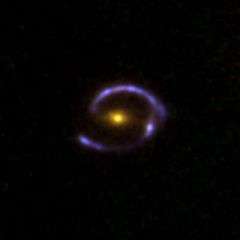
The Cosmic Eye, showing the foreground galaxy in yellow at the centre of the image surrounded by the blue arc of the distant galaxy. Credit: Mark Swinbank/Durham University

A Cosmic Eye has given scientists a unique insight into galaxy formation in the very early Universe. Using gravity from a foreground galaxy as a zoom lens the team was able to see a young star-forming galaxy in the distant Universe as it appeared only two billion years after the Big Bang.

Scientists at the California Institute of Technology (Caltech), USA, and Durham University and Cardiff University, UK, are behind the research published today in the prestigious scientific journal Nature.

The researchers, led by Dr Dan Stark, of Caltech, say their findings show for the first time how the distant galaxy might evolve to become a present-day system like our Milky Way.

And they say their study also provides a taste of what astronomers will be able to see in the distant Universe once projects such as the planned European Extremely Large Telescope (E-ELT) and the American Thirty Metre Telescope (TMT) come into use.

The Cosmic Eye is so called because the foreground galaxy, which is 2.2 billion light years from Earth, appears in the centre of an arc created by the distant galaxy – giving it the appearance of a human eye.

The distant galaxy, which lies 11 billion light years from Earth, was originally identified using the Hubble Space Telescope.

The team then used the ten metre Keck telescope, on Hawaii, which is equipped with laser-assisted guide star adaptive optics (AO) to correct for blurring in the Earth's atmosphere, to carry out their observations.

By coupling the telescope with the magnifying effect of the gravitational field of the foreground galaxy – a technique called gravitational lensing - they were able to study the distant star system.

Gravitational lensing, the distortion of light rays by massive objects as predicted by Einstein, enlarged the distant galaxy by eight times.

This allowed the scientists to determine the galaxy's internal velocity structure and compare it to later star systems such as the Milky Way.

Research co-author Dr Mark Swinbank, in The Institute for Computational Cosmology, at Durham University, said: "This is the most detailed study there has been of an early galaxy. Effectively we are looking back in time to when the Universe was in its very early stages.

"This technique of using gravitational lensing provides us with a glimpse of what we will commonly achieve when the next generation of telescopes, which are still a decade away, come on-line."

Dr Dan Stark, of Caltech, said: "Gravity has effectively provided us with an additional zoom lens, enabling us to study this distant galaxy on scales approaching only a few hundred light years.

"This is ten times finer sampling than previously. As a result for the first time we can see that a typical-sized young galaxy is spinning and slowly evolving into a spiral galaxy much like our own Milky Way."

Data from the Keck Observatory was combined with millimetre observations from the Plateau de Bure Interferometer, in the French Alps, which is sensitive to the distribution of cold gas destined to collapse to form stars.

Dr Swinbank added: "Remarkably the cold gas traced by our millimetre observations shares the rotation shown by the young stars in the Keck observations.

"The distribution of gas seen with our amazing resolution indicates we are witnessing the gradual build up of a spiral disk with a central nuclear component."

Source: Durham University


print this article email this article download pdf blog this article bookmark this article     Digg this Stumble it share on Facebook share on Reddit add to delicious save to Yahoo! bookmarks
4.4/5 after 17 votes

Rank Filter

Move the slider to adjust rank threshold, so that you can hide some of the comments.


Display comments: newest first

  • thales - Oct 08, 2008
    • Rank: 4 / 5 (1)
    Wait till they figure out that's a picture of our actual Milky Way! Wouldn't that be awesome. Seriously though, this is a very exciting preview of what those future telescopes will be able to do.
  • nano999 - Oct 08, 2008
    • Rank: not rated yet

  • yyz - Oct 08, 2008
    • Rank: 5 / 5 (1)
    A short , discovery paper on this weird system (aka LBG J213512.73-010143 , a Lyman Break Galaxy with a redshift of 3.07) was posted at arXiv:astro-ph/0611486 for Nov 15, 2006. It includes HST images & Keck spectra to help determine the physical characteristics of both the lensing galaxy (at a redshift of 0.73) & the magnified image of the LBG. Lensed systems such as this one can give astronomers valuable information on distant, forming galactic systems that would otherwise prove too faint to accurately examine due to their great distance. Websites such as the Strong Lenses COSMOS Page at http://cosmosstro...i-hd.de/ provide current images & info on these rare and unusual gravitational lenses and are frequently updated with current info & newly discovered objects. These systems not only provide good sources of information on chemical abundances, star formation rates and other physical characteristics of the lensed galaxies, but can also provide info on Dark Matter distribution in the lensing galaxies themselves. These systems are sure to be examined in detail across the entire electromagnetic spectrum in the coming years.A related search for lensed quasars, the SDSS Quasar Lens Search( SQLS ) can be found at http://www-utap.p...dex.html . Similar to the Strong Lenses COSMOS Page, current images & info on lensed quasars can be found here and the site is updated periodically with links to new images, info & newly discovered systems of this type. Both sites are highly recommended for those interested in gravitationally lensed systems and current research being performed on them
  • brant - Oct 08, 2008
    • Rank: 1 / 5 (1)
    That is one system, not a lensed system.
    They must base that on redshift!!
  • bobwinners - Oct 13, 2008
    • Rank: 1 / 5 (1)
    Ok, I'd really like it if these people stopped referencing the 'beginning' of the universe and instead related their findings to current time/space. You know, like "13.5 B years ago". We really don't know how old the universe is or even if it has an age.
  • yyz - Oct 13, 2008
    • Rank: not rated yet
    @bobwinners, I see no mention of 'the beginning of the universe' or '13.5 B years ago' in the article above. Distances mentioned in the article are referenced to distance from Earth, based on their redshift. I think you missed the main point here, that these highly magnified distant galaxies can be probed & measured much more precisely due to the fact that they are gravitationally lensed. Unlensed galaxies or protogalaxies 11 billion l.y. from Earth would make hi-res spectra, color determinations, star-formation rates, etc. impossible due to faint their apparent magnitudes. If you have issues with the age or origin of the universe, this study does not address these issues. Carefully reread the article for what it actually states.
  • yyz - Oct 15, 2008
    • Rank: not rated yet
    I neglected to mention another galaxy lensing site updated regularly and containing many images of gravity lenses. The Cambridge And Sloan Survey of Wide Arcs in the skY( CASSOWARY ) can be found at http://www.ast.ca...sowary/. 23 objects are currently listed, some with spectra and followup information links. Quite an impressive collection.

October 8th, 2008 all stories
Space & Earth / Astronomy

Comments: 7
Rank: 4.4/5 after 17 votes

  • Stumble this up

  • Digg this

  • Share it:
  • share on Facebook
  • share on MySpace
  • share on Slashdot
  • rss-newsfeed
  • share on Google
  • share on Reddit
  • add to delicious
  • save to Yahoo! bookmarks
  • share on Windows Live
  • Add to Mixx!
Rating: 4.4/5 after 17 votes


  • Physicists Demonstrate Quantum Memory with Matter Qubits
    Physicists Demonstrate Quantum Memory with Matter Qubits
    Physics / General Physics
    created Jul 03, 2009 | popularity 4.4 / 5 (17) | comments 1
  • 'Holey' Nanosheets for Wastewater Dye Removal
    Nanotechnology / Nanomaterials
    created Jul 01, 2009 | popularity 5 / 5 (5) | comments 1
  • Jellyfish Robot Swims Like its Biological Counterpart
    Jellyfish Robot Swims Like its Biological Counterpart
    Electronics / Robotics
    created Jun 26, 2009 | popularity 4.4 / 5 (8) | comments 1
  • Could Maxwell's Demon Exist in Nanoscale Systems?
    Could Maxwell's Demon Exist in Nanoscale Systems?
    Physics / General Physics
    created Jun 24, 2009 | popularity 4.4 / 5 (18) | comments 29
  • Living Safely with Robots, Beyond Asimov's Laws
    Living Safely with Robots, Beyond Asimov's Laws
    Electronics / Robotics
    created Jun 22, 2009 | popularity 4.6 / 5 (52) | comments 40
  • Other News

    Scientists: Silent tremors may foretell next Big One

    Space & Earth / Earth Sciences

    created 13 minutes ago | popularity not rated yet | comments 0

    The seismometer is snugged in its hole and tamped over with dirt. Now it's time for the stomp test.


    California to require sun-blocking car windows

    Space & Earth / Environment

    created 12 minutes ago | popularity not rated yet | comments 0

    New cars sold in California must include windshields that block or absorb the sun's rays beginning in 2012, the state's Air Resources Board recently ruled.


    Steam billows from the cooling towers at a nuclear power generating station in Byron

    Tropical zone expanding due to climate change: study

    Space & Earth / Earth Sciences

    created 2 hours ago | popularity 5 / 5 (2) | comments 0

    Climate change is rapidly expanding the size of the world's tropical zone, threatening to bring disease and drought to heavily populated areas, an Australian study has found.


    US ambitions to send astronauts back to the moon as a prelude to missions to Mars have been put in doubt

    Forty years ago man first walked on the moon

    Space & Earth / Space Exploration

    created 23 hours ago | popularity 4.4 / 5 (5) | comments 2

    Forty years ago on July 20, 1969, American astronaut Neil Armstrong realized the oldest dream of human civilizations when he became the first man to walk on the moon.


    The least sea ice in 800 years

    The least sea ice in 800 years

    Space & Earth / Earth Sciences

    created Jul 01, 2009 | popularity 4.1 / 5 (65) | comments 60

    New research, which reconstructs the extent of ice in the sea between Greenland and Svalbard from the 13th century to the present indicates that there has never been so little sea ice as there is now. The ...