CarTel uses WiFi to personalize commutes
October 8, 2008 By Elizabeth A. Thomson
CarTel uses WiFi to personalize commutes

Enlarge

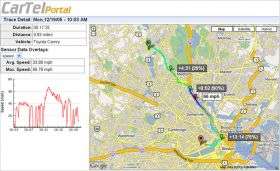
The CarTel web portal, showing a trip taken by one driver and accompanying data. Photo courtesy / Balakrishnan/Madden Labs

(PhysOrg.com) -- Dozens of cars in the Boston area are testing the latest generation of an MIT mobile-sensor network for traffic analysis that could help drivers cut their commuting time, alert them to potential engine problems and more.

In the CarTel project, Professor Hari Balakrishnan and Associate Professor Samuel Madden of MIT's Department of Electrical Engineering and Computer Science use automobiles to monitor their environment by sending data from an onboard computer -- which is about the size of a cell phone -- to a web server where the data can be visualized and browsed. They do so via pre-existing WiFi networks passed during a trip.

The resulting data, accessible from the web or a cell phone, not only helps a driver track conditions specific to their own car, but when combined with everyone else's can indicate historical and real-time traffic conditions at different times of the day. "Everybody's data is contributing to collective views of what congestion looks like," Madden said.

"Our goal," Balakrishnan said, "is to make the data behind CarTel available to help you plan and organize your commute and drives. We want to minimize the amount of time spent in your car."

For example, the current system, deployed since January on 50 Boston-area cars -- including 40 taxis -- tracks traffic by monitoring each vehicle's speed at different points during a trip. Unlike other route-planning systems, "CarTel understands where traffic delays are and recommends routes to avoid them," Madden said.

The system has already cut Balakrishnan's commute to MIT by 25 percent. It recommended a new route that, although a few miles longer than the approach suggested by some mapping web sites, is considerably faster in practice.

CarTel is also linked to a vehicle's onboard diagnostics system (available in all cars sold since 1996), so a driver can check various parameters key to maintenance and be alerted to potential problems.

There are two principal research efforts behind the system. First, Balakrishnan, Madden and Jacob Eriksson (now at the University of Illinois, Chicago) developed a way to connect to WiFi networks that is 35 times faster than other systems. "It can take about 15 seconds to connect using a regular system, so in a car you are already past the WiFi location by the time you get the signal," Madden explained. QuickWiFi can connect in 360 milliseconds. "It's the difference between whether you can use WiFi with a car or not."

The majority of the work, however, is focused on managing the huge amounts of data key to the system. Depending on the sensors in use, CarTel can receive more than 600 data points a second. So the team has developed two generations of software "to synthesize all that data into interesting uses," Madden said.

One such use is new algorithms for traffic-aware routing, or obtaining directions between two locations that take historical and current traffic conditions into account. Balakrishnan and Madden have developed these algorithms with graduate student Sejoon Lim and Professor Daniela Rus, both of the Department of Electrical Engineering and Computer Science.

"CarTel makes it easy to collect, process, deliver and visualize data from a collection of remote, mobile and intermittently connected nodes," the researchers concluded in one of several technical articles and conference presentations on the work. Most recently, they described the research at the Association for Computing Machinery's Conference on Mobile Computing and Networking (MobiCom) in September 2008.

This work is funded by the National Science Foundation and the T-Party Project, a joint research program between MIT and Quanta Computer Inc.

Project: http://cartel.csail.mit.edu/

Provided by MIT

3.8 /5 (5 votes)  

Rank 3.8 /5 (5 votes)
Tags

Relevant PhysicsForums posts
  • feed hold button on CNC lathe
    created11 hours ago
  • Mechanics of Solids ( Final exam question) plz help!
    created13 hours ago
  • RFAC in Fortran
    created15 hours ago
  • dynamics 2/32
    created21 hours ago
  • dynamics
    created21 hours ago
  • Vibration Absorbtion Problem
    createdFeb 08, 2012
  • More from Physics Forums - General Engineering

More news stories

New integrated building model may improve fish farming operations

Today's "locavore" movement with its emphasis on eating more locally-produced food is a natural fit for fruits and vegetables in nearly every region, but few entrepreneurs have dared to apply the concept to ...

Technology / Engineering

created 7 minutes ago | popularity not rated yet | comments 0

Soraa LED light may dim 50-watt halogen rivals

(PhysOrg.com) -- Soraa, a Fremont, California company founded in 2008, this week launched its first product, a light that uses LEDS (light emitting diodes). The "Soraa LED MR16 lamp" is the "perfect" replacement ...

Technology / Semiconductors

created 11 hours ago | popularity 4.6 / 5 (13) | comments 8 | with audio podcast report

Model analyzes shape-memory alloys for use in earthquake-resistant structures

Recent earthquake damage has exposed the vulnerability of existing structures to strong ground movement. At the Georgia Institute of Technology, researchers are analyzing shape-memory alloys for their potential ...

Technology / Engineering

created 6 hours ago | popularity not rated yet | comments 0 | with audio podcast

Google launches Chrome browser for Android smartphones

With more and more people connecting to the Internet through a phone or a tablet instead of a PC, Google Inc. is bringing its fast-growing browser, Chrome, to the newest Android-powered mobile devices.

Technology / Software

created 8 hours ago | popularity 5 / 5 (4) | comments 0

Samsung can continue selling Galaxy tabs in Germany: court

South Korea's Samsung Electronics can continue to sell its Galaxy Tab 10.1N tablet computer in Germany, a German court ruled Thursday, rejecting a bid by arch-rival Apple to have them banned.

Technology / Business

created 9 hours ago | popularity 5 / 5 (2) | comments 2


'Dark plasmons' transmit energy

Microscopic channels of gold nanoparticles have the ability to transmit electromagnetic energy that starts as light and propagates via "dark plasmons," according to researchers at Rice University.

Decoding the molecular machine behind E. coli and cholera

Scientists from Queen Mary, University of London have discovered the workings behind some of the bacteria that kill hundreds of thousands every year, possibly paving the way for new antibiotics that could treat infections ...

Deadly bird parasite evolves at exceptionally fast rate

A new study of a devastating bird disease that spread from poultry to house finches in the mid-1990s reveals that the bacteria responsible for the disease evolves at an exceptionally fast rate. What's more, ...

Flexible paper robots

(PhysOrg.com) -- These inexpensive robots can stretch, bend and twist under control, and lift objects up to 120 times their own weight. Being soft, they can apply gentle and even pressure, and adapt to varied ...

Cell biologists describes mechanism by which some people may be more susceptible to colon cancer

An international research team led by cell biologists at the University of California, Riverside has uncovered a new insight into colon cancer, the third leading cause of cancer-related deaths in the United ...

New method makes culture of complex tissue possible in any lab

Scientists at the University of California, San Diego have developed a new method for making scaffolds for culturing tissue in three-dimensional arrangements that mimic those in the body. This advance, published online in ...