Future risk of hurricanes: The role of climate change
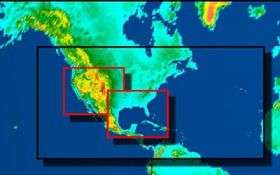
Researchers are homing in on the hurricane-prone Gulf of Mexico and Caribbean Sea to assess the likely changes, between now and the middle of the century, in the frequency, intensity, and tracks of these powerful storms. Initial results are expected early next year.
The National Center for Atmospheric Research (NCAR) in Boulder, Colo., working with federal agencies as well as the insurance and energy industries, has launched an intensive study to examine how global warming will influence hurricanes in the next few decades.
The goal of the project is to provide information to coastal communities, offshore drilling operations, and other interests that could be affected by changes in hurricanes.
"This science builds on years of previous investment," said Cliff Jacobs, program director in the National Science Foundation (NSF)'s Division of Atmospheric Sciences, which is funding the project. "The outcome of this research will shed light on the relationship between global warming and hurricanes, and will better inform decisions by government and industry."
The project relies on an innovative combination of global climate and regional weather models, run on one of the world's most powerful supercomputers.
"It's clear from the impacts of recent hurricane activity that we urgently need to learn more about how hurricane intensity and behavior may respond to a warming climate," says NCAR scientist Greg Holland, who is leading the project. "The increasingly dense development along our coastlines and our dependence on oil from the Gulf of Mexico leaves our society dangerously vulnerable to hurricanes."
The new study follows two major reports, by the U.S. Climate Change Science Program (CCSP) and Intergovernmental Panel on Climate Change (IPCC), that found evidence for a link between global warming and increased hurricane activity.
But many questions remain about future hurricane activity. For example, the CCSP report concluded that future changes in frequency were uncertain, and that rainfall and intensity were likely to increase, but with unknown consequences.
Improved understanding of climate change and hurricanes is an especially high priority for the energy industry, which has a concentration of drilling platforms, refineries, pipelines and other infrastructure in the region that are vulnerable to severe weather.
Hurricanes Gustav and Ike damaged offshore oil production and several refineries, disrupting gasoline supplies.
The project is part of a larger effort examining regional climate change between 1995 and 2055.
The simulations are being run on NCAR's bluefire supercomputer with support from NSF, NCAR's sponsor, and through a long-term collaboration with the insurance industry through the Willis Research Network.
"This research program by NCAR is a major contribution to the insurance industry and public policy makers," says Rowan Douglas, managing director of Willis.
"The primary way to improve our understanding of present and future hurricane risk is to generate computer simulations of storms in unprecedented detail."
For the project, the model will examine three decades in detail: 1995-2005, 2020-2030, and 2045-2055. Scientists will use statistical techniques to fill in the gaps between these decades.
A major goal is to examine how several decades of greenhouse-gas buildup could affect regional climate and, in turn, influence hurricanes and other critical weather features. Scientists will also investigate the impact of the powerful storms on global climate.
One of the most difficult technical challenges for such a project is to create a model that can capture both the climate of the entire world and the behavior of a single hurricane.
To get around this roadblock, NCAR has developed an approach called Nested Regional Climate Modeling (NRCM). The center "nests" a special version of its high-resolution weather model (the Weather Research and Forecasting model, or WRF) inside its lower-resolution, global climate model (the Community Climate System Model, or CCSM).
The resulting simulations show fine-scale detail for certain regions, like the Gulf of Mexico, while also incorporating global climate patterns.
For each of its decade-long time slices, the NRCM's resolution will be about 20 miles across Africa, Europe, and the South Atlantic, 7.5 miles across the tropical Atlantic and northeastern United States, and an even sharper 2.5 miles over the Caribbean and Gulf of Mexico, southeastern United States, and drought-prone western United States.
"Combining weather and climate models in this way enables more detailed projections of hurricanes in a warming world than any study to date," says Holland. "These projections will help reduce the uncertainty of current assessments, and they also serve the very important role of providing experience about applying future predictions of changes to high impact weather systems in general."
Source: National Science Foundation


