RNA molecules boost vaccine effectiveness
October 8, 2008 RNA Molecules, Delivery System Improve Vaccine Responses, Effectiveness

Enlarge

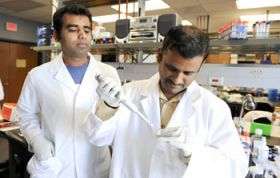
Krishnendu Roy prepares a suspension of the vaccine in the lab while Ankur Singh stands by. Photo: Beverly Barrett

(PhysOrg.com) -- A novel delivery system that could lead to more efficient and more disease-specific vaccines against infectious diseases has been developed by biomedical engineers at The University of Texas at Austin.

The findings use specific ribonucleic acid (RNA) molecules to significantly bolster a vaccine's effectiveness while tailoring it based on the type of immune response that is most desirable for a particular disease, says Krishnendu Roy, associate professor of biomedical engineering and lead investigator on the study.

Roy and his team, which included his graduate student Ankur Singh and collaborators at M.D. Anderson Cancer Center in Houston, achieved their results during a two-year study primarily working with a DNA-based hepatitis B vaccine. Their work was recently published in Molecular Therapy, the official journal of the American Society of Gene Therapy.

In their studies using mice, immune responses were five to 50 times stronger than with traditional vaccine delivery. The stronger the immune response to a vaccine, the better protection the vaccinated person should have.

Their research uses a novel polymer-based delivery system that consists of micron-sized particles carrying both the vaccine and the RNA to immune cells.

"What we've achieved is a delivery system that provides DNA-based vaccines along with RNA which allows us to significantly enhance the immune response and drive them into a certain direction that is effective against the disease," Roy says.

The team worked with what are called "silencing RNA," which shut down specific proteins in the body.

"By silencing certain proteins in the cells that process your vaccine, we can direct the immune response one way or the other," says Roy, who holds the General Dynamics Endowed Faculty Fellowship.

Physicians want to tailor the immune response because, Singh says, vaccines for parasitic infections may need more of an antibody response, while vaccines for viral infections need more of a cellular response, one that kills the infected cells.

The team's delivery system would work for a wide range of diseases, making it a broad platform for infectious disease vaccines, Roy says.

Roy says mice studies will continue for the next four to five years. If the tests continue to prove successful, testing could begin on primates and eventually humans within six to 10 years.

"Eventually, we want to try it with (vaccines for) cancer and other auto-immune diseases," Singh says.

Other collaborators include research fellow Hui Nie and graduate student Bilal Ghosn of the university, and Hong Qin and Dr. Larry W. Kwak of M.D. Anderson Cancer Center.

Provided by University of Texas at Austin


print this article email this article download pdf blog this article bookmark this article     Stumble it Digg this share on Facebook retweet share on Reddit add to delicious
Rate this story - 5 /5 (4 votes)


October 8, 2008 all stories

Comments: 0

5 /5 (4 votes)
  • Stumble this up

  • Digg this

  • share this

  • hide
  • Related Stories

  • Naturally occurring lipid blocks RSV infection in lungs
    created Dec 21, 2009 | popularity not rated yet | comments 0
  • Mutation leads to new and severe form of bacterial disease
    created Dec 18, 2009 | popularity not rated yet | comments 0
  • New Vaccines May Help Thwart E. coli O157:H7
    created Dec 18, 2009 | popularity not rated yet | comments 0
  • Researchers find human protein that prevents H1N1 influenza infection
    created Dec 17, 2009 | popularity not rated yet | comments 0
  • Researchers work on vaccine to improve immune system in newborns
    created Dec 15, 2009 | popularity not rated yet | comments 0


  • hide
  • Relevant PhysicsForums posts

  • Parkinsons like symptoms
    created 6 hours ago
  • Kidneys processing urine
    created Dec 25, 2009
  • Protein synthesis with learning
    created Dec 25, 2009
  • monovision and 3d movies
    created Dec 25, 2009
  • More from Physics Forums - Medical Sciences

Other News

Splitting fluorescent protein helps image clusters in live cells

Medicine & Health / Research

created 9 hours ago | popularity not rated yet | comments 0

Half a protein is better than none, and in this case, it's way better than a whole one. A Rice University lab has discovered that dividing a particular fluorescent protein and using it as a tag is handy for analyzing the ...


US Senate votes on landmark health bill

Medicine & Health / Health

created Dec 24, 2009 | popularity 2.6 / 5 (5) | comments 3

Senators gave Barack Obama a huge political boost on Thursday by passing a sweeping remake of the US health care system that aims to extend coverage to 31 million uninsured Americans.


'Self-seeding' of cancer cells may play a critical role in tumor progression

Medicine & Health / Cancer

created Dec 24, 2009 | popularity 5 / 5 (3) | comments 0

Cancer progression is commonly thought of as a process involving the growth of a primary tumor followed by metastasis, in which cancer cells leave the primary tumor and spread to distant organs. A new study by researchers ...


New tool in the fight against mosquito-borne disease: A microbial 'mosquito net'

Medicine & Health / Diseases

created Dec 24, 2009 | popularity 4.8 / 5 (4) | comments 0

Earlier this year, researchers showed that they could cut the lives of disease-carrying mosquitoes in half by infecting them with a bacterium they took from fruit flies. Now, a new report in the December 24th issue of Cell, ...


Molecular anchor links the 2 inheritable diseases Fanconi anemia and Bloom's syndrome

Medicine & Health / Genetics

created Dec 24, 2009 | popularity not rated yet | comments 0

A new study establishes a molecular link that bridges two rare inherited disorders and explains why these diseases result in genetic instability. The research, published by Cell Press in the December 24th issue of the journal ...