A new hand -- and signs of sensory recovery
October 9th, 2008 Brain View

Enlarge

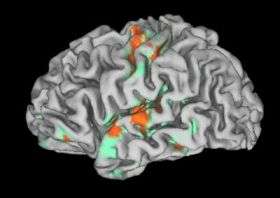
Activation of the left cerebral hemisphere during sensory stimulation of the transplanted right palm as viewed by enhancement of fMRI findings. Credit: Courtesy of Scott Frey

Four months after a successful hand transplant -- 35 years after amputation in an industrial accident at age 19 -- a 54-year-old man's emerging sense of touch is registered in the former "hand area" of the his brain, says a University of Oregon neuroscientist.

The finding, appearing online in advance of regular publication in the Oct. 14 issue of the journal Current Biology, centers only on the man's right palm of a donated hand, which was attached along with major nerves, bones, tendons, and muscle, in a surgery by Kleinert, Kutz and Associates Hand Care Center of Louisville, Ken. A co-author, Dr. Warren C. Breidenbach, also was the lead surgeon of the team that performed the first long-term successful hand transplant in 1999.

Still to be determined, said lead author Scott H. Frey, UO psychology professor and director of the Robert and Beverly Lewis Center for NeuroImaging, is how the brain's map of the individual fingers will evolve with increasing sensation. Just four months post-surgery, initial touch sensations were reported on the thenar eminence -- muscle on the palm just below the thumb -- and on the lateral base of the thumb near the radial nerve.

Functional magnetic resonance imaging was used to record brain activity while sensory stimuli were delivered to the hands and faces of the transplant recipient and four control participants. Results showed that sensory signals from the transplanted hand are being processed in the same brain regions that would have formerly handled sensations from the hand prior to amputation.

"This individual is very unique from a brain standpoint," Frey said. "We know that when someone loses a hand, there are reorganizational changes that take place in areas of the brain that have received sensory input from that hand. Yet, even after 35 years, the restoration of sensory input seems capable of recapturing the former territory of the hand. The capacity of the brain to reverse these changes is all the more striking in light of the fact that his brain was fully mature when the amputation occurred. We believe that this work may have far reaching implications for our understanding of brain plasticity in adulthood and neurorehabilitation."

The patient received the transplant in December 2006. After losing his hand in a machine press accident, he wore a standard cable-hook-prosthetic device, allowing him to continue working.

Reorganization in sensory regions begins within hours of a limb loss. Research on animals has shown that neurons that had been devoted to receiving sensory inputs from the limb take on new duties. Exactly what happens is not entirely clear, nor are we certain how long such changes continue Frey said, "but one way to think about it is that none of the brain's real estate is left vacant for very long." Over time, the injured man reported gradual reductions of phantom sensations and pain often reported by amputees.

Recovery of sensation and the brain's systematic mapping of the hand-to-brain network, in this case, involve only gross hand map zones, referring to activity of major nerves that were reattached, not any peripheral connections to individual digits. "We don't know what that map will look like in the future as the nerves of his fingers regenerate and sensation improves," Frey said.

Physicians at the Hand Care Center have performed four of the almost 30 hand transplants done worldwide. Advances in imaging technology are allowing neuroscientists to map the brain before and after surgeries, opening new insights into brain reorganization and recovery, Frey said.

"What this hand transplant allows us to ask for the very first time in history is: Following reorganizational changes, is it possible to reverse the restoration of sensory input into the brain? The answer, which appears to be yes, extends well beyond the case of hand transplants," he said. "In general, it gives us some ideas about the reorganizational potential of the brain."

Source: University of Oregon


print this article email this article download pdf blog this article bookmark this article     Digg this Stumble it share on Facebook share on Reddit add to delicious save to Yahoo! bookmarks
5/5 after 3 votes


October 9th, 2008 all stories
Medicine & Health / Research

Comments: 0
Rank: 5/5 after 3 votes

  • Stumble this up

  • Digg this

  • Share it:
  • share on Facebook
  • share on MySpace
  • share on Slashdot
  • rss-newsfeed
  • share on Google
  • share on Reddit
  • add to delicious
  • save to Yahoo! bookmarks
  • share on Windows Live
  • Add to Mixx!
Rating: 5/5 after 3 votes

  • Related Stories

  • A scientist probes the origins of 'ouch!'
    created Jul 02, 2009 | popularity not rated yet | comments 0
  • People who wear rose-colored glasses see more, study shows
    created Jun 03, 2009 | popularity not rated yet | comments 0
  • Brain's object recognition system activated by touch alone
    created May 28, 2009 | popularity not rated yet | comments 0
  • Impaired brain plasticity linked to Angelman syndrome learning deficits
    created May 10, 2009 | popularity not rated yet | comments 0
  • Cell transplants may cure deafness
    created Apr 22, 2009 | popularity not rated yet | comments 0


  • Physicists Demonstrate Quantum Memory with Matter Qubits
    Physicists Demonstrate Quantum Memory with Matter Qubits
    Physics / General Physics
    created Jul 03, 2009 | popularity 4.4 / 5 (17) | comments 1
  • 'Holey' Nanosheets for Wastewater Dye Removal
    Nanotechnology / Nanomaterials
    created Jul 01, 2009 | popularity 5 / 5 (5) | comments 1
  • Jellyfish Robot Swims Like its Biological Counterpart
    Jellyfish Robot Swims Like its Biological Counterpart
    Electronics / Robotics
    created Jun 26, 2009 | popularity 4.4 / 5 (8) | comments 1
  • Could Maxwell's Demon Exist in Nanoscale Systems?
    Could Maxwell's Demon Exist in Nanoscale Systems?
    Physics / General Physics
    created Jun 24, 2009 | popularity 4.4 / 5 (18) | comments 29
  • Living Safely with Robots, Beyond Asimov's Laws
    Living Safely with Robots, Beyond Asimov's Laws
    Electronics / Robotics
    created Jun 22, 2009 | popularity 4.6 / 5 (52) | comments 40
  • Other News

    Caffeine reverses memory impairment in Alzheimer's mice

    Caffeine reverses memory impairment in Alzheimer's mice

    Medicine & Health / Research

    created 1hour ago | popularity not rated yet | comments 0

    Coffee drinkers may have another reason to pour that extra cup. When aged mice bred to develop symptoms of Alzheimer's disease were given caffeine - the equivalent of five cups of coffee a day - their memory ...


    Parents' endorsement of vigorous team sports increases children's physical activity, say researchers

    Medicine & Health / Psychology & Psychiatry

    created 24 minutes ago | popularity not rated yet | comments 0

    Parents who value strenuous team sports are more likely to influence their children to join a team or at least participate in some kind of exercise, and spend less time in front of the TV or computer, a new study says.


    Researchers find possible environmental causes for Alzheimer's, diabetes

    Medicine & Health / Diseases

    created 1hour ago | popularity not rated yet | comments 0

    A new study by researchers at Rhode Island Hospital have found a substantial link between increased levels of nitrates in our environment and food with increased deaths from diseases, including Alzheimer's, diabetes mellitus ...


    Variations in 5 genes raise risk for most common brain tumors

    Medicine & Health / Genetics

    created 17 hours ago | popularity not rated yet | comments 1

    Common genetic variations spread across five genes raise a person's risk of developing the most frequent type of brain tumor, an international research team reports online in Nature Genetics.


    Wind power may have its own environmental problems

    Medicine & Health / Health

    created 16 hours ago | popularity 3.7 / 5 (6) | comments 4

    Wind power generation is expected to be a clean and environmentally friendly natural energy source, but a new kind of environmental problem has surfaced as infrasonic waves caused by windmills are suspected of causing health ...