AAAS satellite image analysis reveals South Ossetian damage
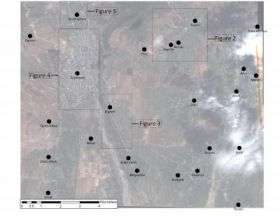
Satellite images captured before and after the 7-8 August clash between Georgia, South Ossetian separatists and Russia reveal that 424 civilian structures near Tskhinvali were damaged by 19 August – although they appeared intact in images taken on 10 August and earlier, the American Association for the Advancement of Science (AAAS) has reported.
Georgia has claimed that Russia fully controlled Tskhinvali by 10 August, according to the BBC News. (See: news.bbc.co.uk/2/hi/europe/7551576.stm.) But Russia has disputed the departure date, and claims that Georgian troops inflicted most of the damage to civilian areas of South Ossetia.
The new satellite-image analysis, completed by the AAAS Science and Human Rights Program at the request of Amnesty International USA shows 202 damaged structures on 10 August, plus an additional 424 damaged structures on 19 August that did not appear damaged in the earlier image, for a total of 626 points of destruction affecting civilians. Encompassing 1,000 square kilometers, the AAAS study examined damage to 24 villages near the city of Tskhinvali in South Ossetia, close to the Georgia-Russia border.
In the village of Tamarasheni, for example, 152 structures that were intact on 10 August seemed to have been damaged by 19 August. Similarly, said Lars Bromley, who heads the AAAS Geospatial Technologies and Human Rights Project, 70 structures in the village of Berula, all seemingly intact on 10 August, apparently had been damaged by 19 August.
No damage could be seen in eight of the 24 villages, mostly located to the far eastern and southern regions of the study area, Bromley reported. But two satellite images captured 10 August and 19 August clearly showed that the remaining 16 villages sustained damage during that time period. Along a corridor including the villages of Eredvi, Berula and Argvitsi, for instance, 147 structures were damaged or destroyed by 19 August, Bromley said, but only 10 damaged structures were seen on 10 August.
In contrast, Tskhinvali, the capital of the South Ossetian region of Georgia "sustained the majority of damage (182 structures) on or before" 10 August, the AAAS report concludes. Another four structures in Tskhinvali seemed to have been damaged by 19 August.
Satellite images reveal significant fire damage to civilian structures in the South Ossetian region, Bromley said.
"Whenever you see the interior walls of a structure, that's very indicative because it means that the structure has no roof, first of all, and secondly, that it wasn't an explosive that did the damage, necessarily, but probably a fire," he explained. "This is consistent with on-the-ground reporting of fires during the conflict, and numerous coincident fire detections by NASA satellites. We also did see evidence of explosions, though. If a structure is blown up, it tends to look like a powdery smudge, but if it's burned, we see a structure with interior walls and no roof."
Although the analysis focused mainly on civilian structures such as homes, hospitals and offices, Bromley also documented damage to unpopulated areas, including track marks from large vehicles crossing agricultural fields, craters possibly caused by shelling, and other evidence of military activity. One dramatic portion of a 10 August image, for instance, shows an undisturbed section of roads and fields outside Tskhinvali, which had been scarred by vehicle tracks in an image taken nine days later. In addition, Bromley said, "A significant amount of military hardware, including helicopters and armored vehicles" were identified within the images.
In summary, the AAAS report concludes: "Imagery analysis demonstrates initial concentrated damage to the city of Tskhinvali and small amounts of damage to outlying areas that had occurred by 10 August. By 19 August, a much broader range of destruction occurred in the village areas surrounding Tskhinvali … Other significant signs of military actions were also shown to have occurred in the region, including many obvious craters from shelling, and tracks from the presumed movement of military vehicles, which resulted in clearly visible damage in the vegetated areas throughout the region."
The development of the conflict involving Georgia, South Ossetian separatists and Russia remains the subject of intense dispute. But, AAAS sources said that tensions seemed to begin rising earlier this year after the North Atlantic Treaty Organization (NATO) agreed to one day allow the Ukraine and Georgia – independent from the Soviet Union since 1991 – to join the alliance. Then in July, Russia reportedly conducted military exercises near Georgia's historically ethnic South Ossetian, separatist region. Roadside bombs near Tskhinvali in early August may have further aggravated the conflict, though all such details are mired in controversy. By 6 August, Tskhinvali was being subjected to heavy shelling by Georgia, and by 7 August, Russian troops had entered the conflict. All Georgian troops left South Ossetia and Abkhazia sometime between 10 August and 13 August.
The AAAS study combined eye-witness accounts of destruction with objectively interpreted satellite images purchased through three commercial vendors: GeoEye, DigitalGlobe and ImageSat International.
To precisely quantify damaged civilian structures, Bromley and colleagues Susan Wolfinbarger and Jonathan Drake also used the software packages ERDAS Imagine and ArcView to leverage the power of remote sensing technology and Geographic Information Systems (GIS), respectively. Other specific sources of information used for the AAAS analysis included: one 10 August image captured by cameras aboard GeoEye's IKONOS satellite; one 19 August image produced by Digital Globe's WorldView satellite; and a second 19 August image from ImageSat's EROS-B satellite. The resulting report relies on place names provided by the U.S. National Geospatial Intelligence Agency; and national and administrative unit borders compiled from Digital Chart of the World.
After completing a side-by-side assessment of earlier and later satellite images, Bromley further substantiated the AAAS findings by looking at images captured 2 July 2005 by DigitalGlobe's Quickbird satellite, and an additional image from 26 July 2007. "The images from July 2005 and 2007 represent how the region looked before the conflict," Bromley explained. "The 10 August image shows the status of the region in the middle of the conflict, and the 19 August image was acquired after fighting had largely ended." The resolution of all images was "one meter or better," Bromley said.
Bromley noted that additional analysis of the affected region was conducted by United Nations Institute for Training and Research (UNITAR) Operational Satellite Applications Programme (UNOSAT), with whom AAAS cooperates. "We hope that the AAAS analysis will complement the UNOSAT reporting, which covers Tskhinvali and numerous villages to the north of the city, whereas the AAAS report covers regions to the east and south of Tskhinvali, and our analysis encompasses different dates," he said.
To view Lars Bromley's video summary on this research, log onto www.aaas.org/news/releases/200 … patial_georgia.shtml
Source: American Association for the Advancement of Science


