Ripple effect: Water snails offer new propulsion possibilities
October 9, 2008
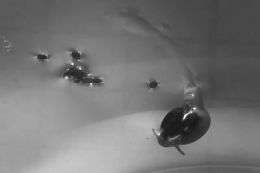
A UC San Diego engineer has found that mimicking the movement of water snails like the one above could lead to new propulsion methods. Credit: David Hu (MIT and Georgia Tech) and Brian Chan (MIT)
(PhysOrg.com) -- A UC San Diego engineer has revealed a new mode of propulsion based on how water snails create ripples of slime to crawl upside down beneath the surface.
Eric Lauga, an assistant professor of mechanical and aerospace engineering at the Jacobs School of Engineering, recently published a paper in the journal Physics of Fluid called "Crawling Beneath the Free Surface: Water Snail Locomotion," that explains how and why water snails can drag themselves across a fluid surface that they can't even grip.
Based on Lauga's research, the secret is in the slime. The main finding of Lauga's research is that soft surfaces, such as the free surface of a pond or a lake, can be distorted by applying forces; these distortions can be exploited (by an animal, or in the lab) to generate propulsive forces and move. Some freshwater and marine snails crawl by "hanging" from the water surface while secreting a trail of mucus. The snail's foot wrinkles into little rippling waves, which produces corresponding waves in the mucus layer that it secretes between the foot and the air.
Lauga and his team demonstrate that water snails have to distort the surface in order to move. "If they don't, they won't go anywhere," said Lauga, who explained that these water snails naturally rise up due to their low weight, and therefore do not have to work to remain near the surface.
Lauga and his colleagues said their finding could lead to a new method of propulsion. One of Lauga's colleagues, Anette Hosoi of the Massachusetts Institute of Technology, has already imitated the adhesive/ lubricating propulsive method of land snails to drive a robotic device. Now, as a result of this new water snail finding, the researchers said it may be possible to build similar devices that walk on water.
"The water snails show us that this is possible, and therefore one can design biomimetic systems taking advantage of that movement," Lauga says.
An example of a biomimetic system that could be designed based on Lauga's water snail research, he said, is small robotic swimmers, which could crawl underneath the free surface in a coordinated fashion. This type of technology, Lauga said, could be used for a number of small scale applications, such as aquatic military uses.
"The military is always looking for new ways to navigate and control displacements," he said.
The mechanism of terrestrial snail locomotion has been investigated over the past couple of decades, but the propulsion of water snails that crawl beneath a free surface hasn't been researched as extensively until now.
"This is interesting from a pure biological standpoint because it helps us understand Mother Nature," Lauga said.
'Bionic' Nature
Biomimetics is the application of biological methods and systems found in nature that could be used to design engineering systems and modern technology. Proponents of bionic technology believe that the transfer of technology between life forms and synthetic constructs is attractive because evolutionary pressure typically forces living organisms to become highly optimized and efficient. Therefore, they contend, designing engineering methods or tools that mimic such biological functions could be extremely efficient.
Examples of biomimetics in engineering include the hulls of boats imitating the thick skin of dolphins, as well as sonar, radar and medical imaging imitating the echolocation of bats. (Echolation involes emitting sound waves and listening to the echo in order to locate objects or to navigate).
For Lauga, his recent water snail research is a prime example of how engineers often look to nature's wide variety of locomotion strategies to inspire new inventions and robotic devices.
"Anything we can learn about biology and the way biological systems move and how particular biological systems generate forces is interesting," he said. "On a fundamental level we have to understand the world we live in."
Lauga, who specializes in fluid mechanics, said he will continue to use engineering techniques and methods to help unlock some of biology's most interesting mysteries.
"If you look at the best engineering departments in the country, many researchers are working to identify new problems and ask new questions in order to improve our understanding of how biological systems work," he said.
Lauga's paper, "Crawling Beneath the Free Surface: Water Snail Locomotion," can be found in the August 2008 issue of Physics of Fluid. Co-authors of the paper included Sungyon Lee, John W. M. Bush and A.E. Hosoi.
Source: University of California - San Diego
-
Broadcast study of ocean acidification to date helps scientists evaluate effects on marine life
Jan 23, 2012 |
5 / 5 (4) |
24
-
Crucial gene activator in slow-killing parasite identified
Jan 05, 2012 |
5 / 5 (1) |
0
-
Marine biodiversity loss due to warming and predation: study
Nov 28, 2011 |
5 / 5 (2) |
3
-
Research team clarifies mechanics of first new cell cycle to be described in more than 20 years
Oct 30, 2011 |
4.7 / 5 (3) |
3
-
Simple nerve cells regulate swimming depth of marine plankton
Oct 18, 2011 |
not rated yet |
0
-
Fast photon control brings quantum photonic technologies closer
10 hours ago |
5 / 5 (4) |
0
-
Engineers build first sub-10-nm carbon nanotube transistor
Feb 01, 2012 |
4.9 / 5 (33) |
30
-
Something old, something new: Evolution and the structural divergence of duplicate genes
Jan 31, 2012 |
4.6 / 5 (7) |
1
-
The hidden nanoworld of ice crystals: Revealing the dynamic behavior of quasi-liquid layers
Jan 30, 2012 |
5 / 5 (5) |
1
-
Stock market network reveals investor clustering
Jan 27, 2012 |
3.9 / 5 (23) |
8
-
Physics question for the brainiacs
2 hours ago
-
minimum magnetic field detected and measured
2 hours ago
-
Diffraction
3 hours ago
-
Compressible vs. Incompressible Flow Equations
5 hours ago
-
How fast, on average, does the gas come out of a rocket's nozzle?
10 hours ago
-
Projectile Arrow Angle Transformation Equation
11 hours ago
- More from Physics Forums - General Physics
More news stories
Tandem polymer solar cells that set record for energy-conversion
(PhysOrg.com) -- In the effort to convert sunlight into electricity, photovoltaic solar cells that use conductive organic polymers for light absorption and conversion have shown great potential. Organic polymers ...
5 hours ago |
5 / 5 (4) |
2
|
Fast photon control brings quantum photonic technologies closer
(PhysOrg.com) -- Using photons instead of electrons to transmit information could lead to faster and more secure ways to communicate, among other advantages. Now a team of physicists has taken another step toward realizing ...
Leading the quest to crack cosmological mysteries
Sometimes a scientist can only laugh in the face of a seemingly insurmountable challenge.
4 hours ago |
3.8 / 5 (4) |
2
|
Two new records: The world's strongest and purest neutron beam
The world's strongest neutron beam is produced by a scientific instrument at the research neutron source FRM II (Forschungs-Neutronenquelle Heinz Maier-Leibnitz) at the Technischen Universitaet Muenchen (TUM). ...
5 hours ago |
5 / 5 (1) |
1
|
Researchers make better heat sensor based on butterfly wings
(PhysOrg.com) -- Scientists have long known that butterfly wings produce their iridescent colors by bouncing light around and between tiny ridges in structures made of chitin. More recently they’ve discovered ...
First-of-its-kind stem cell study re-grows healthy heart muscle in heart attack patients
Results from a Cedars-Sinai Heart Institute clinical trial show that treating heart attack patients with an infusion of their own heart-derived cells helps damaged hearts re-grow healthy muscle.
Scientists discover reason for Mt. Hood's non-explosive nature
(PhysOrg.com) -- For a half-million years, Mount Hood has towered over the landscape, but unlike some of its cousins in Oregons Cascade Mountains and many other volcanoes around the Pacific Rim ...
Discovery paves way for salmonella vaccine
(Medical Xpress) -- An international research team led by a University of California, Davis, immunologist has taken an important step toward an effective vaccine against salmonella, a group of increasingly antibiotic-resistant ...
Time of year important in projections of climate change effects on ecosystems
(PhysOrg.com) -- Does it matter whether long periods of hot weather, such as last year's heat wave that gripped the U.S. Midwest, happen in June or July, August or September?
Smoking bans lead to less, not more, smoking at home: study
Smoking bans in public/workplaces don't drive smokers to light up more at home, suggests a study of four European countries with smoke free legislation, published online in Tobacco Control.
Ovarian cancer arises in fallopian tube of knockout mice
(Medical Xpress) -- The most deadly form of "ovarian" cancer arises in the fallopian tubes not the ovaries of knockout mice that lack two genes associated with the disease, said researchers led by Baylor College ...
Oct 09, 2008
Rank: 5 / 5 (1)
Oct 09, 2008
Rank: 4 / 5 (1)
Oct 09, 2008
Rank: 2.5 / 5 (2)