At 2.8 km down, a 1-of-a-kind microorganism lives all alone
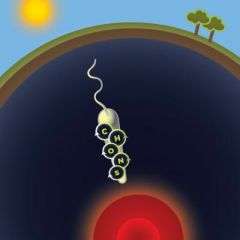
The first ecosystem ever found having only a single biological species has been discovered 2.8 kilometers (1.74 miles) beneath the surface of the earth in the Mponeng gold mine near Johannesburg, South Africa. There the rod-shaped bacterium Desulforudis audaxviator exists in complete isolation, total darkness, a lack of oxygen, and 60-degree-Celsius heat (140 degrees Fahrenheit).
D. audaxviator survives in a habitat where it gets its energy not from the sun but from hydrogen and sulfate produced by the radioactive decay of uranium. Living alone, D. audaxviator must build its organic molecules by itself out of water, inorganic carbon, and nitrogen from ammonia in the surrounding rocks and fluid. During its long journey to the extreme depths, evolution has equipped the versatile spelunker with genes – many of them shared with archaea, members of a separate domain of life unrelated to bacteria – that allow it to cope with a range of different conditions, including the ability to fix nitrogen directly from elemental nitrogen in the environment.
D. audaxviator was captured and its unusual genome sequenced and analyzed using the techniques of environmental genomics, also called metagenomics, by scientists from the U.S. Department of Energy's Lawrence Berkeley National Laboratory (Berkeley Lab), Joint Genome Institute (JGI), and Pacific Northwest National Laboratory (PNNL), working with colleagues from Princeton University, Indiana University, National Taiwan University, Massachusetts Institute of Technology (MIT), Florida State University, the Desert Research Institute, and the University of Western Ontario. The work was a project of the Virtual Institute for Microbial Stress and Survival (VIMSS), supported by DOE and directed by Berkeley Lab's Adam Arkin and Terry Hazen, and the Indiana Princeton Tennessee Astrobiology Initiative (IPTAI) of NASA's Astrobiology Institute, directed by Tullis Onstott of Princeton University and Lisa Pratt of Indiana University. The researchers report their results in the 10 October, 2008 issue of the journal Science.
"The great thing about environmental genomics is that it has made it possible to form a much more complete picture of microscopic life everywhere on Earth, instead of being limited to the very small proportion of bugs" – microorganisms, that is – "that can be cultured in the lab," says Dylan Chivian of Berkeley Lab's Physical Biosciences Division (PBD), lead author of the Science paper. "Almost all organisms live in communities with subdivided roles within their ecosystems. By extracting DNA from environmental samples, the various players in these microbial communities and the abilities of their dominant members can be identified, even if complete genomes of most of them are impossible to sort out."
It was such a collection of organisms that the researchers expected to find when they painstakingly filtered some 5,600 liters of fluid collected by Onstott and coworkers from fractures in the rock of the site tagged MP104, a newly opened section of the Mponeng Mine's level 104. Presence of the species later to be named D. audaxviator was a safe bet; although its genome had never been sequenced, the organism had been identified at MP104 by Onstott, Li-Hung Lin of National Taiwan University, and their coworkers in 2006, and it was known to be the most common microbe found living more than 1.5 kilometers deep in South Africa's Witwatersrand mining district.
"We knew from previous work in these mines, using molecular biology techniques, that there seemed to be very simple communities living down there," says Fred Brockman of the Biology Department of PNNL in Washington state, where the DNA was extracted from the filtered cells. "We expected we'd have a good chance of assembling one entire genome of the most dominant species, or perhaps 70 to 80 percent of several species."
Says Chivian, "What we instead discovered was that there was only one organism present in the sample. More than 99.9 percent of the DNA came from that single organism, and the tiny remainder appeared to be trace contamination from the mine and the laboratory."
The sequencing effort at DOE's JGI was led by Alla Lapidus of Berkeley Lab's Genomics Division; even before the analysis was complete it was evident that the lone species's genome was remarkable. The genome was not as streamlined as might be expected of an organism living in what is presumably a very stable environment. Such streamlined bacteria typically have about 1,500 genes, whereas D. audaxviator has 2,157 protein-coding genes – slim, but hardly stripped.
What this not-quite-minimal gene package can do was revealed by the genome analysis done by Chivian, Arkin, and Paramvir Dehal of PBD, and Eric Alm of MIT: the genome contained everything needed for the organism to sustain an independent existence and reproduce, including the ability to incorporate the elements necessary for life from inorganic sources, move freely, and protect itself from viruses, harsh conditions, and nutrient-poor periods by becoming a spore.
"One question that has arisen when considering the capacity of other planets to support life is whether organisms can exist independently, without access even to the sun," says Chivian. "The answer is yes, and here's the proof. It's sort of philosophically exciting to know that everything necessary for life can be packed into a single genome."
Previous work had identified sulfates as the most readily available energy source in D. audaxviator 's environment. D. audaxviator not only has the equipment to reduce sulfates, this capacity is backed up by additional genes that appear to have been borrowed from archaea by horizontal gene transfer, the incorporation of genetic material from an unrelated species. Archaea, a domain distinct from bacteria, first attracted attention as extremophiles, although many other kinds of archaea have been found since. Some 280 types of bacteria and 44 types of archaea have been found in microbial communities in the South African mines.
D. audaxviator can get its carbon from a number of sources, depending on the local surroundings. It can digest sugars and amino acids, suggesting that one source of carbon might be the dead cells of other microbes in locations where the concentration of cells permits. But in the fluid from level 104, where biodensity is low, D. audaxviator is able to survive because its genome also contains genes equipping the organism to get carbon from carbon monoxide, carbon dioxide, bicarbonate, formate, and other nonbiological sources.
Its nitrogen comes from ammonia released from rocks and dissolved in the fluid at level 104, but D. audaxviator also has a gene for a nitrogenase that could, if necessary, extract nitrogen from its surroundings after first converting it to ammonia – a gene that also appears to be shared with high-temperature archaea.
Other genes shared with archaea confer such traits as defense against viruses, but one system of self-protection is unique to D. audaxviator 's bacterial phylum, Firmicutes: the ability to form endospores, tough structures that shield DNA and RNA from drying out, and from heat, starvation, and chemical attack. Like many bacteria, D. audaxviator is equipped with a flagellum, a whiplike structure that allows it to swim toward sources of nourishment such as might be found in pores in the rock and other mineral surfaces.
About the only thing D. audaxviator can't do is resist oxygen, which suggests it hasn't been exposed to pure oxygen for a very long time. For D. audaxviator to have evolved its remarkably versatile genome, key parts of which are shared with archaea, it must have been on its deep journey for many generations, perhaps as long as the water in the fracture from which it was captured, which has not seen the surface for millions of years.
"Part of the strength of comparative genomics comes from the fact that we now have the genomes of over a thousand bacteria and archaea and we know what many of these genes can do," says Chivian. "At a simple level, it allows us to look at a new genome and put Humpty Dumpty's metabolism back together again, based on the similarity to genes in the genomes of these more well-studied microorganisms. This is particularly powerful for understanding novel bugs from the environment that are otherwise not well characterized."
D. audaxviator 's remarkable capabilities gave rise to its remarkable name. The genus name Desulforudis was coined by Tullis Onstott from the Latin for "from sulfur" and "rod," noting its shape and its ability to get energy from sulfates. And audaxviator? Dylan Chivian found the clue in Jules Verne's Journey to the Center of the Earth, in a message – "Conveniently in Latin," says Chivian -- deciphered by Verne's protagonist, Professor Lidenbrock, which reads in part, "descende, Audax viator, et terrestre centrum attinges." It means "descend, Bold traveler, and attain the center of the Earth."
Citation: "Environmental genomics reveals a single-species ecosystem deep within the Earth," by Dylan Chivian, Eoin L. Brodie, Eric J. Alm, David E. Culley, Paramvir S. Dehal, Todd Z. DeSantis, Thomas M. Gihring, Alla Lapidus, Li-Hung Lin, Stephen R. Lowry, Duane P. Moser, Paul Richardson, Gordon Southam, Greg Wanger, Lisa M. Pratt, Gary L. Andersen, Terry C. Hazen, Fred J. Brockman, Adam P. Arkin, and Tullis C. Onstott, appears in the 10 October issue of Science, and is available online to subscribers at dx.doi.org/10.1126/science.1155495 .
Source: Lawrence Berkeley National Laboratory


