Deep magma matters in volcanic eruption cycle
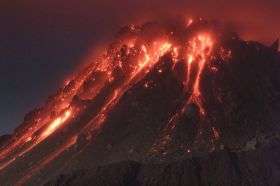
October 9th, 2008 Lava pours out of Montserrat

Enlarge

Lava pours out of Montserrat during an eruption. Researchers have used observations to create a new model that better explains what happens beneath the volcano's surface. Image: University of Arkansas

Although the Soufriere Hills volcano on Montserrat exhibits cycles of eruption and quiet, an international team of researchers found that magma is continuously supplied from deep in the crust but that a valve acts below a shallower magma chamber, releasing lava to the surface periodically.

"Continuous records of surface deformation are available for only a few volcanoes," says Derek Elsworth, professor of energy and geo-environmental engineering, Penn State. "The Soufriere Hills volcano has been erupting since 1995 and provides a peek into the processes occurring deep beneath this stratovolcano."

Stratovolcanoes are one of the most common forms of volcano on Earth. They are cone-shaped with steep sides created by episodic eruptions of magma that flow down from the cone a short way and create layer upon layer of volcanic material.

The researchers, who include Elsworth; Barry Voight, professor emeritus of geology and geological engineering, and Joshua Taron, a doctoral student in energy and geo-environmental engineering, Penn State; Glen Mattioli, professor of geosciences, University of Arkansas, and Richard Herd, senior lecturer in geophysical Earth observation, University of East Anglia, UK, report on using measurements of ground inflation and deflation as a window to the transfer of magma deep within the crust. From these observations, "it is apparent that the major changes in magma storage that have supplied the eruption are from depth, with the lower reservoir contributing only a third of the erupted volume," they say in today's issues (Oct. 9) of the journal Science.

In 1995, Soufriere Hills volcano began the current series of eruptions and pauses. The November 1995 event lasted until March 1998, during which time a dome of andesite – a volcanic rock – grew continuously. From March 1998 until November 1999, there was a pause in above ground volcanic activity and the lava dome collapsed from its own weight and inactivity. Beginning in December 1999, the second episode continued until mid-July 2003, followed by a pause until October 2005. The third episode began then and ended in March 2007.

"The pause that began in 2007 apparently ended in August 2008 with the slow extrusion of lava on the western flank of the dome," says Elsworth.

The pattern of eruptions and pauses might suggest that the magma beneath the Earth behaves in a stop-and-start pattern but the data indicate that magma production beneath the volcano is continuous and relatively constant. During eruptive pauses, the magma supply inflates the deep chamber until this stored magma is released into the upper chamber where it forces a renewed eruption. These observations implicate the deep reservoir in setting the timing of eruptions, rather than the shallow chamber, as had previously been considered.

The researchers believe that the upper reservoir is open and that there is a "valve" between it and the lower reservoir because the lower reservoir can refill while the upper reservoir is open and unaffected. It is unknown whether a build-up of heat or the pressure of gas breaches the valve from the lower to upper reservoir.

Analysis of the data collected on the Soufriere Hills volcano also indicates that the periodic eruptions deplete only the lower magma reservoir, not the upper reservoir. During lulls in eruption, the deep reservoir refills but at only half the rate that the magma was lost. Because the pauses between eruptions are shorter than the eruptions, the deep magma chamber does not make up the pre-eruption volume and the deep magma chamber, over time, contains less and less magma.

Source: Penn State


print this article email this article download pdf blog this article bookmark this article     Digg this Stumble it share on Facebook share on Reddit add to delicious save to Yahoo! bookmarks
4.5/5 after 11 votes


October 9th, 2008 all stories
Space & Earth / Earth Sciences

Comments: 0
Rank: 4.5/5 after 11 votes

  • Stumble this up

  • Digg this

  • Share it:
  • share on Facebook
  • share on MySpace
  • share on Slashdot
  • rss-newsfeed
  • share on Google
  • share on Reddit
  • add to delicious
  • save to Yahoo! bookmarks
  • share on Windows Live
  • Add to Mixx!
Rating: 4.5/5 after 11 votes

  • Related Stories

  • Mountain on Mars may answer big question
    created Mar 04, 2009 | popularity not rated yet | comments 0
  • CALIPSO monitors pulse of Soufriere Hills volcano
    created Dec 17, 2004 | popularity not rated yet | comments 0
  • Scientists' Drill Hits Magma: Only Third Time on Record
    created Jun 29, 2009 | popularity not rated yet | comments 0
  • New study closes in on geologic history of Earth's deep interior
    created Jun 15, 2009 | popularity not rated yet | comments 0
  • What goes down, must come up: Geoscientists offer new model for degassing of Earth's mantle
    created May 27, 2009 | popularity not rated yet | comments 0


  • Physicists Demonstrate Quantum Memory with Matter Qubits
    Physicists Demonstrate Quantum Memory with Matter Qubits
    Physics / General Physics
    created Jul 03, 2009 | popularity 4.4 / 5 (17) | comments 1
  • 'Holey' Nanosheets for Wastewater Dye Removal
    Nanotechnology / Nanomaterials
    created Jul 01, 2009 | popularity 5 / 5 (5) | comments 1
  • Jellyfish Robot Swims Like its Biological Counterpart
    Jellyfish Robot Swims Like its Biological Counterpart
    Electronics / Robotics
    created Jun 26, 2009 | popularity 4.4 / 5 (8) | comments 1
  • Could Maxwell's Demon Exist in Nanoscale Systems?
    Could Maxwell's Demon Exist in Nanoscale Systems?
    Physics / General Physics
    created Jun 24, 2009 | popularity 4.4 / 5 (18) | comments 29
  • Living Safely with Robots, Beyond Asimov's Laws
    Living Safely with Robots, Beyond Asimov's Laws
    Electronics / Robotics
    created Jun 22, 2009 | popularity 4.6 / 5 (52) | comments 40
  • Other News

    Forty years ago man first walked on the moon

    Space & Earth / Space Exploration

    created 9 hours ago | popularity 5 / 5 (2) | comments 0

    Forty years ago on July 20, 1969, American astronaut Neil Armstrong realized the oldest dream of human civilizations when he became the first man to walk on the moon.


    The least sea ice in 800 years

    The least sea ice in 800 years

    Space & Earth / Earth Sciences

    created Jul 01, 2009 | popularity 4.3 / 5 (59) | comments 52

    New research, which reconstructs the extent of ice in the sea between Greenland and Svalbard from the 13th century to the present indicates that there has never been so little sea ice as there is now. The ...


    Gas around young galaxy

    Intense heat killed the Universe's would-be galaxies, researchers say

    Space & Earth / Astronomy

    created Jul 01, 2009 | popularity 3.2 / 5 (19) | comments 25

    (PhysOrg.com) -- Our Milky Way galaxy only survived because it was already immersed in a large clump of dark matter which trapped gases inside it, scientists led by Durham University's Institute for Computational ...


    Scientists' Drill Hits Magma: Only Third Time on Record

    Scientists' Drill Hits Magma: Only Third Time on Record

    Space & Earth / Earth Sciences

    created Jun 29, 2009 | popularity 4.7 / 5 (20) | comments 19

    (PhysOrg.com) -- Scientists drilling a borehole deep into Iceland’s rocky crust to explore new methods of using geothermal energy hit a major roadblock on Thursday: Their drill ran into molten rock at a depth ...


    NASA manager pitches a cheaper return-to-moon plan

    Space & Earth / Space Exploration

    created Jun 30, 2009 | popularity 4 / 5 (7) | comments 18

    (AP) -- Like a car salesman pushing a luxury vehicle that the customer no longer can afford, NASA has pulled out of its back pocket a deal for a cheaper ride to the moon.