Expedition 18 Crew To Launch from Baikonur
October 9, 2008
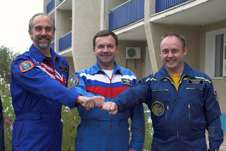
Spaceflight participant Richard Garriott (left), along with cosmonaut Yury Lonchakov (center), Expedition 18 flight engineer; and astronaut Michael Fincke, Expedition 18 commander, participate in a flag raising ceremony near the Cosmonaut Hotel at the Baikonur launch facility in Kazakhstan. Photo Credit: NASA/Victor Zelentsov
(PhysOrg.com) -- Commander Edward Michael "Mike" Fincke and Flight Engineer Yury Valentinovich Lonchakov of the 18th International Space Station crew are scheduled to launch in their Soyuz TMA-13 from the Baikonur Cosmodrome in Kazakhstan about 3 a.m. EDT Sunday to begin a six-month stay in space.
With Fincke, an Air Force colonel, and Lonchakov, a colonel in the Russian Air Force, will be spaceflight participant Richard Garriott, flying under contract with the Russian Federal Space Agency.
Garriott will return to Earth with Expedition 17 crew members, Commander Sergei Volkov and Flight Engineer Oleg Kononenko, in their Soyuz TMA-12 on Oct. 23. Expedition 17 launched to the station April 8.
Expedition 18 crew members will be welcomed by the Expedition 17 crew, including astronaut Gregory E. Chamitoff, after their docking to the orbiting laboratory, scheduled for Tuesday. Chamitoff launched to the station on the STS-124 mission of Discovery May 31. He joined Expedition 17 in progress and will provide Expedition 18 with an experienced flight engineer for the first part of its increment.
Fincke, 41, is making his second long-duration flight on the station. He is a graduate of Massachusetts Institute of Technology and holds master's degrees from Stanford University and the University of Houston, Clear Lake.
He served as an Air Force flight test engineer. He was selected by NASA in 1996. He was commander of the second NASA Extreme Environment Mission Operations (NEEMO 2), working seven days on the seafloor off Florida in May 2002. He served as a flight engineer on station Expedition 9 from April to October 2004.
Lonchakov, 43, is a graduate of the Orenburg Air Force Pilot School and the Zhukovski Air Force Academy. He is a class 1 air force pilot. He has more than 1,400 hours of flight time. He also is a paratroop training instructor with 526 jumps.
He was selected as a test cosmonaut candidate in late 1997. He has flown two previous space missions, STS-100 to the station in April 2001 and a Soyuz delivery flight to the station in October and November 2002.
Astronaut Sandra H. Magnus is scheduled to fly to the station on STS-126 to replace Chamitoff as a flight engineer on E18. Magnus, 43, will be replaced near the end of Expedition 18 by Japanese astronaut Koichi Wakata, who will launch on Discovery on the STS-119 mission. Magnus holds bachelor's and master's degrees in physics from the University of Missouri-Rolla and a Ph.D. from Georgia Institute of Technology.
She was selected as an astronaut in 1996. Magnus will be making her second spaceflight. She flew as a mission specialist on STS-112 in October 2002.
Provided by NASA
-
Via research aircraft instead of dog sled
Dec 08, 2011 |
4 / 5 (1) |
0
-
Russia's attempts to save Mars probe unsuccessful (Update)
Nov 10, 2011 |
5 / 5 (8) |
29
-
International team to drill beneath massive antarctic ice shelf
Nov 09, 2011 |
3.6 / 5 (5) |
3
-
Launch date confirmed for PromISSe mission to Space Station
Nov 08, 2011 |
5 / 5 (1) |
0
-
Russia eyes caves on moon for setting up a lunar base
Oct 20, 2011 |
4.7 / 5 (10) |
34
-
Engineers build first sub-10-nm carbon nanotube transistor
Feb 01, 2012 |
4.9 / 5 (33) |
30
-
Something old, something new: Evolution and the structural divergence of duplicate genes
Jan 31, 2012 |
4.6 / 5 (7) |
1
-
The hidden nanoworld of ice crystals: Revealing the dynamic behavior of quasi-liquid layers
Jan 30, 2012 |
5 / 5 (4) |
1
-
Stock market network reveals investor clustering
Jan 27, 2012 |
3.9 / 5 (23) |
8
-
Of microchemistry and molecules: Electronic microfluidic device synthesizes biocompatible probes
Jan 26, 2012 |
5 / 5 (2) |
0
-
Never ending outer space.....
22 hours ago
-
Neutron Star fragments?
Feb 11, 2012
-
stationary or not?
Feb 11, 2012
-
Scale of the Universe
Feb 10, 2012
-
Titan's lack of impact craters
Feb 09, 2012
-
Real pictures of black hole eating a star?
Feb 08, 2012
- More from Physics Forums - General Astronomy
More news stories
Salvage workers begin pumping fuel from Italian shipwreck
Salvage workers Sunday began pumping fuel from the shipwrecked Italian cruise liner Costa Concordia, a day ahead of schedule, officials said.
7 hours ago |
5 / 5 (1) |
0
Latin America mining boom clashes with conservation
Latin America is experiencing a mining boom as prices rise fuelled by a hike in global demand, but the region is also being hit by a wave of violent protests, strikes and rallies by environmentalists.
15 hours ago |
5 / 5 (1) |
1
Political leaders play key role in how worried Americans are by climate change: study
More than extreme weather events and the work of scientists, it is national political leaders who influence how much Americans worry about the threat of climate change, new research finds.
Feb 06, 2012 |
5 / 5 (7) |
73
NASA budget will axe Mars deal with Europe: scientists
US President Barack Obama's budget proposal to be submitted next week for 2013 will cut NASA's budget by 20 percent and eliminate a major partnership with Europe on Mars exploration, scientists said Thursday.
Space & Earth / Space Exploration
Feb 10, 2012 |
5 / 5 (3) |
58
Humans may have helped the decline of African rainforests 3000 years ago
(PhysOrg.com) -- Large areas of rainforests in Central Africa mysteriously disappeared over three thousand years ago, to be replaced by savannas. The prevailing theory has been that the cause was a change ...
Scientists discover molecular secrets of 2,000-year-old Chinese herbal remedy
For roughly two thousand years, Chinese herbalists have treated Malaria using a root extract, commonly known as Chang Shan, from a type of hydrangea that grows in Tibet and Nepal. More recent studies suggest that halofuginone, ...
New method to examine batteries -- MRI from the inside
There is an ever-increasing need for advanced batteries for portable electronics, such as phones, cameras, and music players, but also to power electric vehicles and to facilitate the distribution and storage of energy derived ...
A mitosis mystery solved: How chromosomes align perfectly in a dividing cell
Although the process of mitotic cell division has been studied intensely for more than 50 years, Whitehead Institute researchers have only now solved the mystery of how cells correctly align their chromosomes during symmetric ...
Overeating may double risk of memory loss
New research suggests that consuming between 2,100 and 6,000 calories per day may double the risk of memory loss, or mild cognitive impairment (MCI), among people age 70 and older. The study was released today and will be ...
Lab study raises questions over nano-particle impact
Tests involving chickens have raised questions about the impact on health from engineered nano-particles, the ultra-fine grains commonly used in drugs and processed foods, scientists said on Sunday.
Google might launch Drive for cloud storage soon
(PhysOrg.com) -- Google's next big move, according to the Wall Street Journal, is a cloud storage service called Drive. Hardly first to the plate, Google is simply catching up to introducing its cloud reposi ...