Pushing child to 'clean his plate' can backfire, study warns
October 9, 2008 By Susan Lang Pushing child to 'clean his plate' can backfire, study warns

Enlarge

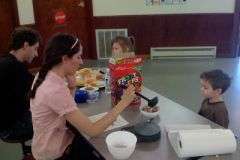
Andrew Herman '07 and Dominique Sinopoli '11 help conduct a study on whether children whose parents encourage them to "clean their plates" at home ask for larger portions away from home. Conclusion: They do.

(PhysOrg.com) -- Telling preschoolers to "clean" their plate can backfire, resulting in the children asking for larger portions when they are away from home, concludes a new Cornell study.

"We found that the more insistent parents were to tell their 4-year-olds to clean their plates, the more likely the kids -- especially boys -- were to request larger portions of sweetened cereal for a snack at day care," says Brian Wansink, Cornell's John S. Dyson Professor of Marketing. "These consequences of belonging to what we call 'the clean plate club' have implications for how much children eat and their potential for overeating."

The study of 63 children, conducted with Collin Payne, assistant professor at New Mexico State University, and Carolina Werle, assistant professor at the University of Grenoble, France, is published in the October issue (162:9) of the Archives of Pediatrics and Adolescent Medicine.

"Parents who insist children clean their plate may be asserting excess control, and they could unknowingly be inhibiting the development of the child's self-control around food," says Wansink, who is on leave until January 2009 for a 14-month appointment as executive director of the U.S. Department of Agriculture's Center for Nutrition Policy and Promotion. "If true, children who have been conditioned to clean their plate may have little control over their home food environment. They might end up overreacting or 'acting out' by requesting more food when excess controls do not exist -- such as when they are away from home."

He suggests that physicians who counsel families with potential obesity issues or parents who want to avoid unwanted consequences of a clean-your-plate approach use an alternative approach: "Provide moderate portions, encourage children to at least try all foods, and then let them determine whether they want additional servings.

"The bottom line: If my kids don't want to clean their plate, it's okay with me," concludes Wansink.

Provided by Cornell University


print this article email this article download pdf blog this article bookmark this article     Stumble it Digg this share on Facebook retweet share on Reddit add to delicious
Rate this story - 3.3 /5 (6 votes)


October 9, 2008 all stories

Comments: 0

3.3 /5 (6 votes)
  • Stumble this up

  • Digg this

  • share this

  • hide
  • Related Stories


  • hide
  • Relevant PhysicsForums posts

Other News

Overeating can set stage for obesity, researchers say

Medicine & Health / Health

created 8 hours ago | popularity not rated yet | comments 1

It doesn't seem like a fair fight. In one corner loomed the Thanksgiving table, groaning with poultry, pie and mashed potatoes.


eye

Over-the-counter eye drops raise concern over antibiotic resistance

Medicine & Health / Medications

created 15 hours ago | popularity 3.5 / 5 (2) | comments 1

(PhysOrg.com) -- The use of antibiotic eye drops for conjunctivitis has increased by almost half since they became available over the counter at chemists in 2005, data obtained by Oxford University researchers ...


New tools for prediction of disease progression in acute childhood leukemia

Medicine & Health / Cancer

created 9 hours ago | popularity not rated yet | comments 0

(PhysOrg.com) -- Researchers at Uppsala University and University Children’s Hospital in Uppsala have devised powerful new tools for typing cells from children with acute lymphatic leukemia and for prediction of how children ...


Nuclear science to fight sleeping sickness

Medicine & Health / Diseases

created 11 hours ago | popularity not rated yet | comments 0

The International Atomic Energy Agency on Friday announced an agreement to help African nations battle the tsetse fly, the main carrier of parasites that causes sleeping sickness with its bites.


What a grind: Bruxism at night likely a sign of stress by day

Medicine & Health / Health

created 3 hours ago | popularity 5 / 5 (1) | comments 0

You can practically track Steve Barkley's stress by the level of activity in his temporomandibular joint, or TMJ, the hinge joint that connects the lower jaw to the temporal bone of the skull and helps one chew, talk and ...