A new explosive: Melt-castable nitrate ester with high explosive energy
October 10, 2008
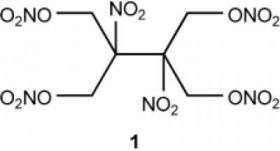
A high-energy-density nitrate ester (1) with unique properties was synthesized in good yield in a three-step process. Destructive stimuli studies and explosive performance calculations show that (1) has similar performance properties to those of well-characterized explosives. Credit: (C) Wiley-VCH 2008
Since the discovery of nitroglycerin in 1846, the nitrate ester group of compounds has been known for its explosive properties. A whole series of other nitrate esters have been subsequently put to use as explosives and fuels. A research team led by David E. Chavez at Los Alamos National Laboratory (USA) has now developed a novel tetranitrate ester. As reported in the journal Angewandte Chemie, the compound has a particularly interesting characteristic profile: it is solid at room temperature, is a highly powerful explosive, and can be melt-cast into the desired shape.
Nitrate esters are organic nitric acid compounds that can contain enormous explosive force. However, their liquid physical state makes handling very difficult. By mixing in various other components, Alfred Nobel developed dynamite, a distinctly safer and easier to handle nitroglycerine-based explosive. The only solid nitrate ester used as an explosive before is nitropenta. Because of its high melting point of about 140 °C, nitropenta must be pressed into the desired form.
Chavez and his co-workers have now made another nitrate ester to give nitropenta a run for its money. Thanks to its low melting point of only about 85 °C, which is well below its decomposition point (141 °C), it can be melted and poured into molds, a much easier process for the production of explosive components.
The new compound contains four nitrate ester groups (–ONO2) and two nitrate groups (–NO2) bound to a total of six carbon atoms. Its crystals demonstrate the highest density found for a nitrate ester so far. Computer calculations predict that the new tetranitrate ester should have an explosive power as high as that of octogen (HMX) — currently one of the highest-performance explosives. The sensitivity of the new compound toward shocks, friction, and sparks is equivalent to that of nitropenta.
“Because of its amazing properties, the new nitrate ester opens up a unique opportunity to produce castable explosive components,” says Chavez. “In addition, it could also be used as a highly energetic softener for other explosives, and as an oxidizer component.”
The researchers also plan to use their new synthetic route for the development of other explosive materials.
Citation: David E. Chavez, Synthesis of an Energetic Nitrate Ester, Angewandte Chemie International Edition 2008, 47, No. 43, 8306–8308, doi: 10.1002/anie.200803648
Source: Wiley
-
Graphene foam detects explosives, emissions better than today's gas sensors
Nov 24, 2011 |
3.9 / 5 (8) |
3
-
Scientists demonstrate novel ionic liquid batteries
Apr 15, 2011 |
4.6 / 5 (7) |
0
-
Reseachers predict larger-than-average Gulf 'dead zone'; impact of oil spill unclear
Jun 28, 2010 |
not rated yet |
0
-
Australian oil spill '10 times worse' than thought
Mar 14, 2009 |
4.3 / 5 (3) |
2
-
Glowing films reveal traces of explosives
May 23, 2008 |
4.5 / 5 (2) |
0
-
Engineers build first sub-10-nm carbon nanotube transistor
Feb 01, 2012 |
4.9 / 5 (33) |
30
-
Something old, something new: Evolution and the structural divergence of duplicate genes
Jan 31, 2012 |
4.6 / 5 (7) |
1
-
The hidden nanoworld of ice crystals: Revealing the dynamic behavior of quasi-liquid layers
Jan 30, 2012 |
5 / 5 (4) |
1
-
Stock market network reveals investor clustering
Jan 27, 2012 |
3.9 / 5 (23) |
8
-
Of microchemistry and molecules: Electronic microfluidic device synthesizes biocompatible probes
Jan 26, 2012 |
5 / 5 (2) |
0
More news stories
Scientists discover molecular secrets of 2,000-year-old Chinese herbal remedy
For roughly two thousand years, Chinese herbalists have treated Malaria using a root extract, commonly known as Chang Shan, from a type of hydrangea that grows in Tibet and Nepal. More recent studies suggest that halofuginone, ...
5 hours ago |
4.7 / 5 (12) |
5
|
New method to examine batteries -- MRI from the inside
There is an ever-increasing need for advanced batteries for portable electronics, such as phones, cameras, and music players, but also to power electric vehicles and to facilitate the distribution and storage of energy derived ...
Chemistry / Analytical Chemistry
5 hours ago |
5 / 5 (5) |
0
|
Hydrogen from acidic water: Researchers develop potential low cost alternative to platinum for splitting water
A technique for creating a new molecule that structurally and chemically replicates the active part of the widely used industrial catalyst molybdenite has been developed by researchers with the Lawrence Berkeley ...
Feb 09, 2012 |
4.8 / 5 (16) |
21
|
Fool's gold may prove an unlikely alternative to overexploited catalytic materials
Catalytic materials, which lower the energy barriers for chemical reactions, are used in everything from the commercial production of chemicals to catalytic converters in car engines. However, with current catalytic materials ...
Feb 10, 2012 |
4.4 / 5 (8) |
8
|
Research provides octagonal window of opportunity for carbon capture
(PhysOrg.com) -- Filtering carbon dioxide, a greenhouse gas, from factory smokestacks is a necessary, but expensive part of many manufacturing processes. However, a collaborative research team from the National ...
Feb 08, 2012 |
5 / 5 (2) |
5
|
Google might launch Drive for cloud storage soon
(PhysOrg.com) -- Google's next big move, according to the Wall Street Journal, is a cloud storage service called Drive. Hardly first to the plate, Google is simply catching up to introducing its cloud reposi ...
Overeating may double risk of memory loss
New research suggests that consuming between 2,100 and 6,000 calories per day may double the risk of memory loss, or mild cognitive impairment (MCI), among people age 70 and older. The study was released today and will be ...
Injured boomers beware: Know when to see doctor
(AP) -- It happened to nurse Jane Byron years after an in-line skating fall, business owner Haralee Weintraub while doing "men's" push-ups, and avid cyclist Gene Wilberg while lifting a heavy box.
Lab study raises questions over nano-particle impact
Tests involving chickens have raised questions about the impact on health from engineered nano-particles, the ultra-fine grains commonly used in drugs and processed foods, scientists said on Sunday.
A mitosis mystery solved: How chromosomes align perfectly in a dividing cell
Although the process of mitotic cell division has been studied intensely for more than 50 years, Whitehead Institute researchers have only now solved the mystery of how cells correctly align their chromosomes during symmetric ...
Starve a virus, feed a cure? Findings show how some cells protect themselves against HIV
A protein that protects some of our immune cells from the most common and virulent form of HIV works by starving the virus of the molecular building blocks that it needs to replicate, according to research published online ...