Astronomers get best view yet of infant stars at feeding time
October 10, 2008
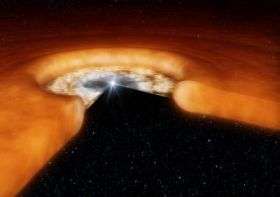
Artist's impression of the environment of a young star, showing the geometry of the dust disc in the outer area and the hot gas disc closer to the central star. Note that the image is not to scale and the inner gas disc, which was studied by the astronomers using ESO's Very Large Telescope Interferometer, is smaller than the distance between the Earth and the Sun, while the whole disc is tens of times larger. Credit: ESO
Astronomers have used ESO's Very Large Telescope Interferometer to conduct the first high resolution survey that combines spectroscopy and interferometry on intermediate-mass infant stars. They obtained a very precise view of the processes acting in the discs that feed stars as they form. These mechanisms include material infalling onto the star as well as gas being ejected, probably as a wind from the disc.
Infant stars form from a disc of gas and dust that surrounds the new star and, later, may also provide the material for a planetary system. Because the closest star-forming regions to us are about 500 light-years away, these discs appear very small on the sky, and their study requires special techniques to be able to probe the finer details.
This is best done with interferometry, a technique that combines the light of two or more telescopes so that the level of detail revealed corresponds to that which would be seen by a telescope with a diameter equal to the separation between the interferometer elements, typically 40 to 200 metres. ESO's Very Large Telescope Interferometer (VLTI) has allowed astronomers to reach a resolution of about a milli-arcsecond, an angle equivalent to the size of the full stop at the end of this sentence seen from a distance of about 50 kilometres.
"So far interferometry has mostly been used to probe the dust that closely surrounds young stars," says Eric Tatulli from Grenoble (France), who co-led this international project. "But dust is only one percent of the total mass of the discs. Their main component is gas, and its distribution may define the final architecture of planetary systems that are still forming."
The ability of the VLTI and the AMBER instrument to take spectra while probing objects at milli-arcsecond resolution has allowed astronomers to map the gas. Astronomers studied the inner gaseous environments of six young stars belonging to the family of Herbig Ae/Be objects. These objects have masses a few times that of our Sun and are still forming, increasing in mass by swallowing material from the surrounding disc.
The team used these observations to show that gas emission processes can be used to trace the physical processes acting close to the star.
"The origin of gas emissions from these young stars has been under debate until now, because in most earlier investigations of the gas component, the spatial resolution was not high enough to study the distribution of the gas close to the star," says co-leader Stefan Kraus from Bonn in Germany. "Astronomers had very different ideas about the physical processes that have been traced by the gas. By combining spectroscopy and interferometry, the VLTI has given us the opportunity to distinguish between the physical mechanisms responsible for the observed gas emission."
Astronomers have found evidence for matter falling into the star for two cases, and for mass outflow in four other stars, either in an extended stellar wind or in a disc wind.
It also seems that, for one of the stars, dust may be present closer to the star than had been generally expected. The dust is so close that the temperature should be high enough for it to evaporate, but since this is not observed, it must mean that gas shields the dust from the star's light.
These new observations demonstrate that it is now possible to study gas in the discs around young stars. This opens new perspectives for understanding this important phase in the life of a star.
"Future observations using VLTI spectro-interferometry will allow us to determine both the spatial distribution and motion of the gas, and might reveal whether the observed line emission is caused by a jet launched from the disc or by a stellar wind", concludes Stefan Kraus.
Source: ESO
-
VLT takes most detailed infrared image of the Carina Nebula
Feb 08, 2012 |
5 / 5 (6) |
3
-
Do black holes help stars form?
Feb 03, 2012 |
4.5 / 5 (6) |
1
-
Remnant of an explosion with a powerful kick?
Feb 02, 2012 |
not rated yet |
1
-
A pocket of star formation
Feb 01, 2012 |
not rated yet |
0
-
Stellar embryos
Jan 23, 2012 |
5 / 5 (4) |
6
-
Engineers build first sub-10-nm carbon nanotube transistor
Feb 01, 2012 |
4.9 / 5 (33) |
30
-
Something old, something new: Evolution and the structural divergence of duplicate genes
Jan 31, 2012 |
4.6 / 5 (7) |
1
-
The hidden nanoworld of ice crystals: Revealing the dynamic behavior of quasi-liquid layers
Jan 30, 2012 |
5 / 5 (5) |
1
-
Stock market network reveals investor clustering
Jan 27, 2012 |
3.9 / 5 (23) |
8
-
Of microchemistry and molecules: Electronic microfluidic device synthesizes biocompatible probes
Jan 26, 2012 |
5 / 5 (2) |
0
-
Never ending outer space.....
Feb 11, 2012
-
Neutron Star fragments?
Feb 11, 2012
-
stationary or not?
Feb 11, 2012
-
Scale of the Universe
Feb 10, 2012
-
Titan's lack of impact craters
Feb 09, 2012
-
Real pictures of black hole eating a star?
Feb 08, 2012
- More from Physics Forums - General Astronomy
More news stories
With climate change, today's '100-year floods' may happen every three to 20 years: research
Last August, Hurricane Irene spun through the Caribbean and parts of the eastern United States, leaving widespread wreckage in its wake. The Category 3 storm whipped up water levels, generating storm surges ...
34 minutes ago |
2.3 / 5 (3) |
0
|
China's pollution puts a dent in its economy
Although China has made substantial progress in cleaning up its air pollution,a new MIT study shows that the economic impact from ozone and particulates in its air has increased dramatically. ...
11 minutes ago |
not rated yet |
0
New European rocket lifts off on maiden flight
A lightweight rocket aimed at securing Europe a stake in the market to launch small satellites lifted off from Kourou space base on its maiden flight on Monday.
Space & Earth / Space Exploration
1 hour ago |
5 / 5 (4) |
1
Climate change causes harmful algal blooms in North Atlantic: study
Warming oceans and increases in windiness could be causing of an abundance of harmful algal blooms in the North Atlantic Ocean and North Sea, according to new research.
3 hours ago |
not rated yet |
0
NASA budget will axe Mars deal with Europe: scientists
US President Barack Obama's budget proposal to be submitted next week for 2013 will cut NASA's budget by 20 percent and eliminate a major partnership with Europe on Mars exploration, scientists said Thursday.
Space & Earth / Space Exploration
Feb 10, 2012 |
5 / 5 (4) |
59
Researchers make better heat sensor based on butterfly wings
(PhysOrg.com) -- Scientists have long known that butterfly wings produce their iridescent colors by bouncing light around and between tiny ridges in structures made of chitin. More recently they’ve discovered ...
Manipulating genes with hidden TALENs
(PhysOrg.com) -- A better understanding of gene function in model plant and animal systems could be used to develop useful traits in livestock and crop plants, and might someday lead to developments in stem ...
The joy of cheques
An electronic cheque which eliminates the need for costly processing by banks but preserves the simplicity and ease of a traditional cheque book has been designed by a team of academics in the UK.
Research shows promise in converting camelina oil into jet fuel
(PhysOrg.com) -- Researchers at Montana State University-Northern have developed a process to convert camelina oil to jet fuel and other high-value chemicals. MSU has applied for a U.S. patent and research is ongoing.
Couples in the same place emotionally stay together, study says
(Medical Xpress) -- Despite lifes ups and downs, couples whose feelings are in sync consistently over time are more likely to stay together, says a University of California, Davis, study.
Researchers make breakthrough in stem cell research
(Medical Xpress) -- University of Queensland scientists have developed a world-first method for producing adult stem cells that will substantially impact patients who have a range of serious diseases.