Researchers developing wireless soil sensors to improve farming
October 10, 2008 Sensors for Better Farming

Enlarge

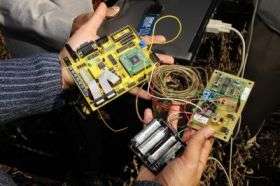
Ratnesh Kumar keeps his prototype soil sensors buried in a box under his desk. He hopes that one day farmers will be burying the devices under their crops.

Kumar is leading an Iowa State University research team that's developing transceivers and sensors designed to collect and send data about soil moisture within a field. Eventually the researchers are hoping the sensors will also collect data about soil temperature and nutrient content.

A major goal is to build small sensors (the prototypes are about 2 inches wide, 4 inches long and less than an inch thick) that can do their work entirely underground. The sensors won't need wires or above-ground antennas, so farmers could work right over the top of them. The sensors would also be able to report their locations. That would make it easy to find sensors if a plow were to move them or when batteries need to be replaced.

Kumar, an Iowa State professor of electrical and computer engineering, said the sensors are designed to be buried about a foot deep in a grid pattern 80 to 160 feet apart. The sensors would relay data along the grid to a central computer that would record information for researchers or farmers.

The sensors could help researchers understand precisely how water moves through a field. They could help them develop better models to predict crop growth and yield. And they could help them understand the carbon and nitrogen cycles within soils.

And those sensors could help farmers manage their nutrient and water resources. That could maximize yields and profits. And it could minimize environmental impacts.

"If nutrients are in excess of what's needed, it doesn't help the yield," Kumar said. "Those resources just drain into the environment."

Stuart Birrell, an Iowa State associate professor of agricultural and biosystems engineering and a part of the sensor research team, said the project will provide the kind of real-time, high-resolution data that researchers and producers have been looking for.

"A challenge of precision agriculture is collecting data at a high enough resolution that you can make good decisions," Birrell said. "These sensors would provide very high resolution data for producers and researchers. They would give us another data layer to explain differences in yield and help us make management decisions."

Kumar said the sensors have worked underground in preliminary, point-to-point tests. A network of multiple sensors will be buried in a research field later this fall for more testing and development.

Also working on the project are Ahmed Kamal, a professor of electrical and computer engineering; Robert Weber, the David C. Nicholas Professor of electrical and computer engineering; Amy Kaleita, an assistant professor of agricultural and biosystems engineering and graduate students Candace Batts, Giorgi Chighladze, Jing Huang and Herman Sahota.

The project is supported by a three-year, $239,999 grant from the National Science Foundation.

"The goal is to hopefully have these sensors in production agriculture," Kumar said. "But first we need to develop them and answer more questions about how cost-effective they could be."

Source: Iowa State University


print this article email this article download pdf blog this article bookmark this article     Stumble it Digg this share on Facebook retweet share on Reddit add to delicious
Rate this story - 4.7 /5 (6 votes)


October 10, 2008 all stories

Comments: 0

4.7 /5 (6 votes)
  • Stumble this up

  • Digg this

  • share this

  • hide
  • Related Stories

  • New Method to Measure Snow, Soil Moisture With GPS May Benefit Meteorologists, Farmers
    created Nov 20, 2009 | popularity not rated yet | comments 0
  • Study uses brain scans to discover how children 'read' faces
    created Nov 20, 2009 | popularity not rated yet | comments 0
  • Nanotube defects equal better energy and storage systems
    created Nov 19, 2009 | popularity not rated yet | comments 0
  • On the Crest of Wave Energy
    created Nov 19, 2009 | popularity not rated yet | comments 0
  • Magnetic Nanotags Spot Cancer in Mice Earlier Than Current Methods
    created Nov 17, 2009 | popularity not rated yet | comments 0


  • hide
  • Relevant PhysicsForums posts

  • Trying to adapt a fuel gage circuit
    created 4 hours ago
  • Pushing the piston.
    created 9 hours ago
  • Do Camcorders/ Video camera have Sensors in them?
    created 14 hours ago
  • Aspiring Engineering major looking for general answers
    created Nov 19, 2009
  • More from Physics Forums - General Engineering

Other News

Newspaper circulation may be worse than it looks (AP)

Newspaper circulation may be worse than it looks

Technology / Internet

created 10 hours ago | popularity not rated yet | comments 0

(AP) -- While U.S. newspapers are losing subscribers at a staggering rate, a few dailies stand out because their circulation is rising. But they aren't necessarily selling more copies.


Canadian woman loses benefits over Facebook photo

Technology / Internet

created 11 hours ago | popularity 5 / 5 (1) | comments 0

(AP) -- A Canadian woman on long-term sick leave for depression says she lost her benefits because her insurance agent found photos of her on Facebook in which she appeared to be having fun.


China is the world's largest emitter of the greenhouse gases blamed for global warming

China harnesses mountain wind power

Technology / Energy

created 20 hours ago | popularity 4.1 / 5 (7) | comments 1

In the mountains above the southwestern Chinese town of Dali, dozens of new wind turbines dot the landscape -- a symbol of the country's sky-high ambitions for clean, green energy.


Analysts say AmEx is most interested in the so-called peer-to-peer services of Revolution

American Express takes aim at PayPal with Revolution

Technology / Internet

created 17 hours ago | popularity 4.5 / 5 (2) | comments 1

With its deal to buy Revolution Money, American Express is taking aim at the growing market for online and alternative payments, in a challenge to recognized leader PayPal, analysts say.


Hackers leak e-mails, stoke climate debate

Technology / Internet

created Nov 21, 2009 | popularity 4.3 / 5 (34) | comments 27

(AP) -- Computer hackers have broken into a server at a well-respected climate change research center in Britain and posted hundreds of private e-mails and documents online - stoking debate over whether some scientists have ...