Venus Express searching for life – on Earth
October 10, 2008
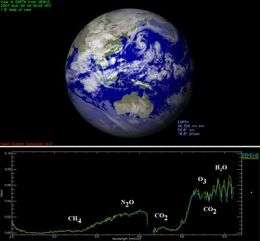
This image composite shows the signatures of methane (CH4), carbon dioxide (CO2), ozone (O3) and nitrous oxide (N2O), minor species of the Earth’s atmosphere but powerful greenhouse gases, detected by the Visual and Infrared Thermal Imaging Spectrometer (VIRTIS) on board ESA’s Venus Express at infrared wavelengths, while the spacecraft was pointing Earth along its orbit around Venus. Our planet was just a pixel in VIRTIS’s field of view. The spectral signatures of these molecules, or chemical fingerprints, are shown for two observing sessions and are plotted by the two curves displayed in two different colours. During the observations Earth was showing to Venus Express the ‘face’ simulated in the image at the top. The light detected by VIRTIS is the thermal emission from the Earth’s surface and, partially, the atmosphere. These observations are relevant as they proof that a distant planet such as an extra-solar planet can reveal to an instrument like VIRTIS the signatures of chemical compounds composing the atmosphere and surface. VIRTIS obtained these spectra on 5 and 6 August 2007. During these observations, Venus Express’s distance from Earth was about 78 million km, while the spacecraft’s distance from Venus was about 14 500 km. Credits: ESA/VIRTIS/INAF-IASF/Obs. de Paris-LESIA (Earth views: Solar System Simulator JPL-NASA)
(PhysOrg.com) -- Scientists using ESA’s Venus Express are trying to observe whether Earth is habitable. Silly, you might think, when we know that Earth is richly stocked with life. In fact, far from being a pointless exercise, Venus Express is paving the way for an exciting new era in astronomy.
Venus Express took its first image of Earth with its Visible and Infrared Thermal Imaging Spectrometer (VIRTIS) soon after its launch in November 2005. About a year after the spacecraft established itself in Venus’s orbit, David Grinspoon, a Venus Express Interdisciplinary Scientist from the Denver Museum of Nature & Science, Colorado, suggested a programme of sustained Earth observation.
“When the Earth is in a good position, we observe it two or three times per month,” says Giuseppe Piccioni, Venus Express VIRTIS Co-Principal Investigator, at IASF-INAF, Rome, Italy. The instrument has now amassed approximately 40 images of Earth over the last two years.
The images of Earth cover both visible and near-infrared regions of the spectrum and can be split into spectra, in order to search for the signature of molecules in the Earth’s atmosphere.
The value of the images lies in the fact that Earth spans less than a pixel in Venus Express’s cameras. In other words, it appears as a single dot with no visible surface details. This situation is something that astronomers expect to soon face in their quest for Earth-sized worlds around other stars.
“We want to know what can we discern about the Earth’s habitability based on such observations. Whatever we learn about Earth, we can then apply to the study of other worlds,” says Grinspoon.
Since 1995, astronomers have been discovering these extrasolar planets and now know of more than three hundred. As observational techniques have been refined and the data continuously taken, so smaller and smaller planets have been discovered.
Now, with CNES–ESA’s COROT and NASA’s Kepler missions, the prospect of discovering Earth-sized worlds in Earth-like orbits around other stars is better than ever. “We are now on the verge of finding Earth-like planets,” says Grinspoon.
As has been proved with the discovery of gas giant planets, as soon as astronomers know that they are there, they invent all sorts of innovative methods to separate the planet’s feeble light from the overwhelming glare of the star.
One thing has become obvious from the study of Earth using Venus Express: determining whether a planet is habitable is not going to be easy. “We see water and molecular oxygen in Earth’s atmosphere, but Venus also shows these signatures. So looking at these molecules is not enough,” says Piccioni.
Instead, astronomers are going to have to search for more subtle signals, perhaps the so-called red edge caused by photosynthetic life. “Green plants are bright in the near infrared,” says Grinspoon. The analysis to see whether this red edge is visible is just beginning.
The team will also compare spectra of the Earth’s oceans with those taken when the continents are facing Venus Express. “We have initiated the first sustained programme of Earth observation from a distant platform,” says Grinspoon. Although the observations may not tell us anything new about the Earth, they will allow us to unveil far-off worlds, making them seem more real than simply dots of light.
Provided by ESA
-
Venus has an ozone layer too: probe finds
Oct 06, 2011 |
5 / 5 (13) |
0
-
Eyes in the sky
Aug 02, 2011 |
4.5 / 5 (4) |
2
-
Dawn spacecraft begins science orbits of Vesta
Aug 02, 2011 |
5 / 5 (3) |
6
-
The shape-shifting southern vortex of Venus
Apr 07, 2011 |
5 / 5 (8) |
7
-
The importance of being magnetized
Mar 21, 2011 |
4.8 / 5 (12) |
13
-
Engineers build first sub-10-nm carbon nanotube transistor
Feb 01, 2012 |
4.9 / 5 (33) |
30
-
Something old, something new: Evolution and the structural divergence of duplicate genes
Jan 31, 2012 |
4.6 / 5 (7) |
1
-
The hidden nanoworld of ice crystals: Revealing the dynamic behavior of quasi-liquid layers
Jan 30, 2012 |
5 / 5 (4) |
1
-
Stock market network reveals investor clustering
Jan 27, 2012 |
3.9 / 5 (23) |
8
-
Of microchemistry and molecules: Electronic microfluidic device synthesizes biocompatible probes
Jan 26, 2012 |
5 / 5 (2) |
0
-
Never ending outer space.....
Feb 11, 2012
-
Neutron Star fragments?
Feb 11, 2012
-
stationary or not?
Feb 11, 2012
-
Scale of the Universe
Feb 10, 2012
-
Titan's lack of impact craters
Feb 09, 2012
-
Real pictures of black hole eating a star?
Feb 08, 2012
- More from Physics Forums - General Astronomy
More news stories
Salvage workers begin pumping fuel from Italian shipwreck
Salvage workers Sunday began pumping fuel from the shipwrecked Italian cruise liner Costa Concordia, a day ahead of schedule, officials said.
9 hours ago |
5 / 5 (1) |
0
Latin America mining boom clashes with conservation
Latin America is experiencing a mining boom as prices rise fuelled by a hike in global demand, but the region is also being hit by a wave of violent protests, strikes and rallies by environmentalists.
17 hours ago |
5 / 5 (1) |
1
Political leaders play key role in how worried Americans are by climate change: study
More than extreme weather events and the work of scientists, it is national political leaders who influence how much Americans worry about the threat of climate change, new research finds.
Feb 06, 2012 |
5 / 5 (7) |
73
NASA budget will axe Mars deal with Europe: scientists
US President Barack Obama's budget proposal to be submitted next week for 2013 will cut NASA's budget by 20 percent and eliminate a major partnership with Europe on Mars exploration, scientists said Thursday.
Space & Earth / Space Exploration
Feb 10, 2012 |
5 / 5 (3) |
58
Humans may have helped the decline of African rainforests 3000 years ago
(PhysOrg.com) -- Large areas of rainforests in Central Africa mysteriously disappeared over three thousand years ago, to be replaced by savannas. The prevailing theory has been that the cause was a change ...
Scientists discover molecular secrets of 2,000-year-old Chinese herbal remedy
For roughly two thousand years, Chinese herbalists have treated Malaria using a root extract, commonly known as Chang Shan, from a type of hydrangea that grows in Tibet and Nepal. More recent studies suggest that halofuginone, ...
New method to examine batteries -- MRI from the inside
There is an ever-increasing need for advanced batteries for portable electronics, such as phones, cameras, and music players, but also to power electric vehicles and to facilitate the distribution and storage of energy derived ...
Google might launch Drive for cloud storage soon
(PhysOrg.com) -- Google's next big move, according to the Wall Street Journal, is a cloud storage service called Drive. Hardly first to the plate, Google is simply catching up to introducing its cloud reposi ...
A mitosis mystery solved: How chromosomes align perfectly in a dividing cell
Although the process of mitotic cell division has been studied intensely for more than 50 years, Whitehead Institute researchers have only now solved the mystery of how cells correctly align their chromosomes during symmetric ...
Lab study raises questions over nano-particle impact
Tests involving chickens have raised questions about the impact on health from engineered nano-particles, the ultra-fine grains commonly used in drugs and processed foods, scientists said on Sunday.
Starve a virus, feed a cure? Findings show how some cells protect themselves against HIV
A protein that protects some of our immune cells from the most common and virulent form of HIV works by starving the virus of the molecular building blocks that it needs to replicate, according to research published online ...
Oct 10, 2008
Rank: 4.8 / 5 (4)
You need a baseline for any comparison.
Aug 05, 2009
Rank: not rated yet