Early planting lets farmers be both mean and green, study shows
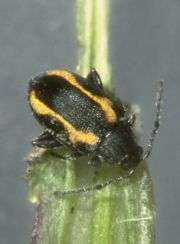
(PhysOrg.com) -- Farmers can be both mean and green when protecting their canola fields from a pesky insect that poses a chronic threat, says a University of Alberta researcher.
Insecticide is no longer the only option available to protect crops from the flea beetle, a striped insect that devours the canola plant in its tender seedling stage, says Lloyd Dosdall, a professor of agricultural, food and nutritional science.
A three-year study of canola in the Lethbridge (southern), Lacombe (central) and Beaverlodge (northern) growing areas of the province conducted by Dosdall and researchers from Agriculture and Agri-Food Canada showed that early seeding plays a role in controlling crop damage without disturbing the environment.
The researchers found that crops seeded in October for early germination the following year survived beetle damage better than crops seeded the next spring from early to mid-May. Crops seeded in April also fared better. To maximize their yields, farmers in all parts of Alberta need to seed their crops as early as possible in the planting season, so that by the time the insects invade in June, the plants are strong enough to withstand the attack, Dosdall says. "By then, the plants have more leaf tissue and there's more surface area to compensate for flea beetles feeding."
The insects exist in the form of two species, one of which was first introduced to North America from Europe in the 1700s by colonists and the second about 200 years later. The pests take a bite out of the farm economy, Dosdall noted. "Economically, the cost in terms of insecticide, spraying and reseeding damaged crops would rank $300 million annually in North America."
More than six million hectares of canola are planted each year across the plains of North America, and Dosdall predicts that growth will expand as interest in developing bio-diesel fuels grows.
Results of the field trials were published recently in the Journal of Applied Entomology, and build on related studies conducted by Dosdall that showed seeding at a higher density and using reduced tillage also provide natural protection against flea beetles. He recommends farmers use an integrated approach for pest control, which will cut down on the use of insecticides. "There are huge areas of Alberta where we can combat flea beetles using combined approaches."
The study also suggests that canola crops in the central and northern regions of the province are at greater risk of flea beetle damage than southern regions. Infestation rates are highest in the Peace region, while central Alberta has less of a problem and could cut back on insecticide use, Dosdall says. Southern Alberta crops, which struggle against dry conditions, were least at risk possibly because those farmers already plant early in the season to capitalize on seasonal moisture.
Provided by University of Alberta


