Is it a bird, is it a plane? No it's supercopter
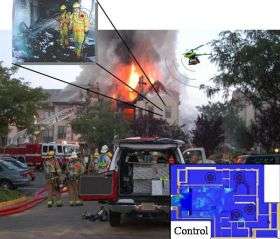
(PhysOrg.com) -- Unmanned helicopters could soon be a key part of emergency relief operations, as well as bringing a new dimension to filmmaking, thanks to some innovative work done by European researchers.
When natural disasters happen one of the first casualties is often the communications network. As a result, rapid response crews can be working virtually blind, cut off from each other and the victims they are trying to help.
Where there are transport arteries, such as roads, rivers and railways, they are also very often damaged or disrupted, which makes getting medical and relief supplies to survivors extremely difficult.
When such disasters happen in remote areas with little in the way of communications or transport infrastructure to start with, the problem is exacerbated.
A solution for both the communications and delivery of supplies problems is now being researched in an EU-funded project, called AWARE, which comprises academic and commercial partners from five European countries.
Self-deploying sensor network
Project coordinator Prof Anibal Ollero says a key part of the system being developed is a self-deploying sensor network. “Most sensor network applications assume there is a communications infrastructure, and so one challenge was to devise a system which can cope when there is no such infrastructure or it has been damaged,” he says.
Helicopters were chosen as the aerial component of the project because of their manoeuvrability and ability to hover. This means they can drop sensor nodes off exactly where they are required, automatically calculating where the gaps are and building up a new communications infrastructure. They are also able to functions as aerial communications relays, and to transmit live photographs of exactly what is happening on the ground. These images are then processed in real time and the results are combined with information from sensor nodes and ground cameras to create a detailed picture that facilitates detection, localisation and tracking.
Finally, helicopters can also be used to carry loads, such as medical supplies, and deliver them to exact locations.
IT in the driving the seat
Ollero points out the aim of the project was to develop the software, middleware and functionalities of a control system for autonomous unmanned helicopters coupled with a ground wireless sensor network with both fixed nodes and nodes carried by vehicles and people.
“This is primarily an IT project so we did not concentrate so much on the helicopters’ airframes as on a scaleable control system which, in the future, could be used on a larger scale,” he notes.
The actual helicopters used were less than two metres in diameter, but were still able to prove the potential of the system in real-life simulations.
“The first trial was in March 2007, and the feedback from this allowed us to complete the system design. Then in April 2008, we had another field trial which allowed partial integration of the various sub-systems in the field. A final, fully integrated demonstration will be held in the spring of 2009, just before the project ends,” he says.
The Sixth Framework Programme-funded project has already been able to demonstrate a world first for either manned or unmanned helicopters by having a load too heavy for one helicopter alone carried by three autonomous unmanned helicopters working together.
“It is very difficult to coordinate the helicopters, so this was a very ambitious objective of the project,” he says.
Ollero points out it is also important for the bottom line, as the cost of helicopters increases exponentially with the payload capacity and sharing loads means smaller helicopters can be used.
Counter-terrorism applications
Future applications of the system will include continuous outdoor and indoor monitoring and tracking of people by using cameras and communications nodes both on the ground and in unmanned helicopters.
As an example, he says the system can detect a fire, localise it and monitor it. Fire fighters can be tracked and monitored inside or outside, and local sensors can provide information on factors like temperature and humidity to reinforce the images produced by cameras. As well as reacting to emergencies and disasters, there are also obvious applications in counter terrorism operations.
Two of the project partners, Flying-Cam SA of Belgium and the Technical University of Berlin, have already made an agreement to commercialise the technology jointly with particular emphasis on developing new products for the film industry, he tells ICT Results.
There is also already a lot of interest in the system from both potential end users, such as fire and police departments, aid agencies and the media, as well as from the commercial organisations which supply equipment and services to them.
“We have invited all of these organisations to the demonstrations and they will be present at the final demonstration next year,” says Ollero.
“Both the people who could use the system we have developed and the companies who can commercialise it and provide it to them are in the loop and interested in carrying on,” he says.
Provided by ICT Results


