NASA Maps Shed Light on Carbon Dioxide's Global Nature
October 10, 2008 NASA Maps Shed Light on Carbon Dioxide's Global Nature

Enlarge

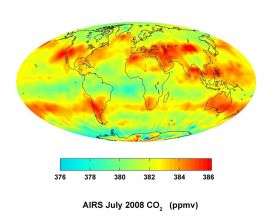
This image was created with data acquired by the Atmospheric Infrared Sounder, AIRS, during July 2008. The image shows large scale patterns of carbon dioxide concentrations that are transported around the Earth by the general circulation of the atmosphere. Image: NASA

(PhysOrg.com) -- A NASA/university team has published the first global satellite maps of the key greenhouse gas carbon dioxide in Earth's mid-troposphere, an area about 8 kilometers, or 5 miles, above Earth. The team's study reveals new information on how carbon dioxide, which directly contributes to climate change, is distributed in Earth's atmosphere and moves around our world.

A research team led by Moustafa Chahine of NASA's Jet Propulsion Laboratory, Pasadena, Calif., found the distribution of carbon dioxide in the mid-troposphere is strongly influenced by major surface sources of carbon dioxide and by large-scale atmospheric circulation patterns, such as the jet streams and weather systems in Earth's mid-latitudes. Patterns of carbon dioxide distribution were also found to differ significantly between the northern hemisphere, with its many land masses, and the southern hemisphere, which is largely covered by ocean.

The findings are based on data collected from the Atmospheric Infrared Sounder (AIRS) instrument on NASA's Aqua spacecraft between September 2002 and July 2008. Chahine, the instrument's science team leader, said the research products will be used by scientists to refine models of the processes that transport carbon dioxide within Earth's atmosphere.

"These data capture global variations in the distribution of carbon dioxide over time," Chahine said. "These variations are not represented in the four chemistry-transport models used to determine where carbon dioxide is created and stored."

Chahine said the AIRS data will complement existing and planned ground and aircraft measurements of carbon dioxide, as well as upcoming satellite missions to study Earth's carbon cycle and climate. Included in the new satellite missions is NASA's Orbiting Carbon Observatory, planned for launch in January 2009. The combination of carbon dioxide data from AIRS and the Orbiting Carbon Observatory will allow scientists to determine the distribution of carbon dioxide in the lower atmosphere, above Earth's surface.

"Carbon dioxide is difficult to measure and track," he said. "No place on Earth is immune from its influence. It will take many independent measurements, including AIRS, to coax this culprit out of hiding and track its progress from creation to storage."

The new maps reveal enhanced concentrations of carbon dioxide south of the northern hemisphere jet stream, in a band between 30 and 40 degrees north latitude. These enhanced concentrations correspond to a well-documented belt of pollution in the northern hemisphere mid-latitudes.

The team attributed the increased levels of carbon dioxide detected over the western North Atlantic to emissions transported from the Southeast U.S. on warm atmospheric "conveyor belts." These belts lift carbon dioxide from Earth's surface into the middle and upper troposphere. The AIRS maps also showed enhanced carbon dioxide over the Mediterranean, resulting from North American and European sources. Carbon dioxide from South Asia ended up over the Middle East, while carbon dioxide from East Asia flowed out over the Pacific Ocean.

In the southern hemisphere, a belt of mid-tropospheric air containing enhanced concentrations of carbon dioxide emerged between 30 and 40 degrees south latitude. This belt had not previously been seen in the four chemistry-transport models used in this study.

The researchers say the flow of air in this belt over South America's high Andes Mountains lifts carbon dioxide from major sources on Earth's surface, such as the respiration of plants, as well as forest fires and facilities used for synthetic fuel production and power generation. A portion of this lifted carbon dioxide is then carried into the mid-troposphere, where it becomes trapped in the mid-latitude jet stream and transported rapidly around the world. "The troposphere is like international waters," Chahine said. "What's produced in one place will travel elsewhere."

Study results were published recently in Geophysical Research Letters. Other participants included the California Institute of Technology, Pasadena, Calif.; and the University of California, Irvine.

More information on AIRS is online at http://airs.jpl.nasa.gov/ .

Animations are available:

-- Windows Media Video (.wmv) 640x360, 1.5 MB
-- Quicktime (.mov) 640x360, 4.8 MB

Provided by NASA


print this article email this article download pdf blog this article bookmark this article     Stumble it Digg this share on Facebook retweet share on Reddit add to delicious
Rate this story - 4.1 /5 (15 votes)

Rank Filter

Move the slider to adjust rank threshold, so that you can hide some of the comments.


Display comments: newest first

  • goldengod - Oct 10, 2008
    • Rank: 4.2 / 5 (5)
    So we can expect to see this map get progressively redder in the coming years which should give the AGW idiots something to think about...
  • MikeB - Oct 11, 2008
    • Rank: 5 / 5 (3)
    So much for CO2 being a well mixed gas.
  • Velanarris - Oct 11, 2008
    • Rank: 5 / 5 (3)
    So much for CO2 being a well mixed gas.


    Yep, that'd throw just about all GW theories (Anthro or not) relating directly to CO2 out of wack.
  • zevkirsh - Oct 12, 2008
    • Rank: 4.6 / 5 (5)
    what a piece of shit map. in 2 years this map will be shown completely obsolete and meaningless
  • GrayMouser - Oct 12, 2008
    • Rank: 5 / 5 (2)
    So much for CO2 being a well mixed gas.


    This map only shows a 10ppmv difference between the blue and red limits. That hardly counts as heterogeneous.
  • Velanarris - Oct 13, 2008
    • Rank: 4 / 5 (1)
    So much for CO2 being a well mixed gas.


    This map only shows a 10ppmv difference between the blue and red limits. That hardly counts as heterogeneous.


    For once, the propaganda caught me. I didn't even look at the scale.
  • MikeB - Oct 13, 2008
    • Rank: 5 / 5 (2)
    You're right Gray...
  • Velanarris - Oct 13, 2008
    • Rank: 5 / 5 (2)
    One other thing I'm noticing, the measurements were taken at mid-troposphere, 8km from the earth.

    The troposphere isn't really a sphere. It's 16km at the equator and shrinks down to 6km at the poles. A generic 8km measurement would be anomalous.

October 10, 2008 all stories

Comments: 8

4.1 /5 (15 votes)
  • Stumble this up

  • Digg this

  • share this

  • hide
  • Related Stories

  • Mankind using Earth's resources at alarming rate
    created 40 minutes ago | popularity not rated yet | comments 0
  • From Greenhouse to Icehouse
    created 48 minutes ago | popularity not rated yet | comments 0
  • NASA Develops Algae Bioreactor as a Sustainable Energy Source
    created Nov 18, 2009 | popularity not rated yet | comments 0
  • Oceans' uptake of manmade carbon may be slowing
    created Nov 18, 2009 | popularity not rated yet | comments 0
  • Scientific debate sparked over carbon sink data
    created Nov 18, 2009 | popularity not rated yet | comments 0


  • hide
  • Relevant PhysicsForums posts

  • The IPCC and the term "most"
    created 16 hours ago
  • Is global warming a fact?
    created 17 hours ago
  • Random variability of wind patterns
    created Nov 23, 2009
  • Record precipitation in the UK
    created Nov 22, 2009
  • How to move cloud from one time to another..
    created Nov 22, 2009
  • Which countries around the world cause the most destruction to the rain forest
    created Nov 21, 2009
  • More from Physics Forums - Earth

Other News

From Greenhouse to Icehouse

From Greenhouse to Icehouse

Space & Earth / Earth Sciences

created 48 minutes ago | popularity not rated yet | comments 0

A new study that reconstructed ocean temperatures from millions of years ago could provide new insight into how the Earth responds to climate change.


Humanity would need five Earths to create the resources needed if everyone lived as like Americans, a report has stated

Mankind using Earth's resources at alarming rate

Space & Earth / Environment

created 40 minutes ago | popularity not rated yet | comments 1

Humanity would need five Earths to produce the resources needed if everyone lived as profligately as Americans, according to a report issued Tuesday.


'Cosmic fruit machine' matches collisions

'Cosmic fruit machine' matches collisions

Space & Earth / Astronomy

created 3 hours ago | popularity not rated yet | comments 0

(PhysOrg.com) -- A new website will give everyone the chance to contribute to science by playing a 'cosmic fruit machine' and compare images of colliding galaxies with millions of simulated images of galactic ...


Astronauts rest up after 3 spacewalks

Space & Earth / Space Exploration

created 1hour ago | popularity not rated yet | comments 0

(AP) -- The astronauts aboard the orbiting shuttle-station complex are resting after their three successful spacewalks.


Kepler Mission Manager Update

Space & Earth / Space Exploration

created 1hour ago | popularity not rated yet | comments 0

(PhysOrg.com) -- Kepler experienced a safe mode event on Nov. 18, 2009.