Unique fossils capture 'Cambrian migration'
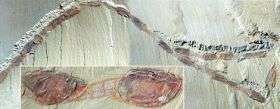
(PhysOrg.com) -- A unique set of fossils indicates that 525 million years ago marine animals congregated in Earth’s ancient oceans, most likely for migration, according to an international team of scientists.
Fossil evidence of collective behaviour is extremely rare. But what makes the find even more intriguing is that it indicates that such behaviour was occurring at the beginning of the ‘Cambrian explosion’ – a major event that saw a vast profusion of complex organisms enter the fossil record for the first time.
The fossils, found in Yunnan province in south west China, were analysed by scientists from Oxford University, the University of Leicester and Yunnan University, China. The find is reported in an article in this week’s Science.
'What we see in these fossils are shrimp-like animals with a carapace and segmented body, which are similar to arthropods that we know existed in the Cambrian seas,’ said Professor Derek Siveter of the Oxford University Museum of Natural History and Oxford’s Department of Earth Sciences, co-author of the article. ‘What’s unique about the Yunnan fossil material is that it shows individual specimens closely interlocked to form a chain, of which there are several examples.’
These chains may have formed for reproductive purposes, or they may represent a stage in the animal’s life cycle – if so there are no comparable occurrences in modern arthropods.
The team believes the congregation is more likely to be evidence of migratory activity, possibly associated with animals congregating as a defence against predators.
‘The simplest explanation is that what we’re seeing is reflecting some sort of migration,’ said Professor Derek Siveter. ‘The spiny lobster is one example of this sort of migratory behaviour amongst modern arthropods. These lobsters join together in a kind of ‘train’ with the antennae of one animal sometimes touching the tail of the animal in front. However, the animals represented by the Chinese fossils are much more closely interlocked – they formed ‘chains’ rather than ‘trains’’.
The fossil was preserved in the Chengjian Lagerstatte, a fossil-rich exceptional preservation deposit discovered in 1984 that has been dated to the Lower Cambrian period, 525 million years ago, making it around 10 million years older than Canada’s famous Burgess Shale.
‘This amazingly rich period in the history of life saw the appearance of more or less all the major groups of animals that provide the biodiversity we see around us today,’ commented Professor Derek Siveter. ‘This find demonstrates that the creatures in our seas 525 million years ago were far from primitive, in fact they were complex organisms exhibiting some very sophisticated behaviour.’
Citation: A report of the research, entitled ‘Collective Behavior in an Early Cambrian Arthropod’ is published in Science on 10 June 2008.
Provided by Oxford University


