Mars Odyssey Shifting Orbit for Extended Mission
October 10th, 2008 Odyssey

Enlarge

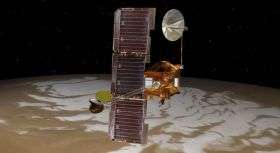
Artist concept of Odyssey. Image credit: NASA/JPL

(PhysOrg.com) -- The longest-serving of six spacecraft now studying Mars is up to new tricks for a third two-year extension of its mission to examine the most Earthlike of known foreign planets.

NASA's Mars Odyssey is altering its orbit to gain even better sensitivity for its infrared mapping of Martian minerals. During the mission extension through September 2010, it will also point its camera with more flexibility than it has ever used before. Odyssey reached Mars in 2001.

The orbit adjustment will allow Odyssey's Thermal Emission Imaging System to look down at sites when it's mid-afternoon, rather than late afternoon. The multipurpose camera will take advantage of the infrared radiation emitted by the warmer rocks to provide clues to the rocks' identities.

"This will allow us to do much more sensitive detection and mapping of minerals," said Odyssey Project Scientist Jeffrey Plaut of NASA's Jet Propulsion Laboratory, Pasadena, Calif.

The mission's orbit design before now used a compromise between what works best for the Thermal Emission Imaging System and what works best for another instrument, the Gamma Ray Spectrometer.

On commands from its operations team at JPL and at Denver-based Lockheed Martin Space Systems, Odyssey fired thrusters for nearly 6 minutes on Sept. 30, the final day of the mission's second two-year extension.

"This was our biggest maneuver since 2002, and it went well," said JPL's Gaylon McSmith, Odyssey mission manager. "The spacecraft is in good health. The propellant supply is adequate for operating through at least 2015."

Odyssey's orbit is synchronized with the sun. The local solar time has been about 5 p.m. at whatever spot on Mars Odyssey flew over as it made its dozen daily passes from between the north pole region to the south pole region for the past five years. (Likewise, the local time has been about 5 a.m. under the track of the spacecraft during the south-to-north leg of each orbit.)

The push imparted by the Sept. 30 maneuver will gradually change that synchronization over the next year or so. Its effect is that the time of day on the ground when Odyssey is overhead is now getting earlier by about 20 seconds per day. A follow-up maneuver, probably in late 2009 when the overpass time is between 2:30 and 3:00 p.m., will end the progression toward earlier times.

While aiding performance of the Thermal Emission Imaging System, the shift to mid-afternoon is expected to stop the use of one of three instruments in Odyssey's Gamma Ray Spectrometer suite. The suite's gamma ray detector needs a later-hour orbit to avoid overheating of a critical component. The suite's neutron spectrometer and high-energy neutron detector are expected to keep operating.

The Gamma Ray Spectrometer provided dramatic discoveries of water-ice near the surface throughout much of high-latitude Mars, the impetus for NASA's Phoenix Mars Lander mission. The gamma ray detector has also mapped global distribution of many elements, such as iron, silicon and potassium, a high science priority for the first and second extensions of the Odyssey mission. A panel of planetary scientists assembled by NASA recommended this year that Odyssey make the orbit adjustment to get the best science return from the mission in coming years.

Increased sensitivity for identifying surface minerals is a key science goal for the mission extension beginning this month. Also, the Odyssey team plans to begin occasionally aiming the camera away from the straight-down pointing that has been used throughout the mission. This will allow the team to fill in some gaps in earlier mapping and also create some stereo, three-dimensional imaging.

Odyssey will continue providing crucial support for Mars surface missions as well as conducting its own investigations. It has relayed to Earth nearly all data returned from NASA rovers Spirit and Opportunity. It shares with NASA's Mars Reconnaissance Orbiter the relay role for Phoenix. It has made targeted observations for evaluating candidate landing sites.

For more about the Mars Odyssey mission, visit: http://mars.jpl.nasa.gov/odyssey

Provided by NASA


print this article email this article download pdf blog this article bookmark this article     Digg this Stumble it share on Facebook share on Reddit add to delicious save to Yahoo! bookmarks
4.5/5 after 2 votes


October 10th, 2008 all stories
Space & Earth / Space Exploration

Comments: 0
Rank: 4.5/5 after 2 votes

  • Stumble this up

  • Digg this

  • Share it:
  • share on Facebook
  • share on MySpace
  • share on Slashdot
  • rss-newsfeed
  • share on Google
  • share on Reddit
  • add to delicious
  • save to Yahoo! bookmarks
  • share on Windows Live
  • Add to Mixx!
Rating: 4.5/5 after 2 votes

  • Related Stories

  • Better looks at Mars minerals for ASU instrument on NASA's Mars Odyssey orbiter
    created Jun 22, 2009 | popularity not rated yet | comments 0
  • Mars Odyssey Alters Orbit to Study Warmer Ground
    created Jun 22, 2009 | popularity not rated yet | comments 0
  • Find your own place on the Red Planet
    created Jun 15, 2009 | popularity not rated yet | comments 0
  • Mars Spacecraft Teams on Alert for Dust-Storm Season
    created Apr 16, 2009 | popularity not rated yet | comments 0
  • US scientists plan greenhouses on the Moon
    created Apr 15, 2009 | popularity not rated yet | comments 0


  • Physicists Demonstrate Quantum Memory with Matter Qubits
    Physicists Demonstrate Quantum Memory with Matter Qubits
    Physics / General Physics
    created Jul 03, 2009 | popularity 4.4 / 5 (17) | comments 1
  • 'Holey' Nanosheets for Wastewater Dye Removal
    Nanotechnology / Nanomaterials
    created Jul 01, 2009 | popularity 5 / 5 (5) | comments 1
  • Jellyfish Robot Swims Like its Biological Counterpart
    Jellyfish Robot Swims Like its Biological Counterpart
    Electronics / Robotics
    created Jun 26, 2009 | popularity 4.4 / 5 (8) | comments 1
  • Could Maxwell's Demon Exist in Nanoscale Systems?
    Could Maxwell's Demon Exist in Nanoscale Systems?
    Physics / General Physics
    created Jun 24, 2009 | popularity 4.4 / 5 (18) | comments 29
  • Living Safely with Robots, Beyond Asimov's Laws
    Living Safely with Robots, Beyond Asimov's Laws
    Electronics / Robotics
    created Jun 22, 2009 | popularity 4.6 / 5 (52) | comments 40
  • Other News

    Steam billows from the cooling towers at a nuclear power generating station in Byron

    Tropical zone expanding due to climate change: study

    Space & Earth / Earth Sciences

    created 53 minutes ago | popularity 5 / 5 (2) | comments 0

    Climate change is rapidly expanding the size of the world's tropical zone, threatening to bring disease and drought to heavily populated areas, an Australian study has found.


    US ambitions to send astronauts back to the moon as a prelude to missions to Mars have been put in doubt

    Forty years ago man first walked on the moon

    Space & Earth / Space Exploration

    created 22 hours ago | popularity 4.3 / 5 (4) | comments 2

    Forty years ago on July 20, 1969, American astronaut Neil Armstrong realized the oldest dream of human civilizations when he became the first man to walk on the moon.


    The least sea ice in 800 years

    The least sea ice in 800 years

    Space & Earth / Earth Sciences

    created Jul 01, 2009 | popularity 4.1 / 5 (64) | comments 60

    New research, which reconstructs the extent of ice in the sea between Greenland and Svalbard from the 13th century to the present indicates that there has never been so little sea ice as there is now. The ...


    Gas around young galaxy

    Intense heat killed the Universe's would-be galaxies, researchers say

    Space & Earth / Astronomy

    created Jul 01, 2009 | popularity 3.4 / 5 (21) | comments 27

    (PhysOrg.com) -- Our Milky Way galaxy only survived because it was already immersed in a large clump of dark matter which trapped gases inside it, scientists led by Durham University's Institute for Computational ...


    Scientists' Drill Hits Magma: Only Third Time on Record

    Scientists' Drill Hits Magma: Only Third Time on Record

    Space & Earth / Earth Sciences

    created Jun 29, 2009 | popularity 4.7 / 5 (22) | comments 20

    (PhysOrg.com) -- Scientists drilling a borehole deep into Iceland’s rocky crust to explore new methods of using geothermal energy hit a major roadblock on Thursday: Their drill ran into molten rock at a depth ...