Scientists resolve long-standing puzzle in climate science
October 10, 2008
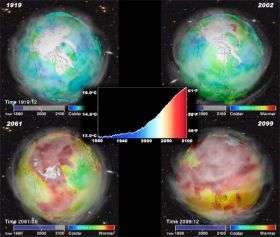
Climate visualizations 1919 - 2099. Image: LLNL
(PhysOrg.com) -- A team led by Livermore scientists has helped reconcile the differences between simulated and observed temperature trends in the tropics.
Using state-of-the-art observational datasets and results from computer model simulations archived at Lawrence Livermore National Laboratory, LLNL researchers and colleagues from 11 other scientific institutions have refuted a recent claim that simulated temperature trends in the tropics are fundamentally inconsistent with observations. This claim was based on the application of a flawed statistical test and the use of older observational datasets.
Climate model experiments invariably predict that human-caused greenhouse gas increases should lead to more warming in the tropical troposphere (the lowest layer of the atmosphere) than at the tropical land and ocean surface. This predicted “amplification” behavior is in accord with basic theoretical expectations.
Until several years ago, however, most satellite and weather balloon records suggested that the tropical troposphere had warmed substantially less than the surface.
For nearly a decade, this apparent discrepancy between simulations and reality was a major conundrum for climate scientists. The discrepancy was at odds with the overwhelming body of other scientific evidence pointing toward a “discernible human influence” on global climate.
A paper published online last year in the International Journal of Climatology claimed to show definitively that “models and observations disagree to a statistically significant extent” in terms of their tropical temperature trends. This claim formed the starting point for an investigation by a large team of climate modelers and observational data specialists, which was led by LLNL’s Benjamin Santer.
In marked contrast to the earlier claim, Santer’s international team found that there is no fundamental discrepancy between modeled and observed trends in tropical temperatures.
“We’ve gone a long way toward reconciling modeled and observed temperature trends in the problem area of the tropics,” said Santer, the lead author of a paper now appearing online in the International Journal of Climatology.
There are two reasons for this reconciliation.
First, the analysis that reported disagreement between models and observations had applied an inappropriate statistical test, which did not account for the statistical uncertainty in observed warming trends. This uncertainty arises because the human-caused component of recent temperature changes is not perfectly known in any individual observed time series – it must be estimated from data that are influenced by both human effects and the “noise” of natural climate variability. Examples of such “noise” include large El Niño and La Niña events, which have pronounced effects on the year-to-year variability of tropical temperatures.
The Livermore-led consortium applied this inappropriate test to randomly generated data. The test revealed a strong bias in the method toward “detecting” differences that were not real.
The consortium modified the test to correctly account for uncertainty in estimating temperature trends from noisy observational data. With this modified test, there were no longer pervasive, statistically significant differences between simulated and observed tropical temperature trends.
The second reason for the reconciliation of models and observations was the availability of new and improved observational datasets, both for surface and tropospheric temperatures. The developers of these datasets used different procedures to identify and adjust for biases (such as those caused by changes over time in the instruments and platforms used to measure temperature).
Access to multiple, independently produced datasets provided the LLNL-led consortium with a valuable perspective on the inherent uncertainty in observations. Many of the recently developed observational datasets showed larger warming aloft than at the surface, and were more consistent with climate model results.
Even with improved datasets, there are still important uncertainties in observational estimates of recent tropospheric temperature trends that may never be fully resolved, and are partly a consequence of historical observing strategies, which were geared toward weather forecasting rather than climate monitoring.
“We should apply what we learned in this study toward improving existing climate monitoring systems, so that future model evaluation studies are less sensitive to observational ambiguity,” Santer said.
Other researchers in this international consortium were Karl Taylor, Peter Gleckler and Stephen Klein (all at Livermore); Peter Thorne at the United Kingdom Meteorological Office Hadley Centre; Leo Haimberger at the University of Vienna; Tom Wigley and Doug Nychka at the National Center for Atmospheric Research; John Lanzante at the National Oceanic and Atmospheric Administration (NOAA)/Geophysical Fluid Dynamics Laboratory; Susan Solomon at the NOAA/Earth System Research Laboratory; Melissa Free at the NOAA/Air Resources Laboratory; Phil Jones at the University of East Anglia; Tom Karl at the NOAA/National Climatic Data Center; Carl Mears and Frank Wentz at Remote Sensing Systems; Gavin Schmidt at the NASA/Goddard Institute for Space Studies; and Steve Sherwood at Yale University.
Provided by Livermore National Laboratory


I'm sorry but I had to rate your comments as poor, immediately negative and pejorative comments are not a very effective way of starting a useful debate.
My understanding of the article is that a large number of scientists have tried to understand why the climate models have not agreed with observed data. Until it can be shown that their work is in some way flawed surely we should respect their integrity, otherwise we are just shouting down anybody with whom we disagree.
Uh so what? Rate away, it's a free country.
I don't get this. If I take a temperature and a weatherperson at the same time and place we should get the same result. Based on the quote we should not as one is trained and the other is not.
Until the prejudices are removed from the analysis, and "hype" toned down, I remain a sceptic.
Anyway... we're in for total financial collapse and world wide starvation long before mankind can pollute itself out of existence. ...my "hype".
Makes sense to me. Basically they're saying what I've been saying, arbitrary values, with arbitrary data when modeled are as accurate as sticking your finger in your ear to determine global climate change.
So, where is the warming coming from if it's not CO2??
I like the article though, even if I prefer to stay on the sideline in discussions like that as my opinion is we have only been here for a short while, so how much do we really know about it.
No no, the data sets being used are picked arbitrarily. For instance, I'll use from 1970-1995 rather than 1930-1995. You'd assume you'll get a better baseline by using a longer period of time however a lot of the leading AGW proponents say that the time scale doesn't matter. The correlating data does.
But if you have a shortened timescale how exactly can you call it correlation if you're only viewing a sample that fits the output you desire.
It's akin to me saying that all women are blonde and simply ignoring brunettes and redheads.
I'm sorry but you're picking frames of reference that don't leave argument to your supposition.
Firstly, CO2 in the upper atmosphere does not have a positive feedback mechanism as you're describing. Pair that with the method of heat transfer from the tropopause to the stratosphere and you'll see that once you leave the lower atmosphere, your main methods of heat loss and energy transfer are convection and re-radiation.
CO2's absorption index at 280ppm is saturated at 10 meters. So any action in the upper atmosphere is negligible as the upper atmosphere starts between 16km and 8 km from the surface of the planet depending on latitude. There is no proven upper atmospheric feedback loop, especially seeing as CO2 is a relatively heavy gas compared to N2 and O2 which make up the majority of our atmosphere. CO2 concentrations in the upper atmosphere are incredibly thin and not substantial enough to cause changes in lower levels of the atmosphere. In regard to water vapro yes it sinks CO2 in the troposphere but it's also reflective to incomming UV and visible spectrum, lowering the amount of available black body or IR that can be trapped by CO2 and other GHGs. This effect shows stronger correlation with temperature increase and decrease than CO2 concentration above 100ppm.
Getting to the la nina el nino cycle it's interesting that it's counted when it shows a trend contrary to the model, but when it reinforces the model it's deemed negligible. One could say that the past decade of temperature change is due to the particularly strong el ninos occuring at the time.
As for the solar minimum and solar maximum cycle if you look at the cycle it is about a 23-28 year cycle from min to min. 14 years ago, global warming was just starting to become popular again. 28 years prior, global cooling, 42 years prior, global warming was theorized.
Do you see a pattern?
"We've gone a long way"? In other words they have not reconciled it.
"Problem area of the tropics"?
No problem unless you trust Atari climate models.
Their own words show that the study is lacking.
- What about Venus?
- What about the IR bands that are absorbed by water vapour but not carbon dioxide?
And as for the bands that H2O occupy, H2O is the most potent greenhouse gas and humans are measured as a 5% contributor through our agricultural practice. The difference is, H2O has just as many negative feedback mechnisms as it does positive and as such tends to maintain an equilibruim.
You want to site your sources before you attack mine? How about I site mine before you assume where the figures come from?
"The absorption peak depends on the spectral resolution which was 2/cm for this spectrometer. With a finer resolution, e.g. 0.5/cm, the peak would become higher and sharper, thus yielding a higher extinction coefficient. The R- (DeltaJ = 1) and the P- (DeltaJ = -1) can be clearly identified as well as the Q-branch (DeltaJ = 0) of the n3 band (15 µm or 667 cm-1). The n2 band (4.2 µm or 2349 cm-1) which only has an R- and P-branch, was measured as well. The decadic extinction coefficients at the band maximum were evaluated as
e = 29.9 m2/mol for n2 and e = 20.2 m2/mol for n3
To calculate the transmission in the total atmosphere, an average CO2 content was taken (from the volume of the atmosphere and the mass) as c = 1.03*10-3 mol/m3. Inserting the above molar extinction, the value for c and the homosphere layer thickness (h = 105 m) into Lambert-Beer's law, yielding a decadic extinction
E(n2) = 29.9 m2/mol * 1.03 * 10-3 mol/m3 * 105 m = 3080
In the same way we find E(n3) = 2080. This means that the transmission T around the peak maxima, defined as 10-E, amounts for 357 ppm to
T(n2) = 10 -3080 and T(n3) = 10 -2080
These are extremely small transmission values which are making any greenhouse increment by CO2 doubling absolutely impossible. Jack Barrett found similar results [2] using spectroscopic and kinetic considerations - tapping into a vasp nest and creating a still vivid discussion [7 - 10].
Inserting e = 20.2 m2/mol for the n3 band into Lambert-Beer's law, using 357 ppm for the CO2 concentration and a 10 m layer, we find the extinction
E = 20.2 m2/mol * 0.0159 mol/m3 * 10 m = 3.21
As the transmission T = 10-3.21 is 0.6 per mille, we conclude that the relative absorption around the peak is 1-T = 99.94% which takes place already within a 10 m layer near ground."
From: The Climate Catastrophy
http://www.john-d...fact.htm
As you'll notice, it's far from an agw skeptic paper, but the data is readily available on both sides of the discussion.
And your "integrity of scientific insight" is comming directly from the desks of politicians. They're well known for their scientific integrity....
No, it'd probably be because he's dead. Died before he finished it. It's a summary paper of his listed sources. Why don't you give those a read. Better yet, how about you read anything that you've touted as fact in your AGW support statements? The difference between you and I when it comes to this discussion is I'm open minded enough to read anything I can get my hands on, where you've simply repeated what you've "heard".
This paper is a study of tropospheric H2O radiative forcing. There's no description of the upper atmospheric process through which CO2 creates a larger positive feedback that you're speaking of. That is if we're both referring to the Alex Hall paper.
Secondly, this paper is based off of a modeling mechnism that has been found to be factually incorrect according to the article that we're currently commenting on.
http://earthobser...tion.gif
Note in particular that between 10 and 14 microns there is a great deal of under-saturated absorption peaks that don't coincide with peaks from other atmopsheric components. Also note that this is absorption by the entire thickness of the atmosphere, not just 10 m of it.
My data is quite current.
Barakn, that graph shows CO2 as not absorbing anything past 6micron or so and that it's absorbing a great amount of IR between 2 and 4 micron. Here's an accurate picture.
http://en.wikiped...sion.png
If you'll notice, CO2 is listed as being saturated or overwritten by other gasses on it's respective wavelengths. Sources are at the bottom of the linked page.
gmurphy, I'm not missing the point. My point that you set out to refute was "CO2 in the upper atmosphere does not have a positive feedback mechanism as you're describing." You supplied a paper about lower atmospheric H2O forcing which is based off of an obsolete model.
Wanna hear something sad.
while some(?) pays good money on debunking your future.
The carboncycle don't give a sh**.
It takes fity years at least for our manmade CO2 to finish its cycle in the atmosphere into the so called heatsinks (primarilly the oceans).
Those oceans are now getting both acidic (unable to sustain life as we know it) by the C02 and unable to take up more CO2.
I saw that one of the ideas behind the so called 'clean coal' project was to use
" Ocean storage, a technology still in its early stages, involves injecting liquid CO2 into waters 500 to 3,000 meters deep, where it dissolves under pressure. However, this method would slightly decrease pH and potentially harm marine habitats. All forms of CO2 storage require careful preparation and monitoring to avoid creating environmental problems that outweigh the benefits of CO2 containment. "
Now, this is f*ng Brilliant isn't it:)
And that carboncycle means that if we stopped all man made CO2 today (Cars coal plants etc etc) we would still have to look at a rising CO2 level for at least fifty years before any 'dip' would show itself.
So?
I think the 'dip' just showed itself.
Nice, very nice. The article we're commenting on is quite published. Re-read my comments.
As for your phd, good for you, it's too bad that you're effectively a mathematician with no understanding of chemical process to suggest that a model using a linear relationship is accurate when the real world effect is logarithmic.
You've been propagandized to the point where no one can help you but yourself.
Ok the atmosphere is made up primarily of N2, O2, and trace gasses. CO2 Let's see, it's O2 and C meaning that it weighs the same as O2 plus the weight of a Carbon atom. So that makes it heavier than O2. And seeing as Nitrogen is lighter than Oxygen I'm willing to bet that N2 is lighter than CO2 as well.
And by the way, for CO2 to be toxic you would need a concentration of 70,000 parts per million. Not 350-380 ppm.
No what I'll do is stop assuming you know anything about science and baby step you through every conversation we have.
No it's not, the frame of reference is "Climate model experiments invariably predict that human-caused greenhouse gas increases should lead to more warming in the tropical troposphere (the lowest layer of the atmosphere) than at the tropical land and ocean surface." Meaning LOWER atmosphere. Not the UPPER atmosphere.
L2Read.
Yes, this uncertainty has been "removed" through adding more layers of calulations to the model. Effectively they've rebalanced their equations to make the model match the observed data.
A PhD in Comp Sci would call this "tampering."
I absolutely did not. I said CO2 is a heavier gas than O2 and N2, and to that effect, as CO2 is such a sparse gas in our atmosphere that by it's weight alone it will not have as much relevance to the upper atmosphere. This is agreed upon by the models for climate variability that you tout as accurate, as well as known physical properties of gasses under IR stimulus.
Well that's pretty well physical fact. Heat rises due to the molecules moving at a greater velocity through vibration due to the absorption of energy of any form. What you're not understanding is what happens after that when the molecule must return that enrgy to it's environment to stay with the second law of thermodynamics.
You energize the molecule and it will "rise" by being faster moving, or vibrating, than it's contemporaries until such point that it leaves a state of equilibrium with it's surrondings and releases that extra energy through re-radiation. The re-radiation is omnidirectional unless faced with an explicit barrier for transferrence.
Absolutely not, take the time to familiarize yourself with the layers and processes of heat transferrance through the atmosphere and you'll see why I am saying you are not looking at a proper frame of reference.
For instance, the hottest part of our atmosphere is not the part we live in. It's the furthest out, which you'd probably believe to be the coolest due to it's interaction with space. It's far from a semantics argument.
Here's some reading, it's on your level of understanding: http://www.window...ers.html
If I have no facts, then why do you have to fight this hard to prove your point? It's simple, because the data I have brought to the table in this conversation is in stark contrast to your preconceptions. Seeing as the burden of proof is not on me I have a wealth of existing data to use to support my stance, which I have. You however, have to search and interpret your data to bring an argument to the table. Couple that with your lack of understanding on the matter and you break down into purile insults.
As green guilt can be extrapolated out to be a byproduct of too much free time and recycling ill quoted facts, as you're prone to do, is a sign of an addled mind.
Sorry, I'm too busy reading the studies that are released to further my understanding of both points of view. It does look like you're too busy sorting through relevant facts to find the one nugget of info that helps your cause. As for your "conspiracy" hypothesis, that's great, take an established dynamic, and supplant that those who oppose it are unjust, or ignorant of reality. When it is you, sir, who cannot see the forest for the trees.
How wouold one retake measurements in time, when that point in time has passed?
You can't. You can only reconcile the available data within a particular degree of accuracy.
Let's say I had an astral body I wanted to take the temperature of from my station from 1950 until now, and every 25 years the equipment would become more precise. Let's further say that the accuracy of my data becomes more precise by a factor of 10.
I take a measurement in 1950 of 2000k, plus or minus 100.
Data range of 2100k-1900k
1975 I take a measurement of 2250k, plus or minus 10
Data range of 2240k-2260k
In 2000 I take a measurement of 2285k, plus or minus 1.
Data range of 2284k-2286k.
Now someone takes my data and creates a model describing the temperature change on that object over time.
His model assumes my equipment measure high every time so he uses my reading and subtracts the entire standard of deviation.
So his graph would start at 1900k and end at 2284k, difference of 384k
It's an impressive graph. Now someone else decides that I always measured low. His graph starts at 2100k and ends at 2286k. Difference of 186k
Well you now have two different models using the exact same data with two very different results, but which one is correct? Which one has been tampered with? Technically, both of them.
Truth is, when you manipulate the statistics using the stated standard of deviation you will come up with wildly different answers and there is no reconciliation that can be done. The data sets are no good because the precision of the measurement was and is still garbage.
Unless you can go back in time with more accurate equipment and re-take the reading, you cannot fix the modeling to be accurate.
Now this is a simple representation, with more point sof data the variation could be even more wild, requiring a person to create a mean or median line to interpret the data.
Effectively the graph coould look like this:
http://en.wikiped...00_years]http://en.wikiped...00_years[/url]
Where the blue line is the average and the red the actual readings.
With enough mean and median interpretation it could end up looking like this:
http://en.wikiped...00_years]http://en.wikiped...00_years[/url]
When the actual data would look like this:
http://www.john-d...-LIA.gif
(Pictures above are used as examples only and are not proving a point other than the fallacy of median and mean graphing of inprecise data)
According to this, CO2 enters altitudes over 20km by tropical upwelling, not diffusion. However it does follow the same basic trend as ground level in overall increase. There is a very clear decrease in CO2 in the upper atmosphere relative to other gasous species.
Just figured since everyone seems to be insulting each other repeatedly, I would throw in my own 5 minutes of research. Oh, and I figure a nature article on direct sampling of atmosphere percentages gets to qualify as a worthwhile source for everybody.
I personally don't know how much of warming is human or not. I know it is happening, but I also know that correlation IS NOT causation. Every high school chemistry/physics student is taught that. As always, the earth most DEFINITELY goes through abrupt warming and cooling cycles: http://en.wikiped...ture.png
If you notice, we are at the end of an ice age, which means it is warmer than it used to be and historically we still haven't hit our peak. We might be screwed regardless. Alternatively we should refocus our efforts on ending deforestation and, if for no other reason than it seems to just make good sense, continue to explore more efficient/clean/safe power production.
Oh, feel free to call me a tard, idiot, etc. because frankly I don't care. It is clearly an argumentum ad hominem, making the entire argument look weak.
I do have another graph for you that's rather interesting in regards to our "currently leaving an ice age".
http://www.seed.s...emp2.jpg
Unfortunately this graph is proxy data from the Vostok ice cores in antartica. Fortunately, they are the exact same ice core samples that the alarmist charts come from.
Furthermore, the article that Spaulding links to states that the variance in CO2 levels is 1% from the tropopause to the mid-stratosphere (given that we're currently at 380ppm). This is hardly a decrease.
You also say you have a wealth of existing data. That sounds a bit weak as you have previously used data from an unpublished source. Where is this data?, inquiring minds would like to know.
I don't understand your reference to green guilt?
Last but not least, your assertion that you're "too busy" to write a published paper which disproves the global warming "conspiracy" is a joke. I mean, c'mon, at this stage I expected better. Maybe you could use the "wealth of data" you've got squirrelled away to back it up.
Right, and the very next line states:
"First, the analysis that reported disagreement between models and observations had applied an inappropriate statistical test, which did not account for the statistical uncertainty in observed warming trends. This uncertainty arises because the human-caused component of recent temperature changes is not perfectly known in any individual observed time series %u2013 it must be estimated from data that are influenced by both human effects and the %u201Cnoise%u201D of natural climate variability. Examples of such %u201Cnoise%u201D include large El Niño and La Niña events, which have pronounced effects on the year-to-year variability of tropical temperatures. "
So effectively they had to re-estimate the data set. Re-estimate.... Wait a minute, you'll have to show me where I argued that the models were too simple. So far I've argued that the models are flawed due to operating off of bad datasets, and tampering with constants to produce results that fit expectations. Hence my statement
Meaning they've added a second layer to the model which changes the data sets prior to modeling.
The tropopause is where the stratosphere meets the troposphere, meaning that from the start of the stratosphere to the middle of the stratosphere CO2 is homogenous.
I completely agree with that. This does not make any statement to the comparison of CO2 ppmv in the troposphere compared to the CO2 ppmv in the stratosphere.
Let's step away from published and unpublished as it has zero bearing on scientific fact. If we really want to get into this argument we need only look at the volumes of published and peer reviewed papers on such theories as the steady state theory, to show that being published, vs. not being published really means nothing when compared to fact and the scientific process.
Didn't think you would.
Or I could write one and you could misread that a few hundred times and think it agrees with your parroted information.
The fact that you say that whether data is published or unpublished has zero bearing on scientific fact shows you are not a scientist. Data only has value once it has passed a rigorous peer reviewed process. Everything else is speculation. You don't seem to appreciate the importance of this fact. Now, maybe you have data which has been scientifically generated but if you can't get it published its pretty clear that it's flawed in some fundamental way.
Why don't you write the article so then?, try and get your theories published. Its clear from this exchange you believe that the data from this article has been tampered with. Why don't you start there?
I've had to explain my points and your own points to you several times here. I've had to clarify topics and subjects as well as assist you in understanding the terminology at play. Now you want to engage in sophistry. We have nothing further to discuss.
If you look at http://www.junkscience.com it shows the new graphs from this study and this hotspot is still not there.Its there in the write up but not in the data.
Well that's simple, the data and their processes are outlined in the paper summarized above. Go read the paper. What their calculations did was adjust temperature readings by establishing a satellite decay constant and adjusting temperature for distance based off of that constant.
this is pure manipulation due to the fact that satellites do not have a constant rate of decay. If satellites had a constant rate of decay we wouldn't need the US airforce to spend millions of dollar a month in calculations to maintain the accuracy of the GPS network. Secondly, after establishing their constant rate of decay they still did not find the hotspot they were looking for. It was in the model but not in the data. That's also listed in the paper and completely contrary to the predictions of AGW.
If you had even a basic inkling of what you're talking about this would not have run on as long as it has, and if we want to talk about deflection how about we take a look at your counter points. Oh wait, the only one produced was a paper on H2O forcing in the lower atmosphere to refute my statements on CO2's role in Upper atmospheric effect. Let me ask you a few questions:
Did you actually read the entire paper you proposed as a foil to my statement?
If you did read it entirely, did you understand it?
If you did understand it did you assume I wouldn't read it when you brought it to the table, or did you assume I wouldn't understand it?
Since you're such an expert at claiming I'm using invalid points for my arguments why don't you design an experiemtn to prove your point and write a published paper. Then maybe we can take you seriously.
Sorry, that old canard (The main reason is that the IR absorption bands are already ~95% saturated at ~300 ppm CO2.) is flat wrong.
Example, see complexity of IR absorbtion charted at http://www.john-d...data.gif
If your theory held, then only the very narrow band tight around 667 um would be absorbed. The broad V shape of the absorption, with apparently a lot more scope for broadening, obviously indicates a lot more complexity.
we already went into this a few post upwards.
That chart is an example of re-radiative study. The page you pulled it from explains the chart.
This is the best you will ever do, spreading misinformation doggedly on the internet. You will never rise above this.
I will close with a quote from Max Planck : "truth never wins -- its opponents just go extinct."
My information thus far has been accurate, certifiable, and experimentally sound. I understand your frustration on the topic as you've listened to what others have told you and now you're finding the established base of your faith has been dismantled by a faceless person on the internet. I'm very sure that's a deep wound to live with.
As I will close with a quote from Former US Senator Timothy Wirth
"What we've got to do in energy conservation is try to ride the global warming issue. Even if the theory of global warming is wrong, to have approached global warming as if it is real means energy conservation, so we will be doing the right thing anyway in terms of economic policy and environmental policy."
There is a well penned article by one of the experts that is rather in line with my stance on AGW/AGC here:
http://www.canada...0507.htm
EA as in artificial intelligence? In that case you no more qualified than I am. Outside of computer science you are not expert in the subject matter.
On the subject of computers and software engineering I am qualified to comment and, given the state of the art in programming (especially by people that are not CS techies) I would say that the models being used are questionable.