Toolbox
Share on facebook Reddit del.icio.us Save to Yahoo! bookmarks Slashdot it Save to Windows live Save to MySpace science news feed Add to google
- size +

Faint gamma-ray bursts do actually exist
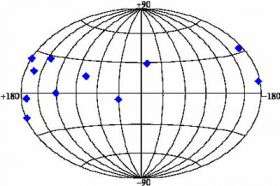
This plot shows the distribution of faint gamma-ray bursts (GRBs) as observed by the IBIS imaging telescope on board ESAs Integral gamma-ray observatory in supergalactic coordinates (such coordinate system is a spherical system whose equator is align ...
This plot shows the distribution of faint gamma-ray bursts (GRBs), as observed by the IBIS imaging telescope on board ESA’s Integral gamma-ray observatory, in ‘supergalactic coordinates’ (such coordinate system is a spherical system whose equator is aligned with the so-called supergalactic plane, a major structure in the local universe formed by the distribution of near-by clusters of galaxies, out to several hundred megaparsecs; 1 megaparsec corresponds to about 30 trillion km, or about 3.26 light years). As it can be seen, these faint gamma-ray bursts are mainly distributed along the supergalactic plane. Credits: S. Foley/UCD
(PhysOrg.com) -- Gamma-ray bursts, powerful glares of high-energy that wash through the Universe once every day or so are, for a brief time, the brightest objects in the gamma-ray sky. ESA’s Integral gamma-ray observatory has observed several low-luminosity gamma-ray bursts, confirming the existence of an entire population of weaker bursts hardly noticed so far.
When it comes to detecting gamma-ray bursts (or GRBs), Integral is equipped with the most sensitive detector ever launched into space – the IBIS imager. Its field of view is very well shielded from any background radiation, making the detection of faint gamma-ray signals possible.

Astronomers estimate that about 1400 GRBs per year occur but, because no one knows when and where they are going to appear, only a part of them happen to be detected. Integral detects an average of 10 GRBs per year, and has collected data about 47 of them during four and a half years of operations.

When studying IBIS gamma-ray burst data, Prof. Lorraine Hanlon from the School of Physics, University College Dublin, Ireland, and her colleagues, realised that some of the faintest bursts have distinctive gamma-ray emission, and also present faint afterglows in the lower-energy X-ray and visible wavelengths.

Since, in general, GRBs are colossal explosions of energy triggered by the collision of very massive and compact objects such as neutron stars or black holes, or by the explosion of incredibly powerful supernovae, or hypernovae, one may think that these bursts are perceived as faint just because they take place very far away from us, in the remote corners of the Universe.

However, Prof. Hanlon and colleagues noticed that these faint bursts, just at the sensitivity threshold of IBIS, seem to originate in our cosmic neighbourhood, within the nearby clusters of galaxies.

“If the bursts we have studied are so ‘close’ in cosmological terms, it means that they are faint from the beginning,” says Hanlon. “From this we can deduce that the processes triggering them could be less energetic than those generating the more powerful bursts we are more used to observing.”

The study team suggests that the faint bursts may be generated by the collapse of a massive star that does not present the characteristics of a supernova, or by the merger of two white dwarfs (small and dense stars about the size of Earth), or by the merger of a white dwarf with a neutron star or a black hole.

“Past observations had already hinted the existence of faint GRBs, and thanks to Integral’s sensitivity we can now say that an entire population of them exist,” added Hanlon. “Actually, their rate may even be higher than that of the most luminous GRBs but, just because they are weaker, we may be only able to see those which are relatively close by.”

“More Integral observations in the coming years will definitively help us understand the phenomenon of faint GRBs, and to explore the nature of this newly observed population,” she concluded.

The results appeared in the Astronomy & Astrophysics journal (June 2008), in a paper titled: “Global characteristics of GRBs observed with Integral and the inferred large population of low-luminosity GRBs”, by S. Foley, S. McGlynn, L. Hanlon, B. McBreen (University College Dublin, Ireland), and S. McBreen (Max-Planck-Institut für Extraterrestrische Physik, Garching, Germany) (A&A Vol. vol. 484, 143, 2008). The results were also presented at the 7th Integral workshop that took place in Copenhagen, Denmark, in September 2008.

Provided by ESA
» Next Article in Space & Earth science - Astronomy: Astronomers get best view yet of infant stars at feeding time

would you recommend this story?


User Rating

4.2 out of 5 after 16 total votes
  • not at all
  • 1
  • 2
  • 3
  • 4
  • 5
  • highly

Leave a Comment or

Rank filter

Move the slider to adjust rank threshold, so that you can hide some of the comments.
Posted by tpb 10/13/08 12:41
Not rated yet.
1 megaparsec corresponds to about 30 trillion km, or about 3.26 light years.

1 parsec = 3.26 light years
Posted by yyz 10/13/08 13:42
Rank: 5/5 after 2 votes
I'm curious as to whether these faint GRBs are intrinsically low luminosity events or if their faintness may be ascribed to a 'beaming effect' where the GRB jets are not precisely aimed at the Earth? Also, have any of these events been traced directly to a galaxy in a nearby galaxy cluster, and if so, have any been detected in any other wavelengths? While these events may be detected near the supergalactic plane, might this not be due to a selection effect of the observations themselves. In what types of galaxies are these events observed? Might these events be normal luminosity GRBs embedded within very thick obscuring gas and dust clouds? While I haven't read the published paper, it seems the press release is short on details and I would be cautious about ascribing the origins of these events to a new type of GRBs until more data is available.
Posted by Ashibayai 10/14/08 00:09
Rank: 5/5 after 1 vote
^ I agree completely. In fact, I think you mentioned every point of skepticism I had.
Posted by yyz 10/14/08 10:09
Not rated yet.
In response to this story posted at Universe Today, reader Don Alexander, who has seen the paper cited here mentions that it is "riddled with small errors" and did not find the results very conclusive. Does anyone have a link to a free preprint of this paper?
Posted by yyz 10/14/08 20:30
Not rated yet.
The paper referenced in the above article can be found at arXiv:0803.1821v2 authored by S Foley et al. The paper mentions observations of several Xray afterglows and a few optical & near-IR afterglows, one appearing in the galaxy cluster Abell 1651, but mentions no GRBs linked to individual galaxies. It is suggested that the faint GRBs may be located in intergalactic space between galaxies in clusters (how convenient). The authors also consider that some of these faint GRBs may be cloaked by dense clouds of gas & dust, thus negating their claim of these being intrinsically 'faint' GRBs. Overall, their argument for a new class of faint GRBs seems rather premature, IMHO.
Posted by denijane 10/20/08 09:26
Rank: 5/5 after 1 vote
I don't know about this particular type, but for other low-energy GRBs there was a study that checked the absorption lines and didn't find any meaningful explanation in them for their faintness.

A very interesting question is not whether they
are a new type of GRBs but how come we still don't know the mechanism that produces those different emissions-soft/hard, long/short, different wavelength, different energy. All we have is the data and some good guesses. But nothing specific. And even more, we have no idea of the central engine that produces them. It gets as good as "possibly a black hole". With the big BUT(t), since black holes are very unlikely to be involved in those events and the experimental data proves it.

And because detection of GRBs is so dependent on the energy range of the detector, it's very likely to have many more "types" of GRB that we still have not found because of our limited abilities to detect.
Posted by yyz 10/21/08 14:54
Not rated yet.
The new post at http://www.physor...869.html seems to be right along the lines of denijane's post. We really don't have a firm grip on short-hard GRBs. Until then, its a theorists field day.