Tides Have Major Impact on Planet Habitability
October 13th, 2008 Tides Have Major Impact on Planet Habitability

Enlarge

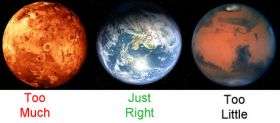
NASA images of Jupiter's moon, Io, (left) Earth (center) and Mars (right), respectively, illustrate worlds with too much, just enough and too little tidal heating to favor life. Internal heating can dramatically affect the suitability of a planet for life. Internal heating produced by tides in Io is so strong the moon undergoes powerful global-scale volcanism. Earth's moderate internal heating drives plate tectonics that create a surface suitable for life. The negligible tidal heating of Mars may be why the planet is so geophysically dormant at present, possibly making it too cold for life.

(PhysOrg.com) -- Astronomers searching for rocky planets that could support life in other solar systems should look outside, as well as within, the so-called "habitable zone," University of Arizona planetary scientists say.

Planets too close to their stars are roasted. Planets too far from their stars are frozen. In between, research models show, there's a habitable zone where planet temperatures approximate Earth's. Any rocky planets in this just-right Goldilocks zone could be awash in liquid water, a requisite for life as we know it, theorists say.

New research by Brian Jackson, Rory Barnes and Richard Greenberg of UA's Lunar and Planetary Laboratory shows that tides can play a major role in heating terrestrial planets, creating hellish conditions on rocky alien worlds that otherwise might be livable. And just the other way, tidal heat can also create conditions favorable to life on planets that would otherwise be unlivable.

Jackson presented the research Saturday at the 40th annual meeting of the Division of Planetary Sciences in Ithaca, N.Y. His talk is titled "Tidal Heating of Extrasolar Terrestrial-scale Planets and Constraints on Habitability." The research will be published soon in the Monthly Notices of the Royal Astronomical Society.

Our own solar system is something of an anomaly, in that its planets move in relatively quiescent, circular orbits around the sun. Most extrasolar planets found to date have highly elongated orbits. During each orbit, the planet is stretched most by tides when it is near the star, and less when the planet is farther from its star. The resulting friction generates internal heat, which drives the planet's geophysical processes.

If the recently discovered "super-Earths" – extrasolar planets only 2-to-10 times as massive as Earth – are indeed terrestrial, tidal heating may be great enough to melt them, or at least produce volcanism on par with Jupiter's moon, Io, "dimming their prospects for habitability," Jackson said. So some of the recently discovered super-Earths may be more like "super-Ios," he said. The lo moon is the most volcanically active body in our solar system.

"Tidal heating scales with planet mass, so we expect that most easily detectable super-Earths will be dominated by volcanic activity," Jackson said. "That's one of our first conclusions from this work, that the first Earth-like planets found are probably going to be strongly heated and have big volcanoes. Even if Earth-like planets are found within the habitable zone, they may not be habitable because they will be overwhelmed by this tidal heating."

Tidal heating may also create habitable conditions on planets that otherwise are too small or too cold to support life, Jackson said. Tidal heating can enhance outgassing of volatiles that contribute or replenish a planet's atmosphere through volcanism. Tidal heating also can generate sub-surface liquid oceans on water-rich rocky planets that would otherwise be frozen, just as tidal heating is believed to warm a sub-surface liquid water ocean on Jupiter's moon Europa.

Also, tidal heating can drive plate tectonics, a mechanism that checks excessive carbon dioxide from accumulating in a planetary atmosphere, producing the kind of deadly greenhouse atmosphere found on Venus.

"Our study shows that tidal heating could produce enough heat to drive plate tectonics for billions of years, long enough for life to appear and flourish," Jackson said.

Provided by University of Arizona


print this article email this article download pdf blog this article bookmark this article     Digg this Stumble it share on Facebook share on Reddit add to delicious save to Yahoo! bookmarks
4.5/5 after 31 votes

Rank Filter

Move the slider to adjust rank threshold, so that you can hide some of the comments.


Display comments: newest first

  • Modernmystic - Oct 13, 2008
    • Rank: 2.9 / 5 (8)
    Another nail in the coffin of the "we are nothing special" school of thought....
  • Velanarris - Oct 13, 2008
    • Rank: 4.9 / 5 (8)
    It's funny, the old 80's game Wing Commander had a hostile alien race called the Kilrathi. Their planet was well outside of the habitable zone but due to intense graviational pull from the binary system it was in the tectonics of the planet that kept it incredibly warm, making it capable of sustaining life.

    80's video games become today's science.
  • Modernmystic - Oct 13, 2008
    • Rank: 4.8 / 5 (4)
    That was an awsome game...played it till my trigger finger and thumbs bled.
  • SmartK8 - Oct 14, 2008
    • Rank: 3.8 / 5 (6)
    Modernmystic: Well technically speaking we still are nothing special. The only ones who decided that living sentient matter is more special than unanimate one (also true for the terms) are us. The humans that is. Anyway.. There're still so many solar systems that the probability should be covered for at least two such planets as Earth. At least..
  • diva4d - Oct 14, 2008
    • Rank: 2 / 5 (6)
    " There're still so many solar systems that the probability should be covered for at least two such planets as Earth. At least.."

    Where do you get that from, SmartK8?
  • tigger - Oct 14, 2008
    • Rank: 3.7 / 5 (3)
    Lol @ the people who are constantly on the lookout for anything that can support their religiously weighted (i.e. not scientific or objective) perspective that we HAVE to be special.
  • Modernmystic - Oct 14, 2008
    • Rank: 3 / 5 (3)
    Lol @ the people who are constantly on the lookout for anything that can support their religiously weighted (i.e. not scientific or objective) perspective that we HAVE to be special.


    What's REALLY funny is that you don't realize you're doing the exact same thing. In fact all the SCIENTIFIC data we've collected so far shows us that the vast majority of other solar systems are not like ours at all, and probably not friendly to the development of complex life.
  • Velanarris - Oct 14, 2008
    • Rank: 4.4 / 5 (5)
    Guys,

    Not enough data to say anything in either direction.

    We don't even have a full understanding of what life is or can be beyond our philosophical views.

    Put this discussion in the "not enough data" pile and call it a day.
  • Modernmystic - Oct 14, 2008
    • Rank: 5 / 5 (2)
    Guys,

    Not enough data to say anything in either direction.

    We don't even have a full understanding of what life is or can be beyond our philosophical views.

    Put this discussion in the "not enough data" pile and call it a day.


    Ok point taken and conceded, however I will say that the data we have collected so far is pointing in an "non-Copernican" fashion.
  • Velanarris - Oct 14, 2008
    • Rank: not rated yet
    Guys,

    Not enough data to say anything in either direction.

    We don't even have a full understanding of what life is or can be beyond our philosophical views.

    Put this discussion in the "not enough data" pile and call it a day.


    Ok point taken and conceded, however I will say that the data we have collected so far is pointing in an "non-Copernican" fashion.


    So far the data we have points to fire being alive based off the loose definitions of life.

    It's breathes, reproduces and consumes. The whole faith v faith debate is tired. You're both smart guys, tip your caps and wait it out.
  • Modernmystic - Oct 14, 2008
    • Rank: 3.7 / 5 (3)
    The really funny part here is I'm a "convert". I used to think that there were at least several hundred thousand planets in the galaxy (everyone has their own estimates on the subject) with complex life and at least a few of those had intelligent life, and perhaps even technological civilizations.

    After reading "Rare Earth" and seeing the data come in from our observations I became more and more beaten down by the data (with a dash of the Fermi paradox thrown in).

    Hey, I don't want us to be alone. I'd like nothing better than an advanced civilization to swoop down (or us to "tune in") and have problems like war, poverty, etc solved overnight. Fact is I'm pretty pessimistic about it all now.

    Who knows, maybe the terrestrial planet finder (why the heck that mission is having trouble getting funding when we're planning on sending an SUV to a planet we've ACTUALLY been to a dozen times before and not seen life I'll never know) will prove me wrong. If it does NO ONE will be more pleased than me.
  • Velanarris - Oct 14, 2008
    • Rank: 5 / 5 (1)
    The really funny part here is I'm a "convert". I used to think that there were at least several hundred thousand planets in the galaxy (everyone has their own estimates on the subject) with complex life and at least a few of those had intelligent life, and perhaps even technological civilizations.

    After reading "Rare Earth" and seeing the data come in from our observations I became more and more beaten down by the data (with a dash of the Fermi paradox thrown in).

    Hey, I don't want us to be alone. I'd like nothing better than an advanced civilization to swoop down (or us to "tune in") and have problems like war, poverty, etc solved overnight. Fact is I'm pretty pessimistic about it all now.

    Who knows, maybe the terrestrial planet finder (why the heck that mission is having trouble getting funding when we're planning on sending an SUV to a planet we've ACTUALLY been to a dozen times before and not seen life I'll never know) will prove me wrong. If it does NO ONE will be more pleased than me.


    you know, I think if we did tune into another society we'd find they're either facing the same problems we are or their solutions won't be able to fit our societies.

    Physical evolution drove society and in turn society is driving physical evolution. It's an interesting dynamic.
  • D666 - Oct 14, 2008
    • Rank: 5 / 5 (3)
    If it does NO ONE will be more pleased than me.


    I'd arm-wrestle you for that.

    The thing is, no matter how much we argue, we're still basing it all on a sample of one. And even the exoplanetary discoveries are only the closest and biggest ones, which are all we can detect, which is going to produce *some* kind of sample bias.

    There are 4 different scenarios that I can think of: 1) we are alone or nearly so, 2) There are lots of ETs but they communicate by hyperwave relay, 3) There are lots of ETs and they use radio, and 4) There are some ETs out there, but given the size of the galaxy, they're probably not close.

    All are possible. Only #3 disagrees with observations. Therefore we can't settle this by logical analysis. More facts needed.
  • Velanarris - Oct 14, 2008
    • Rank: 5 / 5 (2)
    If it does NO ONE will be more pleased than me.


    I'd arm-wrestle you for that.

    The thing is, no matter how much we argue, we're still basing it all on a sample of one. And even the exoplanetary discoveries are only the closest and biggest ones, which are all we can detect, which is going to produce *some* kind of sample bias.

    There are 4 different scenarios that I can think of: 1) we are alone or nearly so, 2) There are lots of ETs but they communicate by hyperwave relay, 3) There are lots of ETs and they use radio, and 4) There are some ETs out there, but given the size of the galaxy, they're probably not close.

    All are possible. Only #3 disagrees with observations. Therefore we can't settle this by logical analysis. More facts needed.


    Well don't forget Sagan's caveat:

    We could be 1 of millions risen at the wrong time, too late or too early and we'd appear to be alone.
  • D666 - Oct 14, 2008
    • Rank: not rated yet
    Well don't forget Sagan's caveat:

    We could be 1 of millions risen at the wrong time, too late or too early and we'd appear to be alone.


    Interesting take by Stephen Baxter in some of his books... His main character argues that humanity is about to bite it because either we're at the end of humanity's lifespan or we're not; if the former, we're in the largest group of currently living people; if the latter, then we're part of the very small fraction of the beginning of humanity's lifespan. Since we're more likely to be in the big group than in the littler group, humanity must be about to tank.

    I have to keep reminding myself that this is fiction he's writing, so I can't hold this against him. But some of the pseudo-logical contortions that people go through when arguing one side or the other of this subject are just as awful.
  • Velanarris - Oct 14, 2008
    • Rank: not rated yet
    Well don't forget Sagan's caveat:

    We could be 1 of millions risen at the wrong time, too late or too early and we'd appear to be alone.


    Interesting take by Stephen Baxter in some of his books... His main character argues that humanity is about to bite it because either we're at the end of humanity's lifespan or we're not; if the former, we're in the largest group of currently living people; if the latter, then we're part of the very small fraction of the beginning of humanity's lifespan. Since we're more likely to be in the big group than in the littler group, humanity must be about to tank.

    I have to keep reminding myself that this is fiction he's writing, so I can't hold this against him. But some of the pseudo-logical contortions that people go through when arguing one side or the other of this subject are just as awful.


    Agreed, Baxter has a very odd way of explaining his ideas.

    I liked his novel, the name escapes me, where we encountered robotic sentience mining the Kuiper belt.
  • denijane - Oct 20, 2008
    • Rank: 1 / 5 (1)
    So what, the physics of planets is more complicated than we thought. Big surprise! I don't understand the implications of that study besides "it's not so simple to say whether a planet is or isn't habitable". Because it works in both directions.
    I just would like to point out that in our Solar system, there aren't many "rocks" showing off signs of active volcanism. So I think it's kind of premature to judge for other systems so quickly.
    http://tothefutur...spot.com

October 13th, 2008 all stories
Space & Earth / Astronomy

Comments: 17
Rank: 4.5/5 after 31 votes

  • Stumble this up

  • Digg this

  • Share it:
  • share on Facebook
  • share on MySpace
  • share on Slashdot
  • rss-newsfeed
  • share on Google
  • share on Reddit
  • add to delicious
  • save to Yahoo! bookmarks
  • share on Windows Live
  • Add to Mixx!
Rating: 4.5/5 after 31 votes

  • Related Stories

  • New definition could further limit habitable zones around distant suns
    created Jun 10, 2009 | popularity not rated yet | comments 0
  • Scientist Explains Why Jupiter's Moon Europa Could Have Energetic Liquid Oceans
    created Dec 12, 2008 | popularity not rated yet | comments 0
  • To Catch a Galactic Thief
    created Oct 23, 2007 | popularity not rated yet | comments 0
  • The Case for Habitable Exoplanet Moons
    created Apr 27, 2006 | popularity not rated yet | comments 0
  • Study highlights role of hit-and-run collisions in planet formation
    created Jan 11, 2006 | popularity not rated yet | comments 0


  • Transform a ball into a rock -- or make it invisible -- using transformation optics
    Transform a ball into a rock -- or make it invisible -- using transformation optics
    Physics / General Physics
    created 6 hours ago | popularity 3 / 5 (2) | comments 0
  • Could a quantum motor do work?
    Physics / General Physics
    created Jul 07, 2009 | popularity 4 / 5 (12) | comments 0
  • Physicists Demonstrate Quantum Memory with Matter Qubits
    Physicists Demonstrate Quantum Memory with Matter Qubits
    Physics / General Physics
    created Jul 03, 2009 | popularity 4.5 / 5 (20) | comments 1
  • 'Holey' Nanosheets for Wastewater Dye Removal
    Nanotechnology / Nanomaterials
    created Jul 01, 2009 | popularity 5 / 5 (5) | comments 1
  • Jellyfish Robot Swims Like its Biological Counterpart
    Jellyfish Robot Swims Like its Biological Counterpart
    Electronics / Robotics
    created Jun 26, 2009 | popularity 4.4 / 5 (9) | comments 1
  • Other News

    Tremors on southern San Andreas Fault may mean increased earthquake risk

    Space & Earth / Earth Sciences

    created 52 minutes ago | popularity not rated yet | comments 0

    (PhysOrg.com) -- Increases in mysterious underground tremors observed in several active earthquake fault zones around the world could signal a build-up of stress at locked segments of the faults and presumably an increased ...


    A Galaxy Collision in Action

    A Galaxy Collision in Action

    Space & Earth / Astronomy

    created 1hour ago | popularity not rated yet | comments 0

    This beautiful image gives a new look at Stephan's Quintet, a compact group of galaxies discovered about 130 years ago and located about 280 million light years from Earth. The curved, light blue ridge running ...


    Methane-eating microbes can use iron and manganese oxides to 'breathe'

    Methane-eating microbes can use iron and manganese oxides to 'breathe'

    Space & Earth / Earth Sciences

    created 2 hours ago | popularity 5 / 5 (2) | comments 0

    Iron and manganese compounds, in addition to sulfate, may play an important role in converting methane to carbon dioxide and eventually carbonates in the Earth's oceans, according to a team of researchers ...


    Aerial view of a flooded area in Bolivia in 2007

    'El Nino' arrives in Pacific for a months-long stay

    Space & Earth / Earth Sciences

    created 2 hours ago | popularity not rated yet | comments 0

    US scientists on Thursday said that the El Nino warming trend of the Pacific Ocean waters has returned, bringing with it almost certain changes in weather patterns around the world.


    Astrophysicists solve mystery in Milky Way galaxy

    Astrophysicists solve mystery in Milky Way galaxy

    Space & Earth / Astronomy

    created 5 hours ago | popularity 4.8 / 5 (6) | comments 0

    A team of astrophysicists has solved a mystery that led some scientists to speculate that the distribution of certain gamma rays in our Milky Way galaxy was evidence of a form of undetectable "dark matter" ...