Computer Simulations Reveal Exotic Weather on Distant Worlds
October 13, 2008 By Lori Stiles
Computer Simulations Reveal Exotic Weather on Distant Worlds

Enlarge

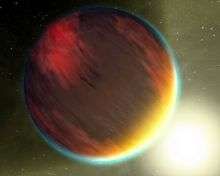
This artist's concept shows a cloudy, Jupiter-like planet that orbits very close to its fiery star. Spitzer Space Telescope observations for at least one such planet, called HD 189733b, showed the nightside temperatures are 1,300 degrees Fahrenheit hotter than they would be on a wind-free planet. (NASA/JPL-Calech/T.Pyle, SSC)

(PhysOrg.com) -- Computer simulations of the atmospheric circulation on Jupiter-like planets around other stars can explain temperature observations of these planets and shed light on the exotic weather experienced by these far-away worlds.

Approximately 300 planets have been discovered around other stars, and for most of those planets, scientists know little more than the mass and orbital properties of the planet. However, for a handful of the brightest planets, temperatures have been inferred from observations carried out with spacebased platforms such as NASA's Spitzer Space Telescope. Those observations and the computer simulations used to explain them, hint at weather patterns truly alien to our Earth-based experience.

Adam Showman of The University of Arizona led a study explaining how a global atmospheric circulation driven by the dayside heating and nightside cooling can drive weather on the so-called "hot Jupiters" – Jupiter-like gaseous giant planets that orbit extremely close to their stars.

"These planets are 20 times closer to their star than Earth is to the Sun, and so they are truly blasted by starlight," Showman said. Their dayside temperatures reach 2,000 or even 3,000 degrees Fahrenheit, much hotter than any planet in the Solar System.

"Because these planets are so close to their stars, we think they're tidally locked, with one side permanently in starlight and the other side permanently in darkness," Showman said. "So, if there were no winds, the dayside would be extremely hot and the nightside would be extremely cold."

Observations conducted last year with the Spitzer Space Telescope showed, however, that for at least one such planet, called HD 189733b, the nightside temperature exceeds 1,300 degrees Fahrenheit – much warmer than expected for a wind-free planet. This shows that winds carry heat from the dayside to the nightside, keeping the nightside warm. Until now, however, no computer models had successfully explained this process in detail.

Showman and colleagues performed state-of-the-art 3D computer simulations that, for the first time, coupled the weather motions to a realistic representation for how starlight is absorbed and how heat is lost to space. The models explain the observed day-night temperature patterns and suggest that, to carry the heat, the planet must have jet streams with speeds reaching a hefty 2 miles per second or 7,000 miles per hour.

"You're talking about winds fast enough to carry you in a hot air balloon from San Francisco to New York in 25 minutes," Showman said.

The winds predicted by the computer simulations move predominantly from west to east, which pushes the hottest regions away from the region that receives the most starlight.

"According to the observations, the hottest region on the planet is not 'high noon' but eastward of that by maybe 30 degrees of longitude," Showman explained. "Our simulations are the first to explain why that phenomenon occurs."

The planet, HD 189733b, is 63 light years from Earth and is in the constellation of Vulpecula, or the Fox. The star around which the planet orbits, HD 189733, is visible with binoculars from here on the ground, but the planet is much too dim to be detected except with the most powerful space-based telescopes.

Also involved in the study are Jonathan Fortney of U.C. Santa Cruz, Yuan Lian of the UA, Mark Marley and Richard Freedman of NASA Ames Research Center in Mountain View, California, and Heather Knutson and David Charbonneau of Harvard University.

So what's the weather forecast for these planets? "Hot Jupiters are pretty crazy places," said Showman. "Expect supersonic winds and dayside temperatures hot enough to melt lead and rocks. Only problem is, if you tried to visit, you'd be fried to a crisp before you could enjoy the view."

Provided by University of Arizona

4.3 /5 (12 votes)  

Rank 4.3 /5 (12 votes)
Relevant PhysicsForums posts
  • Never ending outer space.....
    created13 hours ago
  • Neutron Star fragments?
    created15 hours ago
  • stationary or not?
    created19 hours ago
  • Scale of the Universe
    createdFeb 10, 2012
  • Titan's lack of impact craters
    createdFeb 09, 2012
  • Real pictures of black hole eating a star?
    createdFeb 08, 2012
  • More from Physics Forums - General Astronomy

More news stories

Latin America mining boom clashes with conservation

Latin America is experiencing a mining boom as prices rise fuelled by a hike in global demand, but the region is also being hit by a wave of violent protests, strikes and rallies by environmentalists.

Space & Earth / Environment

created 6 hours ago | popularity not rated yet | comments 0

Political leaders play key role in how worried Americans are by climate change: study

More than extreme weather events and the work of scientists, it is national political leaders who influence how much Americans worry about the threat of climate change, new research finds.

Space & Earth / Environment

created Feb 06, 2012 | popularity 5 / 5 (6) | comments 72

NASA budget will axe Mars deal with Europe: scientists

US President Barack Obama's budget proposal to be submitted next week for 2013 will cut NASA's budget by 20 percent and eliminate a major partnership with Europe on Mars exploration, scientists said Thursday.

Space & Earth / Space Exploration

created Feb 10, 2012 | popularity 5 / 5 (3) | comments 55

Humans may have helped the decline of African rainforests 3000 years ago

(PhysOrg.com) -- Large areas of rainforests in Central Africa mysteriously disappeared over three thousand years ago, to be replaced by savannas. The prevailing theory has been that the cause was a change ...

Space & Earth / Environment

created Feb 10, 2012 | popularity 4.1 / 5 (14) | comments 20 | with audio podcast report

Study shows global glaciers, ice caps, shedding billions of tons of mass annually

Earth's glaciers and ice caps outside of the regions of Greenland and Antarctica are shedding roughly 150 billion tons of ice annually, according to a new study led by the University of Colorado Boulder.

Space & Earth / Earth Sciences

created Feb 08, 2012 | popularity 4.4 / 5 (9) | comments 14 | with audio podcast


Google might launch Drive for cloud storage soon

(PhysOrg.com) -- Google's next big move, according to the Wall Street Journal, is a cloud storage service called Drive. Hardly first to the plate, Google is simply catching up to introducing its cloud reposi ...

Love a click away in Indonesia's Twitter Republic

He was a geeky kid from Yogyakarta, she a glamorous city girl in Jakarta. In a country with one of the world's most vibrant social networking scenes they fell in love on Twitter.

Europeans protest controversial Internet pact

Tens of thousands of people marched in protests in more than a dozen European cities Saturday against a controversial anti-online piracy pact that critics say could curtail Internet freedom.

Walney offshore wind farm is world's biggest (for now)

(PhysOrg.com) -- The Walney wind farm on the Irish Sea--characterized by high tides, waves and windy weather--officially opened this week. The farm is treated in the press as a very big deal as the Walney ...

Navy to begin tests on electromagnetic railgun prototype launcher

The Office of Naval Research (ONR)'s Electromagnetic (EM) Railgun program will take an important step forward in the coming weeks when the first industry railgun prototype launcher is tested at a facility ...

Explained: Sigma

It's a question that arises with virtually every major new finding in science or medicine: What makes a result reliable enough to be taken seriously? The answer has to do with statistical significance -- but ...