Blowing bubbles on a nanoscale
October 14, 2008 Blowing bubbles on a nanoscale

Enlarge

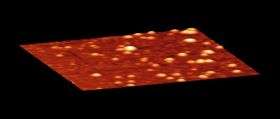
A 3-D visualization of nanobubbles present on a hydrophobic surface. The bubbles have a diameter of only 50-200 nanometres and a thickness of 5-20 nanometres. Image: University of Twente

(PhysOrg.com) -- Scientists are puzzled by the nanobubbles that can develop on surfaces under water. It should be impossible for them to exist but nevertheless they remain intact for hours. They are something of a mystery, yet it is possible to manipulate the development of these bubbles, according to PhD candidate Shangjiong Yang at the University of Twente, Netherlands. The bubbles can then, for example, be used to reduce flow resistance in liquids. Yang received his doctorate from the Faculty of Applied Sciences on 9 October.

If a water-repellent material is submerged in water, nanobubbles can develop on its surface: extremely small air bubbles with a diameter of 50-200 nanometres and a thickness of 5-20 nanometres. These bubbles are so small they cannot even be seen with a normal microscope and that is why they were not discovered until a few years ago.

According to existing theories, these bubbles should really not exist at all, as the pressure inside them is so great that the gas they contain should be pressed out within a fraction of a second. It is still not understood why these bubbles can remain intact for hours. Once it is possible to manipulate the formation and properties of these bubbles, a whole range of applications becomes possible.

For example, the frictional resistance of flowing liquids is reduced by the bubbles, thus enabling them to be used as a lubricant in extremely narrow channels. This is of practical use in the development of the so-called ‘labs-on-a-chip’: a whole laboratory set-up, reduced to the size of a chip. Before these bubbles can be employed in this way, however, we have to understand them better and be able to determine exactly where they should develop.

Production of nanobubbles

Yang demonstrated that electrolysis is a reliable method for controlling the production of nanobubbles. He discovered a way of influencing the formation and size of the bubbles by applying a voltage. He also researched several fundamental properties of the bubbles. After all, before you can use them you have to understand them. That is why he investigated the influence of temperature, gas concentration, the roughness of the surface and the surface treatment method on bubble formation.

Yang made use of the Atomic Force Microscope (AFM) when carrying out his investigation. It is a microscope with a minuscule needle that moves over the surface (just like the needle of a record player) and monitors differences in height. This needle was used not only to investigate the outlines of the bubbles but also to manipulate them.

Shangjiong Yang (1980, Chongqing, China) carried out his PhD research with the specialist groups Physics of Fluids and Solid State Physics in the Faculty of Applied Sciences at the University of Twente. Professor Detlef Lohse and Professor Harold J.W. Zandvliet supervised his research.

Provided by University of Twente, Netherlands


print this article email this article download pdf blog this article bookmark this article     Stumble it Digg this share on Facebook retweet share on Reddit add to delicious
Rate this story - 4.8 /5 (12 votes)

Rank Filter

Move the slider to adjust rank threshold, so that you can hide some of the comments.


Display comments: newest first

  • Flakk - Oct 14, 2008
    • Rank: not rated yet
    "It should be impossible for them to exist but nevertheless they remain intact for hours."

    I'm reminded of an old quote from Arthure C. Clark. "When a distinguished scientist says something is impossilbe, they are very likely wrong."

October 14, 2008 all stories

Comments: 1

4.8 /5 (12 votes)
  • Stumble this up

  • Digg this

  • share this

  • hide
  • Related Stories

  • Making nanoparticles in artificial cells
    created Jun 26, 2009 | popularity not rated yet | comments 0
  • Mysterious nanobubble burst?
    created Dec 02, 2008 | popularity not rated yet | comments 0
  • New nano technique significantly boosts boiling efficiency
    created Jun 26, 2008 | popularity not rated yet | comments 0
  • Nanobubbles Deliver Targeted Cancer Drugs Using Ultrasound
    created Jul 11, 2007 | popularity not rated yet | comments 0
  • Nanobubbles exist, and are more stable than previously thought
    created Apr 02, 2007 | popularity not rated yet | comments 0


  • hide
  • Relevant PhysicsForums posts

Other News

Nanoparticles used in common household items caused genetic damage in mice

Nanotechnology / Bio & Medicine

created Nov 16, 2009 | popularity 4.7 / 5 (22) | comments 11

Titanium dioxide (TiO2) nanoparticles, found in everything from cosmetics to sunscreen to paint to vitamins, caused systemic genetic damage in mice, according to a comprehensive study conducted by researchers at UCLA's Jonsson ...


Using superconducting probes to get a picture of what it's like inside CNTs

Nanotechnology / Nanophysics

created Nov 20, 2009 | popularity 4.9 / 5 (7) | comments 0

(PhysOrg.com) -- "Carbon nanotubes are exciting for fundamental physics, and for potential technological applications," Nadya Mason tells PhysOrg.com. "However, we are generally limited in the way that we can study them. ...


Nanotube defects equal better energy and storage systems

Nanotube defects equal better energy and storage systems

Nanotechnology / Nanomaterials

created Nov 19, 2009 | popularity 4.4 / 5 (9) | comments 2

(PhysOrg.com) -- Most people would like to be able to charge their cell phones and other personal electronics quickly and not too often. A recent discovery made by UC San Diego engineers could lead to carbon ...


When It Comes to Drug Delivery, Size Matters

Nanotechnology / Bio & Medicine

created Nov 20, 2009 | popularity 5 / 5 (1) | comments 0

(PhysOrg.com) -- One of the great promises of nanotechnologies lies in its ability to create drug-containing nanoparticles decorated with targeting molecules that recognize and bind to cancer cells, providing drug delivery ...


New study confirms exotic electric properties of graphene

New study confirms exotic electric properties of graphene

Nanotechnology / Nanomaterials

created Nov 17, 2009 | popularity 4.8 / 5 (23) | comments 1

(PhysOrg.com) -- First, it was the soccer-ball-shaped molecules dubbed buckyballs. Then it was the cylindrically shaped nanotubes. Now, the hottest new material in physics and nanotechnology is graphene: ...