Scientists discover cause of weakness in marine animal hybrids
October 14, 2008
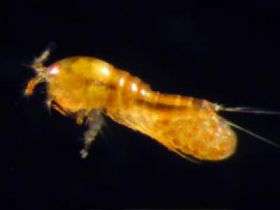
A female Tigriopus californicus copepod with an egg sac containing 30 to 40 offspring was obtained for the new study from a population just south of San Diego's Ocean Beach. Credit: Scripps Institution of Oceanography, University of California - San Diego
Scientists at Scripps Institution of Oceanography at UC San Diego have shown for the first time that a genetic malfunction found in marine crustaceans called copepods likely explains why populations of animals that diverge and eventually reconnect produce weak "hybrid" offspring.
Hybrid animals result when populations of a given species separate from one another, undergoing genetic mutations while apart and eventually reestablish ties and interbreed. Hybrids often suffer from lower fertility levels, slower development and higher rates of mortality due to environmental causes.
The new research described by Christopher Ellison and Ronald Burton of Scripps Oceanography is published in this week's online edition of the Proceedings of the National Academy of Sciences.
"In addition to informing us about evolutionary processes, this research has important implications for a variety of biomedical and agricultural practices, such as stem cell production and cloning of domestic animals," said Burton, a professor in the Marine Biology Research Division at Scripps.
For the past several years, Ellison and Burton have been studying copepods of the species Tigriopus californicus, animals about one millimeter in length that live in coastal intertidal habitats. The researchers produced hybrid specimens in the laboratory by mating animals from San Diego, Los Angeles and Santa Cruz, Calif. At their home between high and low tides, these copepods experience rapid changes in their environment, such as when rainwater dilutes tide pools and the animals are forced to "up-regulate," or activate, specific genes to produce the energy required to manage the stress caused by the rapid change in salinity levels.
Ellison and Burton found that hybrids were incapable of turning on the required genes, and traced this "gene regulation" malfunction to mitochondria, the location inside cells where energy is generated. They further pinned the problem area to a single enzyme, called "RNA polymerase," for the failed trigger.
"In hybrids we found that these genes don't turn on in response to stress, which means the animals don't have enough energy, and that leads to low survivorship," said Burton.
Burton said the study demonstrates how evolution continually molds the interactions of genes in animal populations.
"When populations are hybridized, genes that normally work well within populations are forced to interact with genes from other populations, sometimes leading to dramatic incompatibilities," said Burton. "When the incompatibility affects something as central as cellular energy production, as in Tigriopus, it is not surprising that hybrids show slower growth and reduced reproduction and survivorship."
Burton added that the results of the new study hold implications for stem cell research and animal cloning, as those efforts involve taking components of one cell and placing them into another, situations that test gene compatibility and interaction. The findings also may be applicable to agriculture where many crop plants are of hybrid origin.
Ongoing and future studies in Burton's laboratory involve examinations of hybrids with close geographical ties, such as those that live in close proximity in Southern California, to probe the genetic breakdowns more closely. His group also is attempting to replicate the mechanisms in a test tube, experimenting with various DNA and enzyme combinations that might exhibit the problem.
Ellison, who contributed to the research while a graduate student at Scripps and is now a postdoctoral researcher at Cornell University, earned the 2007 Edward A. Frieman Prize from Scripps for research that paved the way to the new study.
Grants from the National Science Foundation and the National Institutes of Health supported the research.
Source: University of California - San Diego
-
Appalachian tiger swallowtail butterfly is a hybrid of two other swallowtails, scientists find
Sep 08, 2011 |
3.7 / 5 (3) |
3
-
With secondhand gene, 'freaky mouse' defeats common poison
Jul 21, 2011 |
4.3 / 5 (3) |
16
-
Gene flow may help plants adapt to climate change
Jun 28, 2011 |
5 / 5 (1) |
0
-
Through evolution, cavefish have lost sleep
Apr 07, 2011 |
5 / 5 (1) |
1
-
Wildflower colors tell butterflies how to do their jobs
Jan 09, 2011 |
5 / 5 (3) |
0
-
Engineers build first sub-10-nm carbon nanotube transistor
Feb 01, 2012 |
4.9 / 5 (33) |
30
-
Something old, something new: Evolution and the structural divergence of duplicate genes
Jan 31, 2012 |
4.6 / 5 (7) |
1
-
The hidden nanoworld of ice crystals: Revealing the dynamic behavior of quasi-liquid layers
Jan 30, 2012 |
5 / 5 (4) |
1
-
Stock market network reveals investor clustering
Jan 27, 2012 |
3.9 / 5 (23) |
8
-
Of microchemistry and molecules: Electronic microfluidic device synthesizes biocompatible probes
Jan 26, 2012 |
5 / 5 (2) |
0
More news stories
A mitosis mystery solved: How chromosomes align perfectly in a dividing cell
Although the process of mitotic cell division has been studied intensely for more than 50 years, Whitehead Institute researchers have only now solved the mystery of how cells correctly align their chromosomes during symmetric ...
4 hours ago |
5 / 5 (6) |
0
|
The proteins ensuring genome protection
Researchers from the University of Geneva (UNIGE), Switzerland, have discovered the crucial role of two proteins in developing a cell 'anti-enzyme shield'. This protection system, which operates at the level of molecular ...
4 hours ago |
5 / 5 (2) |
0
|
Researchers find extensive RNA editing in human transcriptome
In a new study published online in Nature Biotechnology, researchers from BGI, the world's largest genomics organization, reported the evidence of extensive RNA editing in a human cell line by analysis of RNA-seq data, demons ...
4 hours ago |
5 / 5 (3) |
0
|
Entire genome of extinct human decoded from fossil
(PhysOrg.com) -- In 2010, Svante Pääbo and his colleagues presented a draft version of the genome from a small fragment of a human finger bone discovered in Denisova Cave in southern Siberia. The ...
Feb 07, 2012 |
4.7 / 5 (59) |
48
|
Why are there so few fish in the Earth's oceans?
(PhysOrg.com) -- A Stony Brook University researcher has found that, contrary to popular belief, there are not plenty of fish in the sea.
Feb 08, 2012 |
4.2 / 5 (18) |
27
|
Overeating may double risk of memory loss
New research suggests that consuming between 2,100 and 6,000 calories per day may double the risk of memory loss, or mild cognitive impairment (MCI), among people age 70 and older. The study was released today and will be ...
Google might launch Drive for cloud storage soon
(PhysOrg.com) -- Google's next big move, according to the Wall Street Journal, is a cloud storage service called Drive. Hardly first to the plate, Google is simply catching up to introducing its cloud reposi ...
Scientists discover molecular secrets of 2,000-year-old Chinese herbal remedy
For roughly two thousand years, Chinese herbalists have treated Malaria using a root extract, commonly known as Chang Shan, from a type of hydrangea that grows in Tibet and Nepal. More recent studies suggest that halofuginone, ...
New method to examine batteries -- MRI from the inside
There is an ever-increasing need for advanced batteries for portable electronics, such as phones, cameras, and music players, but also to power electric vehicles and to facilitate the distribution and storage of energy derived ...
Injured boomers beware: Know when to see doctor
(AP) -- It happened to nurse Jane Byron years after an in-line skating fall, business owner Haralee Weintraub while doing "men's" push-ups, and avid cyclist Gene Wilberg while lifting a heavy box.
Lab study raises questions over nano-particle impact
Tests involving chickens have raised questions about the impact on health from engineered nano-particles, the ultra-fine grains commonly used in drugs and processed foods, scientists said on Sunday.