Biomarkers for identifying infant infections
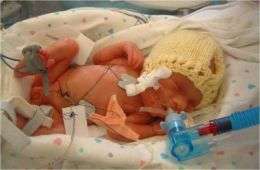
October 14, 2008 Premature Neonate

Premature infants are particularly susceptible to infections, owing to their underdeveloped physiology and requirement of numerous medical interventions. Credit: Stephen Kingsmore, NCGR

Infection is the leading cause of infant deaths worldwide, and particularly a common killer of weaker, pre-term infants. Current diagnostic tests can be slow and non-specific, but researchers have now identified potential biomarkers in the blood that can rapidly identify both the onset of infection and type of microbe.

The circulatory system is a major hotbed of immune system activity, so Stephen Kingsmore and colleagues analyzed plasma samples from 107 infected and non-infected premature infants to try and identify proteins that could reliably identify an infected state.

Their analysis revealed eight proteins, associated with immune responses like inflammation and blood coagulation, which were consistently over-expressed in infected neonates. In addition, the relative levels of these serum proteins could provide insight into the type of infection (for example, the inflammatory proteins IL-6 and IL-8 were 1000-fold higher in streptococcus infections compared to other types).

Kingsmore and colleagues do note that these biomarkers are not completely accurate and thus not ready for any routine use, but with additional studies using larger numbers on infants and different types of analysis (some of which are already underway), a reliable set of infection biomarkers may soon become available.

Source: American Society for Biochemistry and Molecular Biology


print this article email this article download pdf blog this article bookmark this article     Stumble it Digg this share on Facebook retweet share on Reddit add to delicious
Rate this story - not rated yet


October 14, 2008 all stories

Comments: 0

not rated yet
  • Stumble this up

  • Digg this

  • share this

  • hide
  • Related Stories

  • Analyzing structural brain changes in Alzheimer's disease
    created Nov 16, 2009 | popularity not rated yet | comments 0
  • Researchers pioneer kidney disease prediction method
    created Nov 05, 2009 | popularity not rated yet | comments 0
  • No such thing as 'junk RNA,' say Pitt researchers
    created Oct 13, 2009 | popularity not rated yet | comments 0
  • PNNL chemist earns NIH New Innovator Award
    created Sep 24, 2009 | popularity not rated yet | comments 0
  • Genomics sciences guarantees better results in the art of winemaking
    created Sep 09, 2009 | popularity not rated yet | comments 0


Other News

It takes two to infect: Structural biologists shed light on mechanism of invasion protein

Biology / Cell & Microbiology

created 7 minutes ago | popularity not rated yet | comments 0

Bacteria are quite creative when infecting the human organism. They invade cells, migrate through the body, avoid an immune response and misuse processes of the host cell for their own purposes. To this end every bacterium ...


Artificial refuges created to save the reptiles of Doņana

Artificial refuges created to save the reptiles of Doņana

Biology / Ecology

created 57 minutes ago | popularity not rated yet | comments 0

The Aznalcóllar mining accident more than 11 years ago, which contaminated part of the Doņana National Park, also damaged reptile habitat there. Now a team of Spanish researchers, who have been studying ...


How can scientists measure evolutionary responses to climate change?

Biology / Evolution

created 1hour ago | popularity 1 / 5 (1) | comments 0

As global temperatures continue to rise scientists are presented with the complex challenge of understanding how species respond and adapt. In a paper published in Insect Conservation and Diversity, Dr Francisco Rodriguez-Trelles and Dr ...


Lymnaea stagnalis

Right/left handedness of snails changed in the lab

Biology / Plants & Animals

created 5 hours ago | popularity 5 / 5 (2) | comments 0

(PhysOrg.com) -- Like most animals, snails have either left- or right-handed asymmetry (chirality), both internally and externally, and the handedness is hereditary. A new study has for the first time found ...


Immunity-Related Genes in Leafcutting Bee Uncovered

Immunity-Related Genes in Leafcutting Bee Uncovered

Biology / Plants & Animals

created 3 hours ago | popularity not rated yet | comments 0

(PhysOrg.com) -- The first analysis of immunity-related genes in a solitary bee has been conducted by Agricultural Research Service (ARS) scientists and cooperators.