Single-pixel camera has multiple futures: Terahertz version adds new potential to unique invention
October 14, 2008 Single-pixel camera has multiple futures: Terahertz version adds new potential to unique invention

Enlarge

A terahertz version of the single-pixel camera developed by Rice University researchers could lead to breakthrough technologies in security, telecom, signal processing and medicine.

The research, recently published online in Applied Physics Letters, describes a way to replace the expensive, multipixel sensor arrays used in current terahertz imaging systems with a single sensor.

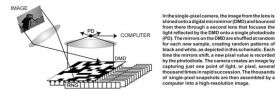
Two keys to the system are the ongoing development of a modulator that would feed a rapid-fire series of randomized images to the sensor, and the compressed sensing algorithm that turns the raw data into an image.

The advances "could make for very inexpensive security and scientific cameras in the near future," said Richard Baraniuk, Rice's Cameron Professor in Electrical and Computer Engineering, who helped make a proof-of-concept prototype that used 600 sheets of copper (which blocks terahertz radiation) through which random holes had been punched as the modulator.

"There's very good reason to believe you could build a terahertz modulator that could do that same task electrically, and very fast," said Daniel Mittleman, a Rice professor in electrical and computer engineering, who is testing a 4-by-4 array of metamaterials supplied by Los Alamos National Laboratory that become opaque to terahertz radiation when a voltage is applied.

"There are lots of applications for terahertz imaging, if you could make a real-time imager that's sensitive enough. Some of them are pretty science-fictiony, but some are pretty realistic," Mittleman said. "I think this is really promising."

Terahertz radiation, which occupies space in the electromagnetic spectrum between infrared and microwave, penetrates fabric, wood, plastic and even clouds, but not metal or water. Unlike X-rays, T-rays are not harmful, and cheap T-ray cameras may someday be used for security screening in airports, supplementing traditional X-ray scanners and walk-through portals.

In addition, hyperspectral capabilities inherent in even basic single-pixel cameras make them useful for all kinds of things, said Kevin Kelly, associate professor in electrical and computer engineering. "Current cameras break an image down into red, green and blue. But this system breaks down every pixel into all the individual wavelengths that make up a color.

"If you want to know whether that green object over there is a bunch of trees or a tank painted green, this system will tell you," he said.

Rice introduced its research into the single-pixel camera two years ago. The technology made waves when it was introduced, and advances have come quickly, particularly in the compressive sensing algorithms that make it possible to do with one pixel what takes commercial digital cameras millions.

Read the paper, "A Single-Pixel Terahertz Imaging System Based on Compressed Sensing," here:
http://scitation.aip.org/journals/doc/APPLAB-ft/vol_93/iss_12/121105_1-div0.html

Source: Rice University


Rate this story - 4.6 /5 (73 votes)


October 14, 2008 all stories

Comments: 0

4.6 /5 (73 votes)

  • hide
  • Related Stories

  • Physicists see through the opaque with 'T-rays'
    created Dec 18, 2009 | popularity not rated yet | comments 0
  • Company Introduces Novel Nanotechnology for Revolutionizing Imaging Using T-rays
    created Oct 20, 2009 | popularity not rated yet | comments 0
  • Super-Sensors to Measure 'Signature' of Inflationary Universe (w/Video)
    created May 03, 2009 | popularity not rated yet | comments 0
  • Team develops new metamaterial device
    created Feb 24, 2009 | popularity not rated yet | comments 0
  • New lens device will shrink huge light waves to pinpoints
    created Jul 12, 2007 | popularity not rated yet | comments 0


  • hide
  • Relevant PhysicsForums posts

  • Interception angle
    created 3 hours ago
  • Pressure created by clamping base and cover
    created 3 hours ago
  • How to find static friction
    created 9 hours ago
  • Calculating decible increases
    created 16 hours ago
  • More from Physics Forums - General Physics

Other News

Extra large carbon

Extra large carbon

Physics / General Physics

created 16 hours ago | popularity 4.7 / 5 (13) | comments 7 | with audio podcast

An exotic form of carbon has been found to have an extra large nucleus, dwarfing even the nuclei of much heavier elements like copper and zinc, in experiments performed in a particle accelerator in Japan. ...


Scientist explore future of high-energy physics

Scientist explore future of high-energy physics

Physics / General Physics

created 22 hours ago | popularity 4.9 / 5 (12) | comments 8 | with audio podcast

In a 1954 speech to the American Physical Society, the University of Chicago's Enrico Fermi fancifully envisioned a particle accelerator that encircled the globe. Such would be the ultimate theoretical outcome, ...


Leaf veins inspire a new model for distribution networks (w/ Video)

Physics / General Physics

created 19 hours ago | popularity 5 / 5 (3) | comments 0 | with audio podcast

(PhysOrg.com) -- Following the straight and narrow may be good moral advice, but it’s not a great design principle for a distribution network. In new research, a team of biophysicists describe a complex netting of interconnected ...


New magnetic tuning method enhances data storage

New magnetic tuning method enhances data storage

Physics / General Physics

created 23 hours ago | popularity 4.2 / 5 (5) | comments 0 | with audio podcast

Researchers in Chicago and London have developed a method for controlling the properties of magnets that could be used to improve the storage capacity of next-generation computer hard drives.


High-performance microring resonator developed by INRS researchers

Physics / Optics & Photonics

created 15 hours ago | popularity 1.5 / 5 (2) | comments 0

A new, more efficient low-cost microring resonator for high speed telecommunications systems has been developed and tested by Professor Roberto Morandotti's INRS team in collaboration with Canadian, American, and Australian ...