The Day the World Didn't End
October 14, 2008
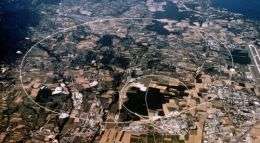
An aerial view of CERN (European Organization for Nuclear Research). The large 5-mile diameter ring traces the underground Large Hadron Collider. Image credit: CERN
Here's what didn't happen on Sept. 10th:
The world did not end. Switching on the world's largest and most powerful particle accelerator near Geneva, Switzerland, did not trigger the creation of a microscopic black hole. And that black hole did not start rapidly sucking in surrounding matter faster and faster until it devoured the Earth, as sensationalist news reports had suggested it might.
Of course, because you're alive and reading this article today, you already knew that. Currently the accelerator, an underground ring 5 miles across called the Large Hadron Collider (LHC), has been shut down for repairs. But once the immensely powerful machine starts back up, is there a chance that the doomsday scenario could still occur?
Relax. As Mark Twain might have said, reports of Earth's death have been greatly exaggerated.
"There never really was a danger from the accelerator, but that sure didn't stop people from speculating that there might be!" says Robert Johnson, a physicist at the Santa Cruz Institute for Particle Physics and a member of the science team for NASA's Fermi Gamma-ray Space Telescope, which launched in June to study gamma rays from many phenomena, including possible evaporating black holes.
There are several reasons why the world did not come to an end on Sept. 10th, and why the Large Hadron Collider isn't capable of triggering such a calamity.
First of all, yes, it is true that the LHC might create microscopic black holes. But, for the record, it could not have created one on its first day. That's because the physicists at CERN didn't steer beams of protons into each other to create high-energy collisions. Sept. 10th was just a warmup run. To date, the collider still has not produced any collisions, and it is the extreme energy of those collisions up to 14 tera-electron volts that could potentially create a microscopic black hole.
Actually, once the LHC is running again and begins producing collisions, physicists will be ecstatic if it creates a tiny black hole. It would be the first experimental evidence to support an elegant but unproven and controversial "theory of everything" called string theory.
In string theory, electrons, photons, quarks, and all the other fundamental particles are different vibrations of infinitesimal strings in 10 dimensions: 9 space dimensions and one time dimension. (The other 6 space dimensions are hidden by one explanation or another, for example by being "curled up" on an extremely small scale.) Some physicists tout string theory's mathematical elegance and its ability to integrate gravity with the other forces of nature. The widely accepted Standard Model of particle physics does not include gravity, which is one reason why it does not predict that the LHC would create a gravitationally collapsed point a black hole while string theory does.
Many physicists have started to doubt whether string theory is true. But assuming for a moment that it is, what would happen when a black hole is born inside the LHC? The surprising answer is "not much." Even if the black hole survives for more than a fraction of a second (which it probably wouldn't), most likely it would be flung out into space. "It would only have the mass of a hundred or so protons, and it would be moving at near the speed of light, so it would easily have escape velocity," Johnson explains. Because the tiny black hole would be less than a thousandth the size of a proton and would have an exceedingly weak gravitational pull, it could easily zip through solid rock without ever touching or sucking in any matter. From the perspective of something this tiny, the atoms that make up "solid" rock appear to be almost entirely empty space: the vast space between the atoms' nuclei and their orbiting electrons. So a micro black hole could shoot down through the center of the Earth and out the other side without causing any damage just as easily as it could shoot up through 300 feet of the Swiss countryside. Either way, it would end up out in the near-vacuum of space, where the odds of it touching and sucking in any matter so that it could grow into a menace would be smaller still.
So the first thing a micro-black hole would do is leave the planet safely behind. But there are other, even stronger reasons why scientists believe the LHC poses no threat to Earth. For one, a black hole created in the LHC would almost certainly evaporate before it got very far, most scientists believe. Stephen Hawking, the physicist who wrote A Brief History of Time, predicted that black holes radiate energy, a phenomenon known as Hawking radiation. Because of this steady loss of energy, black holes eventually evaporate. The smaller the black hole, the more intense the Hawking radiation, and the quicker the black hole will vanish. So a black hole a thousand times smaller than a proton should disappear almost instantly in a quick burst of radiation.
"Hawking's prediction is not based on speculative string theory but rather on well understood principles of quantum mechanics and particle physics," Johnson notes.
Despite its strong theoretical foundations, Hawking radiation has never been observed directly. Still, scientists are confident that any black hole created by the LHC would pose no threat. How can they be so sure? Because of cosmic rays. Thousands of times per day, high-energy cosmic rays strike the Earth's atmosphere, colliding with molecules in the air with at least 20 times more energy than the most powerful collisions that the LHC can produce. So if this new accelerator could make Earth-devouring black holes, cosmic rays would have already done so billions of times during Earth's long history.
And yet, here we are. Let the collisions begin!
Source: by Dr. Tony Phillips, Science@NASA


Me, I am not the least bit worried about this, but I find it frightening that these people would be taken seriously in the face of thousands of really knowledgeable physicists.
I'm not the least bit worried about this either, but it is well to note that a group of really knowledgeable physicists had running bets on whether or not the first atomic bomb would ignite the atmosphere....and they still set it off....
After all, thousands of really knowledgeable physicists have excluded the cold fusion possibility before 18 years and Aether existence before 100 hundred years as well.
http://www.sjcrot...-1-1.pdf
Those of society who do not understand have always put up fear mongering. Let us just back to the experiment and move forward not backwards.
Then just you and your crew would die...
SCIENCE -not learning from NATURE or PHILOSOPHY
Necessity-Demand-Curiosity-Sustain- Basic Management Concepts for SCIENCE
WHAT IS NECESSITY ?- INSPIRATION forms the Back-bone
WHAT IS THE DEMAND FUNCTION: WISDOM IN ADVANCE
Here CURIOSITY-needs to search SUSTENANCE FUNCTION
Part of Universe Function is to maintain a relative balance
between SRISTI, STITHI, LAYA concepts
RELATIVE ASPECTS OF STABILITY
RELATIVE ASPECTS OF CREATION
RELATIVE ASPECTS OF MERGER
The vision Development is an Up-link - UTH-RAM - Consciousness sprouts through
Neutral mode Beam Flow Interlinks to COSMIC FUNCTION OF THE UNIVERSE
Essential Discipline:One has no right to mislead next generation of Science as well- AMBIVALENT STATE
Cosmology Vedas Interlinks above SEARCH ROUTE- Beyond LHC or Blackhole Psychology
Vidyardhi Nanduri
No, there is a CHANCE once they collide their first particles (slim, unfounded chance imo) but until then there is no chance whatsoever. Which could be in years to come if more problems occur.
If the mainstream science could handle the safety analysis seriously, we could read something specific like:
"the duration of the doomsday event at the case of classical BH will be 1700 years, with consideration to short distance interactions 2,3 years only. EOF."
But you can never met with such safety analysis, simply because such analysis never ever existed. You can get into crime easily, when trying to build public bridge without thorough safety analysis or when you'll steal five bucks in the market. When you cause the doomsday event or Wall Street crisis, you'll get a government support instead.
This is how the Universe is working by AWT.
Now I know you have no clue what you're talking about. Relativity does not have any connection with the interactions of the infinitely small.
Meaning, a black hole under the size of an atom is not predicted by relativity. The only formula set where it would be possible is by interacting with gravity unhindered by the theoretical extra dimensions of string theory.
Actually strageletes are a material dreamt up by the standard model. By estimating out the mass of the particle you can determine the amount of energy contained in that particle and attempt to create it through relativistic collision.
And exactly how is that relevant to subatomic black hole theory?
These effect could stabilize the dense matter clusters. Did you read the Randall-Sundrum theory of primordial black holes? These black holes are believed to be stable enough to remain observable from the Big-Bang times.
http://arxiv.org/abs/0809.2353
http://www.physic...t=119294
While Randall-Sundrum model is not string theory exactly, whole model is built out of basic string theory and it's considered as one of few testable predictions of string theory as such.
The Schwarzschild metric is an equation describing the gravitational field surrounding a non moving, non-rotating body. It can further be applied to moving and rotating objects without modification, however, to calculate down to sub atomic sizes you have to alter the equation and use sub atomic masses you have to change the use of time to a constant. This requires quantum mechanics.
Yes but how are you equating this to anything within AWT when you're proposing string theory as your driver. The two theories are mutually exclusive. You've been trapped by your own argument.
Not at all - the AWT just proposes it's own natural explanation, how these tiny primordial black holes could survive up to present days. Unfortunatelly, they can survive the LHC simulation of Big Bang as well - and this is the problem! So, if the string theory is right with its Randall-Sundrum model, we can really get into troubles with black holes, violating the mechanism of Hawking evaporation.
AWT supposes that there is a mystery material, be it gas, black holes, liquid, solids, whathave you, that permeates the galaxy.
Effectively you've taken aspects from current quantum theory and disputed quamtum theory by applying it to Victorian era relativity physics.
It's utterly foolish to believe sub atmoic masses have surface tension of anytype seeing that surface tension is an artifact of electromagnetism, not gravity. Hawking radiation would sit unaffected by electromagnetic cohesion.
By AWT these artifacts are simply a density fluctuations of hypothetical particle environment, similar to foam, which appears inside of dense condensing supercritical fluids. Compare the preon models of strings, string-net liquid concept and some others, recently proposed.
http://www.newsci...5954.200
Now, if we want to take these theories seriously, we should move one step forward and to explain, why they're all predicting an existence of similar artifacts. By AWT the strings or spin foam are the very same things and corresponding theories are special cases of Aether theory. The dynamics of nested foamy density fluctuations inside of dense particle system is surprisingly complex, despite it can still be considered as a consequence Victoria era physics. Anyway, the quantum mechanics phenomena can be still modelled by classical physics. http://www.physor...511.html
It means, here's an unknown physics of tiny dense particle clusters, which should be analyzed first, before we start with high density collision experiments - or we can get into troubles later. Anyway, as I noted above, here doesn't exist thorough safety analysis, even when considering the well known phenomena, not to say the unknown ones.
Most of us forget we create the math too, we get lost, and many predictions falter.
What shocks me is how many refer to mini black holes as a single item - with many collisions a second could we not be inviting thousands of little mathematical black holes - if they exist at all that is? and if so could these merge?
There is still no matter to accrete as the experimentation is done in a vaccuum and the black hole is of such a size that if you pushed it towards a 50 foot thick steel wall it would pass right through without accreting anything. To us matter seems rather dense, to a sub atomic particle it's as though it's in deep space.