New images yield clues to seasons of Uranus
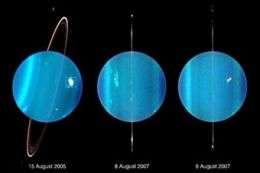
(PhysOrg.com) -- With an 84-year orbit around the sun, it isn't often that planetary scientists have an opportunity to observe the change of seasons on Uranus, a planet some 19 times farther from the sun than the Earth.
But in 2007, the planet reached equinox, the point in time where the sun is directly over the planet's equator and what little sunlight the planet gets is distributed evenly over its northern and southern hemispheres, giving scientists their best opportunity to probe the seasonal dynamics of the ringed planet.
Speaking in Ithaca, N.Y., today (Oct. 13) at a meeting of the American Astronomical Society's Division for Planetary Sciences, a team led by University of Wisconsin-Madison researcher Lawrence Sromovsky shared crisp new Keck II telescope images of the planet as it changed seasons.
"The last time this happened, there were no instruments that could resolve any features on the planet," says Sromovsky, who led the study in collaboration with scientists from the Space Science Institute, the University of California at Berkeley, the SETI Institute and the Keck Observatory on the summit of Hawaii's 14,000-foot Mauna Kea. "Now we can see what's going on."
Improvements in imaging technology, optics and a new generation of large ground-based telescopes like Keck II, Sromovsky explains, are giving researchers a chance to probe in detail the atmospheres of distant planets like Uranus, and they're gaining intriguing insight into the seasonal changes that drive astonishing and mysterious weather features.
The seventh planet from the sun and the first planet to be discovered with the aid of a telescope, Uranus is characterized by a ring system and a blue-green atmosphere composed of hydrogen, helium and methane. It has neatly zoned bands of clouds and some of the strangest discrete cloud features in the outer solar system.
The new study, based on a set of Keck II observations, was intended to take advantage of the change of seasons on Uranus to better understand how the sun influences the planet's weather. In addition to Sromovsky and Pat Fry and William Ahue of UW-Madison, the study was conducted by Heidi B. Hammel of the Space Science Institute, Imke de Pater of UC-Berkeley, Kathy Rages and Mark Showalter of the SETI Institute, and Marcos van Dam of the Keck Observatory.
Sromovsky and his colleagues were especially interested in seeing how the change of seasons influenced the weather on Uranus. The study is challenging, says Sromovsky, because the progress of the seasons is so slow on Uranus and the planet is so far away, but it is intriguing because the planet's equator is tilted at an unusually large 98 degrees from its orbit plane, as if it had been tipped on its side.
"This tilt gives it the largest seasonal forcing of any planet in the solar system," Sromovsky notes. "On an annual average basis, the poles get more sunlight than the equator."
Seasonal forcing is the change in the distribution of solar heating caused by the tilt of a planet on its axis. On Earth, the seasons change in relation to a hemisphere's orientation to the sun as determined by the 23.5-degree tilt of the planet's axis of rotation.
"If the latitudinal distribution of solar energy input varies over the planet's orbit, that forces changes in the weather," according to Sromovsky.
But for Uranus, changes in weather due to seasonal forcing seem to lag behind the forcing: "Although both hemispheres were symmetrically heated by sunlight at equinox, the atmosphere itself was not symmetric, implying that it was responding to past sunlight instead if current sunlight, a result of Uranus's cold atmosphere and long response time," Sromovsky explains.
Uranus is cold because it receives very little energy, Sromovsky notes of a planet whose atmospheric temperatures at cloud tops can reach a frosty minus 360 degrees Fahrenheit. The planet lacks a measureable internal heat source, and at its great distance, the sun's warmth is 400 times less than it is at the Earth.
The most recent Keck II images show changes in the brightness of cloud bands in the planet's northern and southern hemispheres as well as changes in two previously observed and apparently long-lived discrete cloud features. One is a massive vortex that had been oscillating in Uranus's southern hemisphere, perhaps for decades, between 32 degrees and 36 degrees south latitude. In 2004, the feature began drifting north and may soon dissipate, according to the new report.
"For two decades, it seemed like it was behaving in a very reliable way," Sromovsky says. "It may be that a change in the seasons has triggered it into a new dynamical state."
The new images also gave Sromovsky's group the opportunity to measure Uranus' monster winds over a wide range of latitudes than was previously possible. Winds on the planet can achieve speeds of up to 560 miles per hour.
Provided by University of Wisconsin


